Get Full Government Meeting Transcripts, Videos, & Alerts Forever!
Get email alerts on the Data Centers Energy topic
No spam. Unsubscribe anytime.
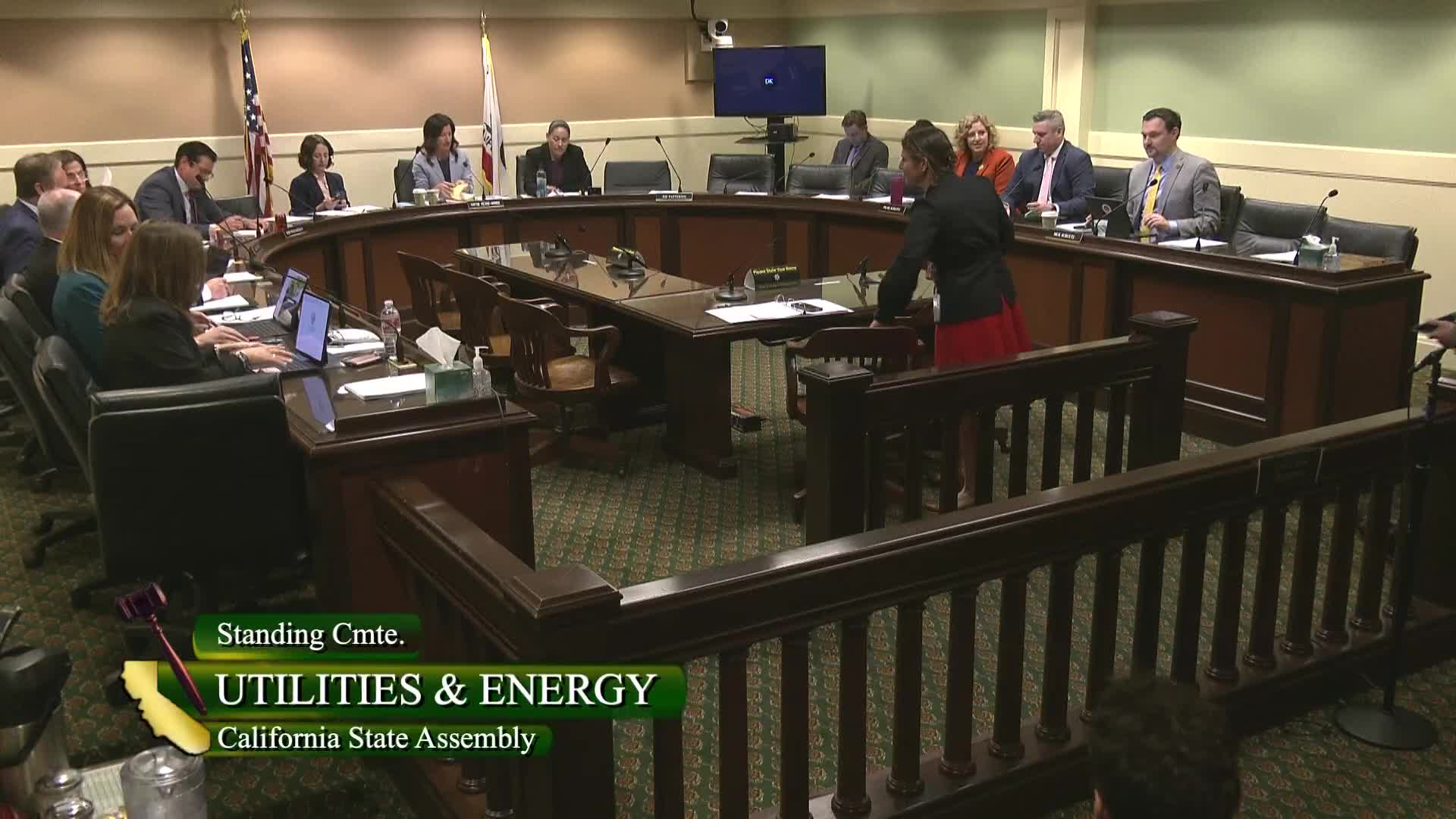
Assembly committee advances bill requiring data-center energy reporting aimed at protecting ratepayers
Summary
The Assembly Committee on Utilities and Energy voted to send AB 222, which would require reporting on data-center energy use and direct regulators to limit ratepayer exposure to costs associated with new data-center-driven infrastructure, to the Privacy and Consumer Protection Committee, amid debate over security and competitiveness.
Assemblymember Bauer Kehan, the bill's author, told the Assembly Committee on Utilities and Energy that AB 222 would require better data collection on data-center energy demand and stop residential ratepayers from shouldering costs for new capacity.
"AB 222 is first and foremost a ratepayer protection measure, but it is also a measure that protects consumers from rolling blackouts," Bauer Kehan said, adding the bill is a "very light touch" meant not to block data centers but to ensure infrastructure and costs align with demand.
The bill's core aim is twofold: require accurate, timely information about the electricity needs of data centers for energy planning, and limit cost-shifting to residential ratepayers when new or expanded grid capacity is built to serve those facilities. Eric Masanet, a professor at the University of California, Santa Barbara, told the committee researchers currently lack consistent, empirical data on actual data-center energy use and that estimates vary widely.
"You can't manage what you don't measure," Masanet said, arguing that publicly available, consistent data would give regulators and planners better ground truth for forecasting.
Environmental and labor groups testified in support, including Sierra Club California, Climate Action California, 350 Bay Area Action, the California Nurses Association, and California Environmental Voters, saying the bill addresses rising local demand and rate pressure tied to the growth of AI-related computing.
Representatives of the data-center industry and allied trade groups opposed the bill. Kara Boender, testifying for the Data Center Coalition, said AB 222 as written raised "concerns regarding privacy, security and technical feasibility" and warned that disclosure of detailed operational energy information could reveal proprietary information or create security vulnerabilities.
"Disclosures of detailed proprietary and operational information such as energy consumption and changes can be used by competitors to deduce trade secrets," Boender said.
Ahmad Thomas of the Silicon Valley Leadership Group told the committee that data centers are critical infrastructure for the state's economy and warned lawmakers that expanding regulator authority over data centers might send a discouraging signal to companies that currently locate or expand in California.
Committee discussion ranged from the need to preserve California's innovation economy to concern about rising retail electricity bills for longtime residents. Vice Chair Patterson and other members said they support increased clean-energy infrastructure but want to prevent rate increases for households. Several members urged the author to continue working with labor and utilities on implementation details.
The committee adopted committee amendments (the author's office noted some issues were addressed by requiring reporting of locations only, since the California Energy Commission already has meter-level data) and voted to pass the measure as amended to the Privacy and Consumer Protection Committee. The motion was moved by Assemblymember Rogers, seconded by Assemblymember Haribadian; the tally reported by the secretary was 11 yeas and 3 nays. Committee staff left the roll open for absent members to add on.
Why it matters: California is seeing rapid growth in data-center construction tied to AI workloads. Committee proponents said AB 222 aims to give regulators the information needed to plan and to prevent residential customers from paying for capacity that primarily benefits large commercial users. Opponents say the bill risks exposing sensitive operational data and could hamper competitiveness.
Votes at a glance: AB 222 ' Motion: due pass as amended to Privacy and Consumer Protection ' Mover: Assemblymember Rogers; Second: Assemblymember Haribadian ' Outcome: passed committee (11-3) and referred to Privacy and Consumer Protection.