Get Full Government Meeting Transcripts, Videos, & Alerts Forever!
Get email alerts on the Business Improvement District topic
No spam. Unsubscribe anytime.
Hartford committee backs amended ordinance to let Parkville property owners vote on a business improvement district
Summary
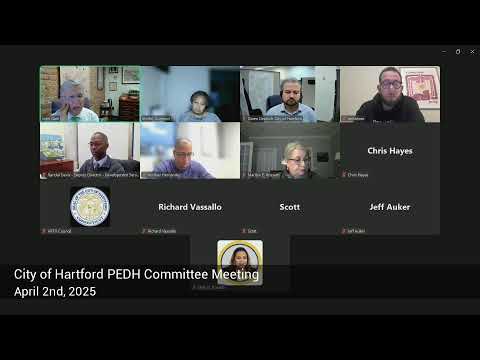
The Hartford Planning, Economic Development and Housing Committee on April 2 voted to send an amended ordinance to the full City Council that would let property owners in the Parkville neighborhood vote on creating a Parkville Business Improvement District funded by a special assessment.
The Hartford Planning, Economic Development and Housing Committee on April 2 voted to send an amended ordinance to the full City Council that would let property owners in the Parkville neighborhood vote on creating the Parkville Business Improvement District, a special services district funded by a property assessment.
The ordinance, introduced by the mayor and drafted with city corporation counsel, would establish an 11‑member board to oversee cleaning, beautification, marketing and public‑safety ambassador services within roughly 400 properties in the Parkville area. If the council approves the ordinance, it would go to a referendum of district property owners; the district would begin only if a majority of owners and a majority of assessed value within the district vote in favor.
“This BID will have specific powers to enhance services within the district boundaries,” said Mary Corsi, who presented the ordinance on behalf of corporation counsel’s office. Corsi said the district map runs roughly north to West Boulevard and Capitol Avenue, east near Park Terrace and Pope Park, south to Flatbush Avenue and west to Prospect Avenue.
Nut graf: The committee approved two amendments before sending the ordinance to the full council: it inserted the word “residential” in front of “lessees” to reserve two board seats for residential lessees, and it added a requirement that the mayor’s ex‑officio appointees be subject to City Council approval. Supporters said the changes were intended to increase resident representation in a neighborhood where homes and businesses are intermingled; opponents had argued in committee that renters lack a vote under state law and could be affected if costs are passed to tenants.
Key details and committee discussion
- Funding and scope: The BID would be financed by a special assessment on taxable properties. Corsi said the proposed levy would generate roughly $180,785.08 annually; the ordinance sets a first‑year assessment equivalent to 2 mills, with future adjustments tied to prior levies plus the Consumer Price Index. Residential owners of one‑ to three‑family homes would be allowed to opt out of the assessment under the ordinance.
- Services and governance: The district would focus on cleaning/beautification, marketing and public safety. Corsi described “public safety ambassadors” as a visible, welcoming presence that complements — not replaces — city police and public‑works services. The board would include six property‑owner commissioners, two lessee commissioners, and three ex‑officio members (two appointed by the mayor and one by the Parkville NRZ). Corsi said the BID would maintain $2,000,000 in liability coverage.
- Referendum procedure and thresholds: If the council approves the ordinance, Corsi said a referendum of record property owners would take place within 60 days; approval requires both a majority of owners voting and those owners’ assessed values to total more than half of the district’s assessed value. If approved, the board would be seated and adopt a budget within 30 days.
Council questions and minority concerns
Councilman Josh Mitchum raised concerns about resident and renter representation and potential rent increases. “There’s no representation for the residents, only for the property owners,” Mitchum said, noting that many Parkville households are renters and that landlords could pass assessments through to tenants.
Corporation counsel Natalie Regley and assigned committee attorney Richard Fasalo (referred to in the meeting transcript as "Attorney Fasalo") said the state statute authorizing such special districts does not preclude renter representation and that the draft ordinance as amended already allows two lessee seats; the mayor’s ex‑officio appointments could also be used to add resident representation. Fasalo advised that narrowing the lessee language to specify “residential lessees” is a minor change that would not require restarting the public‑notice process.
Committee action and next steps
The committee voted to amend the ordinance by adding “residential” before “lessees” and to require council approval of the mayor’s two ex‑officio appointments. After amending the text, the committee voted to send the ordinance to the full City Council with a favorable recommendation. Corporation counsel said she would insert the agreed changes into the ordinance text and recirculate it to the mayor’s office and council.
If the council approves the ordinance, the referendum described in the ordinance would determine whether the Parkville BID is established and its assessment collected through the city’s tax process. Corsi said the first board would adopt an initial budget within 30 days of being seated and that operations would ramp up as funding is collected.
Ending: The Parkville BID ordinance will next appear on the full City Council agenda; if the council approves it the city will mail referendum notices to district property owners as required by state law and the vote will determine whether the special assessment is enacted.