Get Full Government Meeting Transcripts, Videos, & Alerts Forever!
Get email alerts on the City Budget And Reserves topic
No spam. Unsubscribe anytime.
City manager previews cautious 2025–26 budget, highlights Measure FP timeline, reserves and homelessness funding
Summary
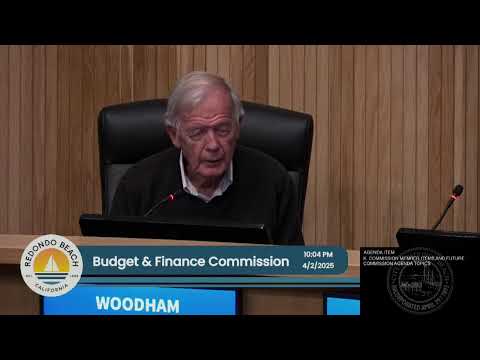
At an April meeting of the Budget & Finance Commission, the city manager outlined a cautious operating-budget approach for fiscal 2025–26, previewed the public safety bond (Measure FP) timeline and urged careful use of reserves while staff compiles a consolidated accounting of homelessness-related spending and grants.
City Manager Mike told the Budget & Finance Commission on April 15 that the city will take a conservative approach when proposing the fiscal 2025–26 operating budget, focusing on executing a newly approved public-safety bond program while holding staffing levels steady.
The city manager said the city has engaged financial and bond counsel and is recruiting a program coordinator for the Measure FP bond program; he estimated “shovels in the ground probably…16 to 18 months” if design and approvals proceed smoothly. He said 11 firms submitted proposals for the program coordinator role and the city is hiring part‑time project management support to coordinate the cross‑department effort.
Why it matters: the bond program and capital work will be the largest near‑term budget priority. At the same time, the manager told commissioners the city faces mixed revenue signals — a strong property reappraisal but flat transient‑occupancy and sales taxes — and must be “very judicious” about borrowing and new hires.
Details on bond timetable, capital priorities and revenues
The manager said the city has selected municipal financial-advisors and bond counsel and expects to approve a disclosure‑counsel retainer in mid‑April. He described a multi‑department delivery team (police, fire, public works, IT and the city manager’s office) and said capital work will be a central focus in FY 2025–26. He repeated his estimate that substantial construction is likely more than a year away, after design development and procurement are complete.
On revenues, the manager said reassessment added about 5.3% in property tax value year over year, but cautioned that sales and hotel taxes are stagnating amid national economic headwinds. He estimated preliminary, conservative general‑tax growth in the $2 million to $3 million range year‑over‑year — roughly 2–3% — but said staff will “drill into” revenue data during budget development.
Capital and leasing updates
The manager reported upbeat leasing in the harbor and Pier Plaza, and said the city approved an option agreement allowing Port Royal Marina to invest about $20,000,000 to rebuild and reconfigure its marina and promenade. He said a 30,000‑square‑foot site (the former “fun factory” space) is moving toward marketing for a family‑oriented use, and a market‑hall concept is under discussion for underused commercial space near the International Boardwalk.
Labor agreements, pension costs and reserves
On operating costs, the manager said the city must absorb multi‑year bargaining agreements and an upcoming unfunded accrued liability (UAL) payment. He identified a roughly $4.2 million UAL payment expected next fiscal year and described the city’s reserve structure:
- An “economic contingency” reserve set by policy at 8.33% of general‑fund expenditures (one month of operating expenditures). The manager described that fund as the city’s top‑line contingency and said the city has historically been reluctant to draw it down. - A separate reserve often described as a “pension reserve” or pension/salary‑benefit set‑aside, about $8 million today, which the manager said is more fungible and has been used and restored in past years.
When commissioners pressed on reserves and whether the city should target a larger percent (for example 20–25%), the manager said the city has built multiple buckets over time — equipment replacement, pension/salary reserve and economic contingency — and that aggregating those buckets brings the city closer to widely‑recommended reserve targets. He also flagged implementation risks: a regional rebuild after major fires could raise construction costs and labor competition, affecting local bond and transportation projects.
Homelessness programs and grant funding
Commissioners pressed for a consolidated accounting of homelessness spending. The manager and finance staff said most operational costs for the city’s pallet‑shelter work and homeless court have been grant‑funded to date, and that only a small set of general‑fund costs (notably a housing navigator position and a supervisor position approved by council) have been incorporated into ongoing operations.
The manager said the pallet‑shelter operator and many wrap‑around services are covered by external grants (he referenced a Health Net private grant and state/county grant streams) and that the city has not spent general‑fund dollars on shelter operations to date. He acknowledged commissioners’ requests for a single consolidated report that would list homelessness‑related contracts, grants and the city’s exposure if external funding ended.
Cannabis licensing and other revenue items
The manager confirmed the council has an adopted, updated cannabis ordinance that embeds RFP selection criteria; the staff will bring an RFP and license‑selection item back to council in the coming months. He said city revenue estimates for cannabis licensing range roughly from $400,000 to $800,000 in potential sales‑tax increment depending on final implementation.
Appointments and staffing item
During the meeting the manager announced he had appointed Stephanie Meyer as the city’s finance director. Commissioners congratulated Meyer; staff explained the budget book and the annual timeline for delivery to council (charter deadline mid‑May; council adopts the budget in June after hearings).
What commissioners asked for and next steps
Commissioners asked staff for a compact, user‑friendly template that would summarize homelessness‑related spending for the fiscal year (grant amounts, contracts or purchase orders paid from those grants, and any general‑fund exposure). Finance staff said they will provide a template and aim to present a populated summary after fiscal‑year close; staff suggested early August as a realistic date to deliver consolidated FY‑end figures and a template earlier if feasible.
Commissioners also asked for clearer long‑term capital planning and cost estimates for projects in the five‑year capital improvement program, and for multi‑year pension and contribution history. Staff said the upcoming proposed budget and CIP materials will include further detail and will be presented to the commission in the joint capital meeting scheduled for April 28.
Ending
The city manager closed by reiterating that the proposed FY 2025–26 budget will emphasize execution of the Measure FP bond program, preserving current service levels where possible and using reserves cautiously while staff refines revenue and expenditure estimates.