Get Full Government Meeting Transcripts, Videos, & Alerts Forever!
Get email alerts on the Real Estate Acquisition topic
No spam. Unsubscribe anytime.
HCDA authorizes $6 million purchase of Block P2 parcels in Kakaʻako to secure community facility and possible housing
Summary
The Hawaiʻi Community Development Authority voted April 2 to authorize its executive director to execute a purchase-and-sale agreement for two contiguous parcels in Kakaʻako—Block P2—at a negotiated price of $6,000,000, citing a $5,000,000 state appropriation to establish a community facility and a longer-term intent to preserve the site for affordable housing.
The Hawaiʻi Community Development Authority voted April 2 to authorize its executive director to execute a purchase-and-sale agreement for two contiguous parcels in Kakaʻako—identified as Block P2, parcels at 952 Kauaʻihaʻu Street and 955 Waimanu Street—at a negotiated purchase price of $6,000,000.
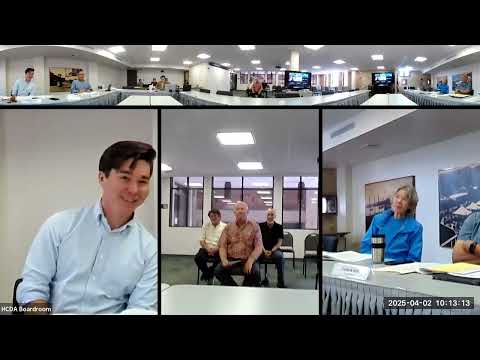
The action, taken at the authority's regular meeting in the American Brewery Building, follows a state budget appropriation of $5,000,000 intended to plan, design and construct a community facility in the Kakaʻako Community Development District. "The staff report is contained in tab 2 of your packet. What I'm asking is for the board's authorization to allow me to enter into a purchase and sale agreement for Block P2," Craig Nakamoto, executive director of the Hawaiʻi Community Development Authority, told the board during his presentation.
Why it matters: Board members and staff framed the purchase as a way to secure a site for a community facility—initially envisioned for Mother Waldron Park but deemed infeasible because of limited park space and the city's management of the park—and to preserve the parcel for future affordable housing development. The authority indicated a short-term plan could include leasing the existing building to a community organization while a longer-term affordable-housing project is pursued.
Key facts and board action - Parcels: two contiguous lots in Kakaʻako (Block P2) described by Oʻahu tax map key numbers 2-3-003-065-093. - Purchase price: $6,000,000 (staff said an independent appraisal returned approximately $7,000,500). - Industrial floor area credit: the authority will give the seller industrial floor area credit of 8,757.72 square feet under the amended development agreement with Victoria Ward. - Funding context: staff said a $5,000,000 state appropriation was made to find and establish a community facility in the district. - Short-term occupant: staff identified the Honolulu Kupuna Shed as a potential short-term tenant; board members were told the authority intends to lease the building on nominal terms and expects the tenant to maintain the building under a triple-net arrangement but said the lease term had not been finalized.
Public testimony and tenant concerns Members of the Honolulu Kupuna Shed addressed the board in support of the purchase. "We're thrilled to be able to be in this community and part of this program," said Robert Spear, who identified himself as president of the organization. Spear described the group’s programs—bicycle repairs, woodworking and intergenerational education—and said the organization would benefit from a space of roughly 7,000 to 8,000 square feet, including a 5,000-square-foot woodshop.
Current tenants of the warehouse raised concerns about displacement. "We have over 600 members of the Kakaʻako community that come to our facility every day," said Sarah Freeman, who identified herself as the owner-operator of the fitness facility currently occupying the building. She and other speakers asked the authority to minimize disruption and to explore alternative locations so the gym could continue serving members.
Nakamoto responded that the authority had not completed due diligence and that any change would follow statutory processes and notices tied to existing leases. In response to a direct question about whether the authority would issue a notice to vacate after closing, Nakamoto said, "Yes. That is correct," when asked whether tenants would receive a notice once the transaction closes.
Board deliberation and outcome Member Evans moved to authorize the executive director to execute the purchase-and-sale agreement and to complete any and all things necessary to close, provided the executive director is satisfied with due diligence; the motion was seconded by Vice Chair Hsing. The board approved the motion by roll call; the chair announced the motion passed.
What the approval does and next steps The vote authorized the executive director to sign the purchase-and-sale agreement and begin due diligence work. The board and staff said that if the authority pursues a lease to a tenant such as the Kupuna Shed, any long-term lease would be returned to the board for approval in a subsequent action. Staff also said it would review existing leases and termination rights as part of the due diligence process and negotiate with current tenants about timing.
Community and planning context Staff said the building on the parcels is a small warehouse (roughly 6,000–8,000 square feet, as described in the presentation) that had been used for community programs. The Victoria Ward amended and restated development agreement requires Victoria Ward to maintain a minimum amount of industrial floor area; the authority said giving credit for 8,757.72 square feet is a mechanism to reconcile the seller’s obligation with the proposed sale.
The authority’s presentation and public comment emphasized the tradeoffs between preserving park space in Mother Waldron Park and acquiring an existing commercial property to house community programs in the near term while keeping open the possibility of developing affordable housing on the site in the mid to long term.
Ending Staff said it will return to the board with more detailed lease proposals and with findings from due diligence. The authority did not set a firm timeline for development decisions and emphasized that site improvements, tenant relocation and any housing development would follow separate planning, procurement and approval steps.