Get Full Government Meeting Transcripts, Videos, & Alerts Forever!
Get email alerts on the Parks Finance topic
No spam. Unsubscribe anytime.
Parks and Recreation reports fee adjustments for 2023–2025, keeps cost‑recovery targets
Summary
Staff summarized fee changes since 2023—including arboretum admission increases, added rental spaces, updated photography and aquatics fees—and said all program areas met their cost‑recovery targets last year.
Parks and Recreation staff reviewed fee policy and changes made since 2023, then confirmed the department is continuing to use a sliding cost‑recovery framework that targets different recovery levels by program type.
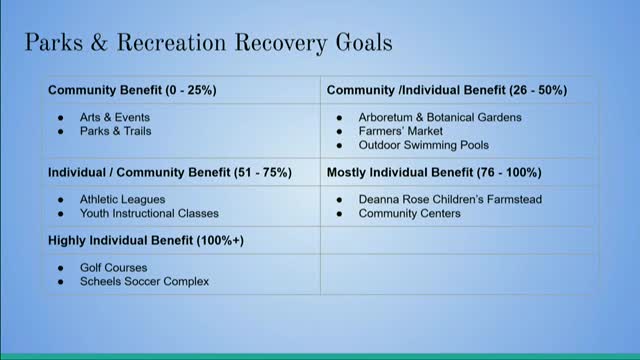
Staff reminded the committee that council resolution 4829 set fee recovery policy and authorized the city manager to adjust fees to meet those goals. Under the framework: arts/events/parks are targeted at 0–25% recovery, arboretum/farmers market/outdoor pools at 26–50%, instructional programs at 51–75%, community centers and Deanna Rose Farmstead at 76–100% and enterprise golf and soccer facilities at 100% recovery.
Recent and planned changes staff summarized included: - Arboretum: adult daily admission increased from $5 to $7; youth (6–17) from $2 to $3; four rental spaces and associated fees were added; photography and commercial use language clarified and a $50 professional portrait permit was removed. - Aquatics: outdoor swim lesson fees moved from $45 to $55 for residents and $50 to $65 for nonresidents; swim and dive team fees increased for residents and nonresidents (examples cited: resident swim team from $105 to $150, nonresidents $115 to $160). - Festivals/markets: fall festival booth fees were adjusted for various booth sizes.
Staff said golf fee changes are set administratively and no single fee rose by more than $2 in recent revisions. Committee members asked whether cost‑recovery targets are being met; staff said that for 2024 each program area fell within its target band and that staff will continue periodic 24‑month reviews.
Why it matters: staff emphasized the framework balances community access and program sustainability; council members said the recovery bands help prioritize taxpayer support for broadly accessible programs while enterprise operations cover their costs.
Ending: staff will continue reviewing fees on a two‑year schedule and coordinate with the city manager when adjustments are needed.