Get Full Government Meeting Transcripts, Videos, & Alerts Forever!
Get email alerts on the Roosevelt Mixed Use Development topic
No spam. Unsubscribe anytime.
Carlsbad planning commission recommends approval of Roosevelt mixed‑use project, 4‑0, amid parking concerns
Summary
The Carlsbad Planning Commission voted 4‑0 on April 2 to recommend that City Council approve the Roosevelt mixed‑use development at 2621 Roosevelt Street, a proposal to demolish an existing two‑story commercial building and construct a four‑story structure with about 5,400 square feet of ground‑floor commercial space and 23 residential units.
The Carlsbad Planning Commission voted 4‑0 on April 2 to recommend that City Council approve the Roosevelt mixed‑use development at 2621 Roosevelt Street, a proposal to demolish an existing two‑story commercial building and construct a four‑story structure with about 5,400 square feet of ground‑floor commercial space and 23 residential units.
The recommendation includes two linked actions: a finding that the project is categorically exempt from California Environmental Quality Act (CEQA) review under an infill exemption and approval of the site development plan with the applicant’s requested density bonus, concessions and waivers. The commission’s approval followed staff’s recommendation and public comment that emphasized parking and design concerns.
Associate Planner Kyle Van Lewin described the project site as a 0.46‑acre, infill parcel in the Village and Barrio master plan area and summarized the proposal: demolition of a two‑story commercial structure, a new mixed‑use building with five ground‑floor tenant spaces, 23 residences, and a parking garage with 24 residential parking spaces. Van Lewin said the applicant requests two 50% density bonuses tied to dedicating two very‑low‑income units and two moderate‑income units, which together increase the base 11 units to the proposed 23 units. He also listed two concessions and eight waivers sought under state density bonus law, including relief from several objective design standards and certain parking requirements.
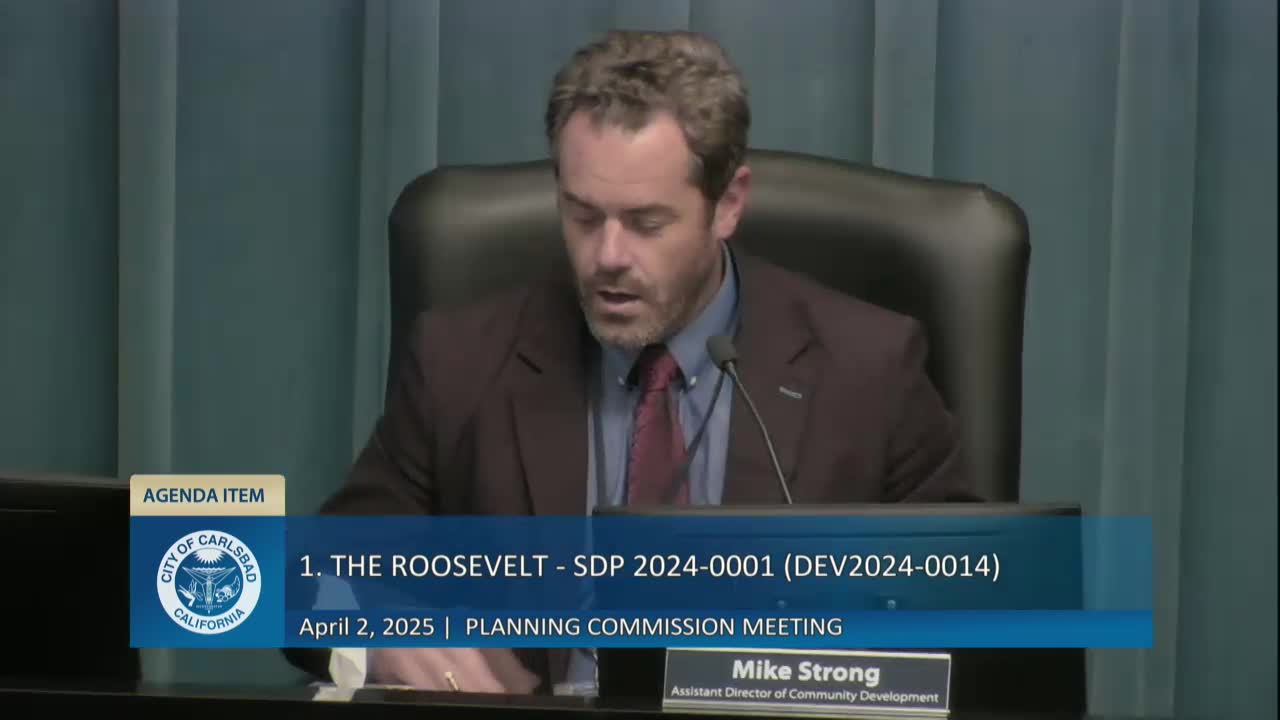
City staff recommended adoption of a resolution that (1) finds the project exempt from CEQA under the infill exemption and (2) approves the site development plan, subject to the conditions of approval in the staff report. Mr. Strong (city staff) explained that the city’s review found the proposal complies with the Village and Barrio master plan except where state density‑bonus law and AB 2097 (a state law affecting parking and incentives near transit) limit local discretion. Strong told the commission AB 2097 "is the latest in the line of a number of laws...to strip away local control and discretion and decision making," and urged that the city monitor impacts through its annual downtown parking surveys.
Bridal Foote, identified in the record as the principal of Fabric Investments and the project’s developer, said the applicant has worked in Carlsbad Village for a decade and described design choices and constraints. Foote said the project includes roughly 4,000 square feet of new plaza/open space and that many of the requested waivers were driven by a fire access requirement that created a rear plaza and reduced buildable floor area. Foote acknowledged public concern about parking: "parking concern, which I know is the primary concern of late, regarded to new development," and said the team has maximized on‑site parking capacity and believes many village users will shift to parking a block away or using transit.
Two residents spoke during public testimony. Laurie Robin, a Carlsbad Village resident, praised some project features but urged more traditional exterior colors for large, permanent surfaces, saying, "This is a large building, and color is subjective," and noting the project’s darker color samples appear different in natural daylight. Craig Ryle, a resident, said his "biggest concern is parking," describing Roosevelt Street as frequently congested and calling the current conditions "borderline dangerous for pedestrians."
Commissioners discussed several issues before voting. Commissioner Foster cautioned that a denial grounded solely in parking preference could expose the city to legal risk given state law, saying the commission "would be putting the city of Carlsbad at risk for litigation" if it rejected an otherwise qualifying density‑bonus project. Commissioners and staff also discussed a possible condition requiring a notice of restriction on title to disclose that public parking availability is not guaranteed in perpetuity; several commissioners opposed adding that notice, saying it could complicate future sales and was unnecessary.
A motion by Commissioner Foster, seconded by Commissioner Mertz, to adopt a resolution recommending City Council (1) find the project exempt from CEQA under the infill exemption and (2) approve the site development plan passed by a 4‑0 vote. The commission noted the decision is a recommendation; final approval rests with City Council. Staff noted the applicant will need to satisfy the listed conditions of approval and any administrative requirements before building permits.
The commission also acknowledged public comments about color and parking and the applicant offered to continue discussions with the community on design details. The Planning Commission closed the public hearing and will forward the resolution and file to City Council for scheduling; the record did not specify the council hearing date.
The schedule note at the meeting’s end: the April 16 Planning Commission meeting was canceled and the commission will reconvene May 7 for subsequent items.