Get Full Government Meeting Transcripts, Videos, & Alerts Forever!
Get email alerts on the Hiv Stigma Index topic
No spam. Unsubscribe anytime.
Austin Public Health and partners launch local People Living with HIV Stigma Index pilot
Summary
Austin Public Health and community partners described a pilot of the People Living with HIV (PLHIV) Stigma Index for the Austin Transitional Grant Area, a peer‑led, in‑person interview study that will pilot 102 interviews with people living with HIV and pay participants and interviewers stipends.
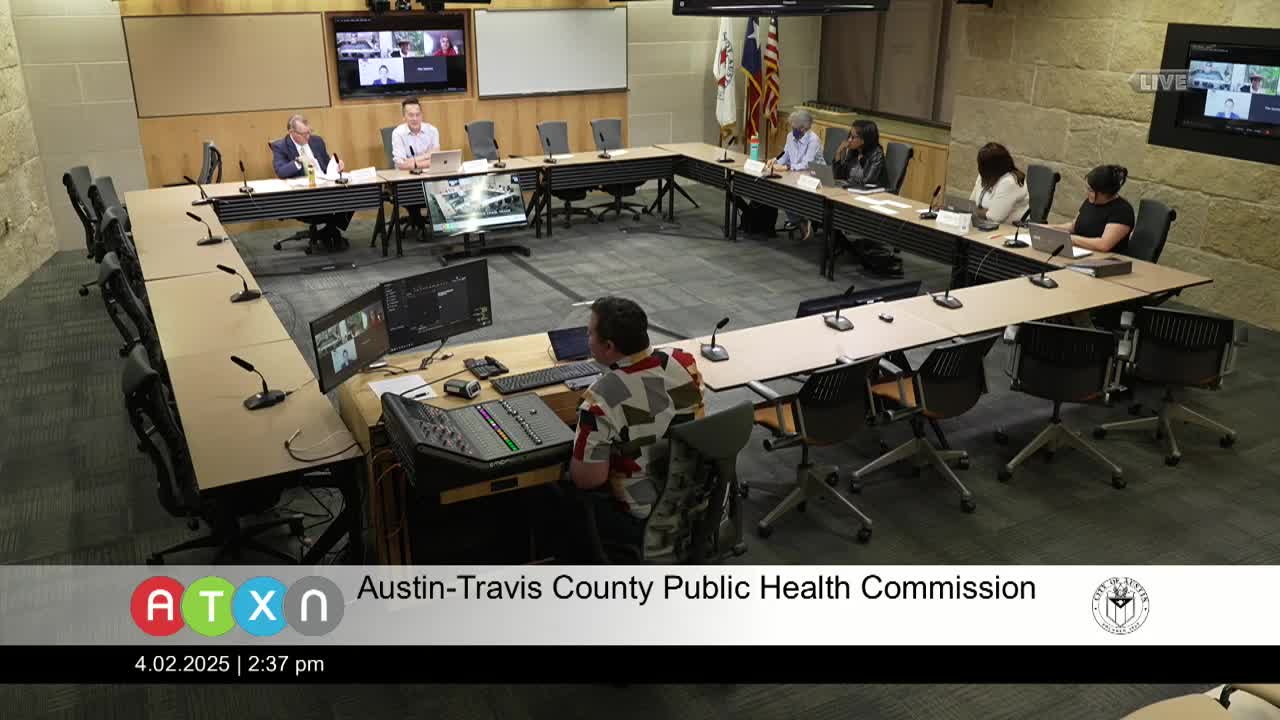
Austin Public Health and community partners outlined a peer‑led project to measure HIV‑related stigma and discrimination in the Austin Transitional Grant Area (TGA) during a Public Health Commission meeting.
The People Living with HIV (PLHIV) Stigma Index pilot will use in‑person, peer‑administered interviews to gather qualitative and quantitative evidence on how stigma affects testing, care and daily life. Michelle Osorio, public health program coordinator with Austin Public Health and the Fast Track Cities Initiative, told commissioners the project aims to produce actionable local data to guide outreach and services.
The commission heard that the pilot will interview about 102 people in the Austin TGA — defined for this project as Bastrop, Caldwell, Hays, Travis and Williamson counties — with a longer-term goal of interviewing up to 320 people. Osorio said each interview will take about 60 to 90 minutes and that participants will receive a $100 stipend. She said interviewers must also be people living with HIV and will be paid for interviews.
"This assessment was created by people living with HIV for people living with HIV," Osorio said, adding the study has technical backing from UNAIDS and Johns Hopkins University. Rick Astrae Kinada, president of Friends of the David Powell Clinic and a person living with HIV who appeared with Osorio, described the project as peer‑led: "We're raising awareness of the social services, the community based organizations, and our AIDS service organizations that are available in Central Texas."
Why it matters: Commissioners were told Austin’s most recent cascade figures (reported as of the end of 2022) were about 83% diagnosed, 91% linked to care and 92% virally suppressed. Osorio and others said the jurisdiction struggles most with diagnosing new cases, and that stigma is a likely barrier to testing and continuing care.
Methods and eligibility: The project will follow the international PLHIV Stigma Index protocol with locally added questions. Organizers said participant requirements for the pilot are: diagnosed with HIV at least 12 months prior, age 18 or older, residency in the Austin TGA, and Spanish or English proficiency for this pilot phase. The study will use roughly 75% venue‑based sampling (clinics, community centers, social venues) and 25% referral‑based recruitment. The steering committee reviewed local additions including qualitative questions on living situation, treatment by health‑care workers, and community suggestions for change.
Partners, governance and resources: Organizers said the project began in August 2023 through the Fast Track Cities social determinants of health and equity work group. A steering committee of 10 people — primarily people living with HIV — was selected after outreach to more than 170 organizations. Cardea Services, a national nonprofit, serves as the research partner for data collection and management. Osorio said Friends of the David Powell Clinic is funding $20,000 of the participant incentives.
Equity and outreach priorities: Presenters said they intend to oversample five priority groups for focus groups and outreach: people experiencing homelessness, men who have sex with men, sex workers, people who use drugs, and transgender individuals. They also emphasized bilingual outreach and community liaisons, and described plans for social‑media outreach and partnerships with local AIDS service organizations and clinics.
Timeline and use of results: Organizers told commissioners they plan a rapid turnaround after interviews conclude: a written report is expected within a few months of completing data collection, followed by community engagement to develop an advocacy plan based on findings. Osorio said the project is intended to inform targeted interventions, advocacy and service design rather than sit on a shelf.
Commissioner questions and next steps: Commissioners asked how local cascade numbers compare with other jurisdictions and whether access or stigma is the primary barrier. Osorio and other panelists said access exists in many places but stigma (including fear of being seen at an HIV clinic) remains a significant deterrent. Commissioners suggested connections with clinics, community health workers and outreach at nonclinical sites to reach people not connected to services. The presenters agreed to provide commissioners with more detailed data on the cascade and to return with results and advocacy plans once analyses are complete.
Provenance: The commission’s presentation and discussion began with a staff introduction and the presenters’ remarks and closed with commissioners’ questions and offers of partnership. (See provenance.)