Get Full Government Meeting Transcripts, Videos, & Alerts Forever!
Environmental commission backs land‑code changes for Walnut Creek wastewater plant expansion with conditions
Summary
The City of Austin’s Environmental Commission on April 2 recommended that the City Council approve site‑specific Land Development Code amendments to allow expansion and upgrades at the Walnut Creek Wastewater Treatment Plant, while attaching multiple conditions addressing water quality mitigation, heritage trees, energy, public access and ongoing monitoring.
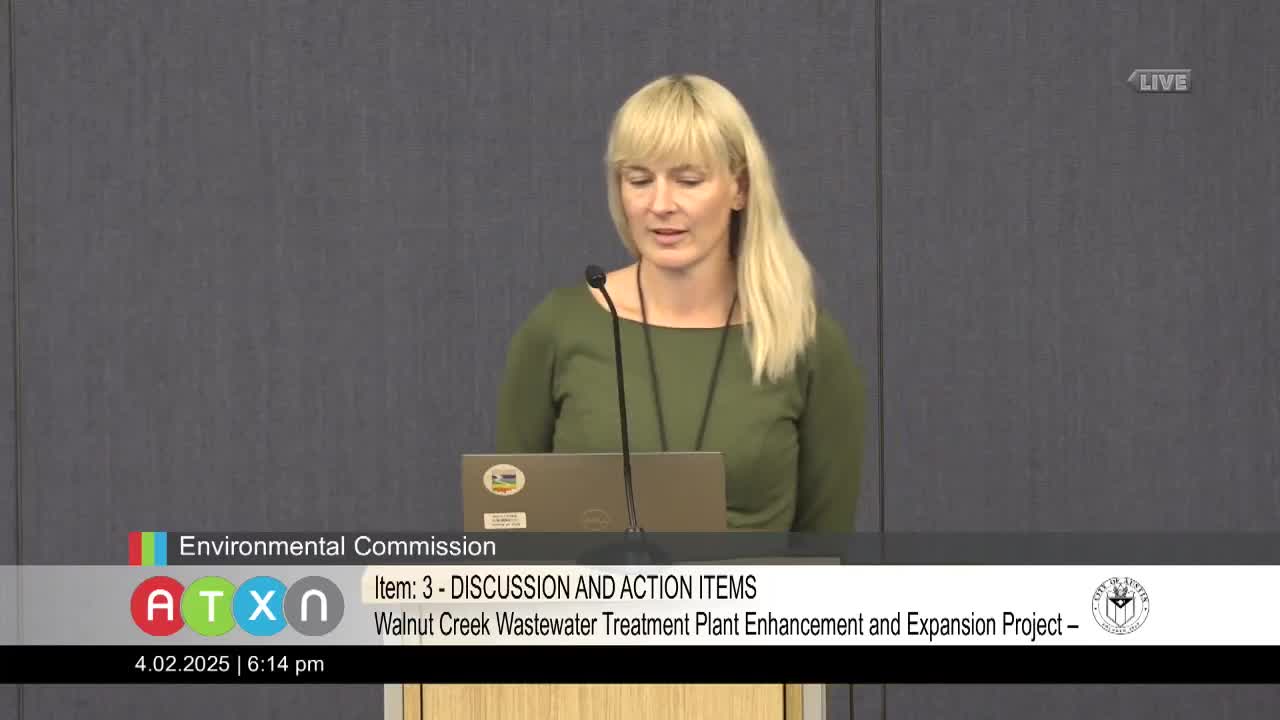
The City of Austin’s Environmental Commission on April 2 recommended that the City Council approve site‑specific amendments to the Land Development Code needed to allow the Walnut Creek Wastewater Treatment Plant Enhancement and Expansion Project, but the commission attached conditions addressing environmental mitigation, tree preservation, energy, public access and ongoing monitoring.
Watershed Protection staff and Austin Water officials told the commission the project would expand the plant’s permitted capacity by 25 million gallons per day — from 75 million to 100 million gallons per day — and convert existing treatment processes to biological nutrient removal. Charles Solaro, assistant director with Austin Water, said the upgrades aim to reduce nutrient discharges and modernize aging infrastructure. “We will reduce phosphorus at a minimum of about 60% from current discharge levels and substantially increase nitrogen removal,” Solaro said during the presentation.
The commission’s recommendation follows Council Resolution No. 20250327‑062 initiating the code amendments and is tied to Capital Improvement Project No. 203023046. City staff described multiple land‑use exceptions they say are “minimally required” for construction: allowing a flood wall into the Critical Water Quality Zone (CWQZ), administrative approval of variances for cut‑and‑fill and slopes, administrative handling of potential heritage‑tree removals, and flexibility for multiple site plans and floodplain variance procedures during project delivery.
Why it matters: Austin…
Already have an account? Log in
Subscribe to keep reading
Unlock the rest of this article — and every article on Citizen Portal.
- Unlimited articles
- AI-powered breakdowns of topics, speakers, decisions, and budgets
- Instant alerts when your location has a new meeting
- Follow topics and more locations
- 1,000 AI Insights / month, plus AI Chat