
Tracy Officials Back SenCal JPA to Compete for County Ambulance Contract
Get AI-powered insights, summaries, and transcripts
Subscribe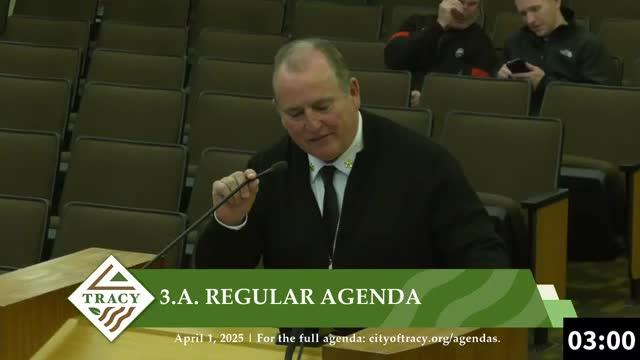
Summary
City council accepted a report on forming the SenCal joint powers authority with Stockton and Lodi to pursue San Joaquin County's exclusive ambulance contract; chief says plan could add ambulances and tap Medi‑Cal revenue streams but carries financial contingencies.
Tracy city leaders on April 1 accepted a report outlining the creation of SenCal, a joint powers authority formed with the cities of Stockton and Lodi that would pursue San Joaquin County’s exclusive operating area ambulance contract due for rebid in 2026.
The report, presented by Randall Bradley, fire chief of the South San Joaquin County Fire Authority, described SenCal’s structure, a teaming agreement with American Medical Response (AMR), and the financial model the partners used to evaluate bringing ambulance transport under public oversight.
Bradley said the county is divided into multiple ambulance zones and that Stockton, Lodi and Tracy are in a single zone that serves roughly 650,000 residents. He said the agencies began preparatory work about three years ago and hired consultants to model options. “The drivers are to improve ambulance services, actually have some oversight and participation in the transport portion of EMS in the county, and then, of course, those additional revenue streams,” Bradley told the council.
Under the proposed approach SenCal has a teaming agreement with AMR that sets exclusivity while the parties prepare to respond to the county request for proposals (RFP). Bradley said the exhibit to the teaming agreement defines day‑to‑day operations, cost structures and per‑hour rates AMR would charge if the bid is successful. He emphasized the arrangement is not a business joint venture at this stage but a structured framework for collaboration.
Bradley and staff described projected fiscal impacts and contingencies in detail. They estimated combined zone revenues in excess of $10 million over the contract term and projected an initial, pro‑rata startup cost of roughly $500,000 for the three agencies; South County Fire expects to use reserve funds and staff said that initial investment could be recovered in the first year under current revenue projections. The plan also anticipates that bringing transport under the public partnership would allow recovery of Medi‑Cal reimbursements that private ambulance providers cannot claim, increasing local revenue available for reinvestment in service levels.
Bradley cautioned there are multiple “off‑ramps”: the county RFP had not been released at the time of the presentation; SenCal may choose not to proceed if the RFP terms are not feasible; and if a bid is unsuccessful the arrangement would be dissolved and another provider would be selected. He also said the agencies designed the pre‑proposal to ensure member agency general funds would not be exposed if anticipated Medi‑Cal revenue did not materialize.
The chief described expected service improvements if the plan is implemented: consolidated dispatch, a single radio frequency for first responders and ambulances, and greater operational coordination. He said the initial proposal would place about 11% more ambulances in the system on day one, managed by the fire agencies if the county award is secured.
Council members asked about the timeline, revenue assumptions and exposure to changes in federal or state health funding. Bradley said the analysis accounted for scenarios in which Medi‑Cal or Medicare funding dropped and that contract language would include reopeners if funding streams changed materially.
After council questions and no public comment on the item, a motion to accept the report passed in a roll call vote with all five members voting yes. The council did not adopt any ordinance or contract at the meeting; the action accepted the informational report and the city’s participation in SenCal’s formation and teaming agreement process going into the county RFP period.
If SenCal and its partner prevail in the county procurement, the agencies said they plan to return with formal agreements, more detailed cost allocations and an operational plan for implementation.