Get Full Government Meeting Transcripts, Videos, & Alerts Forever!
Get email alerts on the Humanitarian Aid Gaza topic
No spam. Unsubscribe anytime.
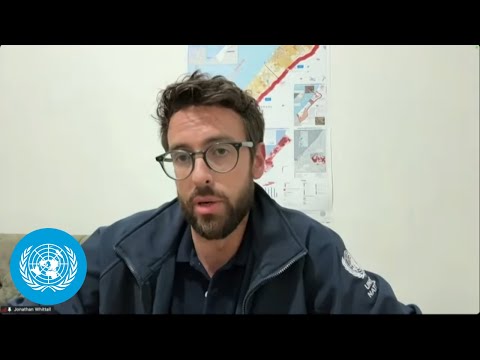
OCHA head in Gaza: 'War without limits' as medics found in mass grave, supplies cut off
Summary
Jonathan Whittle, head of OCHA in the occupied Palestinian territory, described large-scale civilian harm, the discovery of a mass grave containing paramedics and Red Crescent staff, and a month-long halt in supplies into Gaza that has left 2.1 million people trapped and increasingly deprived.
Jonathan Whittle, head of office for the United Nations Office for the Coordination of Humanitarian Affairs (OCHA) in the occupied Palestinian territory, told a United Nations Correspondents Association briefing that humanitarian conditions in Gaza have “defied decency” and amounted to a “war without limits.” He described a recent mission to Rafah in which OCHA and colleagues uncovered a mass grave containing medical workers from the Palestinian Red Crescent Society and civil defence staff, still in uniforms and gloves, and said ambulances, a fire truck and a UN vehicle had been crushed in the area.
Whittle said large parts of Gaza are subject to forced-displacement orders and that access to essential supplies has collapsed. “Today unfortunately marks one month without any supplies entering into Gaza,” he said, adding that the enclave’s population of about 2,100,000 people is “trapped, bombed, starved.” He said 64% of Gaza falls within active displacement orders or so-called buffer zones and that roughly 200,000 people have been displaced since the breakdown of the recent ceasefire. In Rafah alone, he said, about 100,000 people were displaced in the past days.
Whittle told reporters that hospitals are overwhelmed and that subsidized bakeries supported by the World Food Programme have closed: “Yesterday, all 25 subsidized bakeries supported by the WFP were closed,” he said. He warned that children under 5 are likely to be among the first to suffer from the food shortages and that humanitarian assistance delivered during a ceasefire was “a drop in the ocean” compared with current needs.
On allegations that aid has been diverted to armed groups, Whittle said the humanitarian system has “extremely complex and rigorous monitoring” and that OCHA and humanitarian agencies have no evidence that aid delivered through their programmes has been diverted. He described repeated denials or impediments to coordinated humanitarian access as Israeli military operations expanded into areas such as Rafah and said that, despite deconfliction notifications, ambulances and clearly marked UN vehicles have been hit.
Whittle urged political action and accountability alongside humanitarian relief. “There are no humanitarian solutions to the crisis that Gaza is facing. This crisis needs political action,” he said, adding that member states should use political and economic leverage to enforce international law and secure a ceasefire that would stop the “slaughter and free the hostages.”
The briefing was followed by questions from correspondent Amelie Batorlier of Agence France-Presse, Pamela Falk of U.S. News & World Report and others. Reporters asked for detail on displacement figures, the durability of remaining aid stocks, Israeli denials of access and allegations about the status of people killed in ambulances. Whittle repeated that OCHA has documented staff killed and injured in strikes on UN premises and in operations, that names published by some authorities did not match those of the ambulance crews OCHA knew, and that humanitarian personnel had been buried in their uniforms.
OCHA’s account at the briefing provided specific operational and casualty details reported by staff on the ground and a call for immediate renewed access for life‑saving supplies. Whittle said hope remains that a ceasefire and political steps will end the violence, but he warned that the humanitarian situation is “spiraling out of control” and that aid deliveries must resume at scale.
Details provided by OCHA in the briefing — including the reported mass grave, the percentage of territory subject to displacement orders, the number of displaced since the ceasefire rupture and the closure of WFP‑supported bakeries — reflect OCHA’s field reporting as described by Whittle at the briefing.