Get Full Government Meeting Transcripts, Videos, & Alerts Forever!
Get email alerts on the Intergovernmental Agreement topic
No spam. Unsubscribe anytime.
Metro outlines proposed intergovernmental agreement to transfer 30 acres, contracts and capital authority to East Bank Development Authority
Summary
Metro and East Bank Development Authority officials briefed the authority on a proposed intergovernmental agreement that would convey about 30 acres, assign major contracts and transfer roughly $105 million of previously authorized capital spending; no vote was taken.
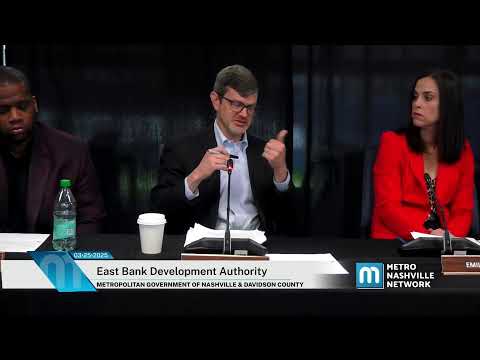
Metro and East Bank Development Authority leaders on Tuesday discussed a proposed intergovernmental agreement that would convey about 30 acres and assign major development contracts and capital spending to the new East Bank Development Authority, but the authority did not vote on the measure.
Bob Mendez, a representative of the mayor’s office, told the authority the presentation was intended for discussion only and that Metro and Metro Council each will have “two touches” on the agreement before either body votes. “We are not asking for a vote today,” Mendez said.
The draft agreement would convey roughly 30 acres tied to the Fallon master development agreement — identified in the presentation as parcels labeled A, B, C, D, E1, E2, F and G — plus the plaza between the football stadium and Fallon’s development area. The city owns roughly 130 acres on the East Bank, Metro staff said; the 30 acres under this agreement are a subset of that acreage and not the entirety of Metro-owned East Bank property.
Saul Solomon, counsel for the authority, described the authority’s initial role as primarily execution of agreed projects rather than independent policymaking. “If it wishes to proceed with Metro Council approval only, that’s permitted under the act, and that is the way that the administration has basically positioned this,” Solomon said.
Under the proposed terms discussed, Metro would assign the 99-year master development agreement (the Fallon agreement) and several three‑party agreements that define shared public-space use among Metro, the Titans and Fallon (identified in the presentation as TSC National Development LLC). Current Metro contracts providing program management and engineering for East Bank work — including a program manager contract with HDR, a civil engineering contract and a contract to develop East Bank Boulevard — would be assigned to the authority.
Metro staff said about $125 million in capital spending was originally authorized for East Bank projects and that approximately $105 million remains unspent; that unspent balance would transfer to the authority. Officials cautioned the Exhibit F in the packet lists originally approved amounts rather than an exact, up‑to‑the‑minute balance and said the final number will likely differ slightly by the time both bodies approve the agreement.
On staffing, the agreement would transfer day‑to‑day control of two current Metro employees who work exclusively on the East Bank to the authority. New employees would be hired by the authority’s CEO; Mendez said the administration expects to have a CEO in place in the first week of April. Metro would initially provide back‑office services (HR, IT and similar administrative support) at standard departmental charge rates, with flexibility for the authority to spin off services later.
The agreement as presented contains several limits set during the enabling legislation process: it does not convey zoning or land‑use powers, it does not convey eminent domain authority, and the authority cannot incur debt without Metro Council approval. Metro and counsel emphasized that decisions about “what to build, when to build and how to pay for it” remain with Metro Council, and any revenue‑generating or debt instruments would require approvals from both bodies.
Operating revenue is expected to be several years away. Until rent or other operating revenue exceeds expenses, Metro would fund the authority’s annual operating budget. Once revenue exceeds expenses, excess funds would first cover operating reserves up to an unspecified percentage of annual expenses and repay Metro’s upfront operating investments; any remaining funds would be remitted to Metro’s general fund, according to the presentation.
Board members asked about due diligence on contracts to be assigned and whether a prospective CEO should review those contracts before accepting the role. Mendez and Solomon said staff will do contract reviews between meetings and that it would be prudent for a CEO to assess comfort with assigned contracts prior to final approval.
Members also raised dispute‑resolution and transparency concerns. One board member said arbitration provisions should allow a public process or be replaced with a state court process; Solomon said the agreement as drafted allows flexibility and that the parties can seek changes during subsequent reviews.
No formal action was taken on the intergovernmental agreement during the meeting. The authority approved the minutes from its February 26 meeting by voice vote earlier in the session.
Officials said the next steps are further review by the authority, a presentation to the Metro Council East Bank Committee in mid‑April, and anticipated council consideration on April 15 with a request to defer one meeting and a hoped‑for vote at a later April council meeting and a final council vote in early May if both bodies are amenable.
Votes at a glance: The authority approved the minutes of the Feb. 26 meeting by voice vote; no tally or names were recorded in the transcript and the intergovernmental agreement was discussed but not voted on.