Get Full Government Meeting Transcripts, Videos, & Alerts Forever!
Austin ISD reports declines in exclusionary-discipline disparities but says work remains
Summary
Brandy Gratton, Austin ISD’s Assistant Director for Discipline Standards and Accountability, reported to the Board of Trustees on Feb. 21, 2025, that the district has made measurable reductions in exclusionary-discipline disproportionality for African American students and students receiving special education services but said one target remains out of range and that additional steps are planned.
Brandy Gratton, Austin ISD’s Assistant Director for Discipline Standards and Accountability, reported to the Board of Trustees on Feb. 21, 2025, that the district has made measurable reductions in exclusionary-discipline disproportionality for two tracked groups but said the district has more work to do to meet its stated targets.
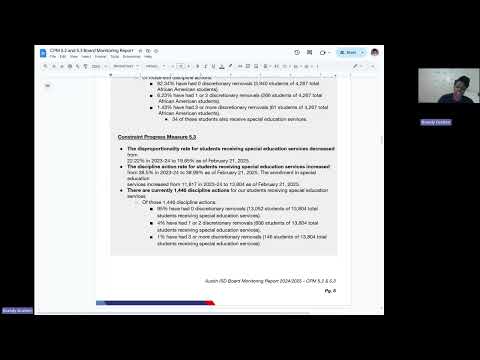
Gratton told trustees that, as of Feb. 21, 2025, the districtwide disparity rate for exclusionary discipline for African American students was 10.33 percent, a decline from 12.39 percent in the 2023–24 reporting period; she said the district’s target for that measure (Constraint Progress Measure 5.2) is to reduce the disparity from 11.35 percent (August 2024 baseline) to 7 percent by August 2029. For students receiving special education services (Constraint Progress Measure 5.3), Gratton said the districtwide rate has fallen from 22.22 percent in 2023–24 to 19.65 percent as of Feb. 21, 2025; she characterized that as progress but said the district was not yet within the CPM target (she noted a target figure in the report of 14.5 percent and also referenced a separate target cited earlier in the presentation of 11 percent for Aug. 2029).
Why it matters: exclusionary discipline measures counted toward CPMs 5.2 and 5.3 include discretionary removals such as in-school suspension (ISS), out-of-school suspension (OSS), or placement at an alternative learning center (ALC), and do not include mandatory offenses such as firearm possession or assaults with injury, Gratton said. Disproportionality, she said, is measured as the difference between a group's discipline-action rate and its enrollment share.
Districtwide and subgroup detail
Gratton provided level-by-level breakdowns she said reflect consistent…
Already have an account? Log in
Subscribe to keep reading
Unlock the rest of this article — and every article on Citizen Portal.
- Unlimited articles
- AI-powered breakdowns of topics, speakers, decisions, and budgets
- Instant alerts when your location has a new meeting
- Follow topics and more locations
- 1,000 AI Insights / month, plus AI Chat