Get Full Government Meeting Transcripts, Videos, & Alerts Forever!
Get email alerts on the School Discipline Disproportionality topic
No spam. Unsubscribe anytime.
Austin ISD reports declines in exclusionary-discipline disparities but says work remains
Summary
Brandy Gratton, Austin ISD’s Assistant Director for Discipline Standards and Accountability, reported to the Board of Trustees on Feb. 21, 2025, that the district has made measurable reductions in exclusionary-discipline disproportionality for African American students and students receiving special education services but said one target remains out of range and that additional steps are planned.
Brandy Gratton, Austin ISD’s Assistant Director for Discipline Standards and Accountability, reported to the Board of Trustees on Feb. 21, 2025, that the district has made measurable reductions in exclusionary-discipline disproportionality for two tracked groups but said the district has more work to do to meet its stated targets.
Gratton told trustees that, as of Feb. 21, 2025, the districtwide disparity rate for exclusionary discipline for African American students was 10.33 percent, a decline from 12.39 percent in the 2023–24 reporting period; she said the district’s target for that measure (Constraint Progress Measure 5.2) is to reduce the disparity from 11.35 percent (August 2024 baseline) to 7 percent by August 2029. For students receiving special education services (Constraint Progress Measure 5.3), Gratton said the districtwide rate has fallen from 22.22 percent in 2023–24 to 19.65 percent as of Feb. 21, 2025; she characterized that as progress but said the district was not yet within the CPM target (she noted a target figure in the report of 14.5 percent and also referenced a separate target cited earlier in the presentation of 11 percent for Aug. 2029).
Why it matters: exclusionary discipline measures counted toward CPMs 5.2 and 5.3 include discretionary removals such as in-school suspension (ISS), out-of-school suspension (OSS), or placement at an alternative learning center (ALC), and do not include mandatory offenses such as firearm possession or assaults with injury, Gratton said. Disproportionality, she said, is measured as the difference between a group's discipline-action rate and its enrollment share.
Districtwide and subgroup detail
Gratton provided level-by-level breakdowns she said reflect consistent reporting periods (school start through February) for both the 2023–24 and 2024–25 comparisons. For African American students under CPM 5.2 she reported:
- Elementary schools: 22.56% (2023–24) to 21.36% (2024–25 reporting period) - Middle schools: 12.65% to 10.23% - High schools: 10.6% to 9.6%
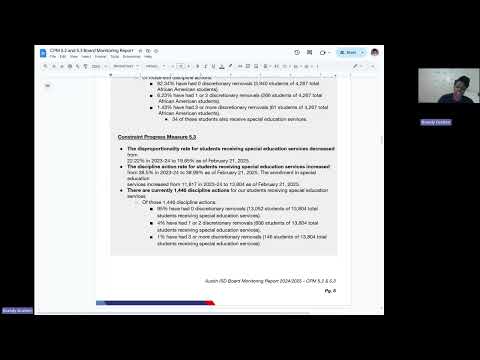
She also gave raw counts for the African American student population the district used in the calculations: 605 disciplinary actions attributed to African American students across the district; of a total African American student population of 4,267, Gratton said 3,940 students (92.34%) had zero discretionary removals in the reporting period, 266 students (6.23%) had one or two removals, and 61 students (1.43%) had three or more removals. Gratton noted that some students with multiple removals also receive special education services; the transcript was ambiguous on the exact cross-count and did not provide an unambiguous single number for that overlap in her spoken presentation.
For students receiving special education services under CPM 5.3 she reported 1,446 discipline actions and said 95% of students receiving special education services (13,052 of 13,804) had zero discretionary removals; 4% (606 students) had one or two removals, and 1% (46 students) had three or more removals.
Root causes and campus practices
Gratton summarized findings from district conversations with principals and assistant principals and from related scholarly literature. She listed commonly cited root causes as: an overreliance on suspensions to control behavior; limited training on implementing individualized education plans (IEPs); vague policy language or inconsistent interpretations (for example, on insubordination or classroom disruption); limited training in alternatives to suspension; and constrained time for assistant principals to review and address underlying causes before deciding on removals.
She credited several campus-level changes where administrators reported measurable reductions. For CPM 5.2 Gratton highlighted Travis Early College High School, which she said reduced its reported disproportionality rate from 19.86% (2023–24) to 1.96% (as of Feb. 21, 2025); Travis’s administration attributed improvement to leadership consistency, building relationships with students, and refining campus systems. For middle schools she highlighted Kealing Middle School (presented in the slide as Keeling/Kealing; recorded and corrected here as Kealing Middle School), which she said declined from a 59.69% disproportionality figure in 2023–24 to 26.88% as of Feb. 21, 2025; Kealing’s administrators attributed improvements to revising the campus mission, strengthening student relationships and increasing data sharing. For CPM 5.3 she highlighted Small Middle School (from 54.7% to 19.98%) and Austin High School (from 42.29% to 10.58%), with campus leaders citing collaborative approaches among administrators, case managers and trusted adults, targeted professional development, frequent data review and relationship-building.
Planned next steps
Gratton described next steps in the district’s plan to continue reductions: ongoing collaboration among special education staff, counselors, licensed mental health providers and restorative-practices teams to monitor data and support campuses; continuing and expanding a district discipline “watch list” to identify students for support and to recognize student growth; training Communities In Schools (CIS) staff in restorative practices in the coming school year; developing and refining a discipline dashboard with the data and analytics team; and strengthening data sharing with executive directors, campus administration and parent-support specialists. She also referenced a grant described in the presentation as the “Ford Grant,” which she said is a roughly $1,000,000 grant received from the U.S. Department of Justice to reimagine school discipline; the district identified Kealing and Covington as pilot campuses for that grant-supported work.
Direct quotes and tone
Gratton framed the results as both cause for cautious celebration and continued effort: “We are proud,” she said, and added later, “we ain't done yet.” She closed the presentation with the district slogan she used to summarize the work: “Strong Schools, Stronger Austin.”
Board action and next reporting
Gratton’s presentation conveyed data, root causes and implementation steps; the transcript records no formal Board vote or formal action at the conclusion of the presentation. Gratton pointed trustees to the written report for fuller detail, including outlier-level data tables and a page labeled “next steps.”
Limitations and transcript ambiguities
Two items in the spoken presentation and the report were internally inconsistent in the transcript: the CPM 5.3 target figure (Gratton referenced both an 11% target and elsewhere a 14.5% target in the report), and a numeric overlap between students with three or more removals and those also receiving special education (the spoken transcript renders that overlap ambiguously). The article reports those figures as presented and notes where the transcript or slides were unclear. The written report that Gratton cited (page 3) should be consulted for the district’s definitive published figures and targets.
—