
Carmel council hears limits of emergency dispatch data after presentation on 911 transfer delays
Get AI-powered insights, summaries, and transcripts
Sign Up Free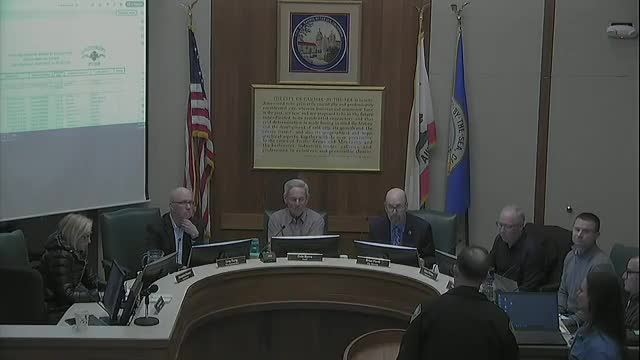
Summary
City staff and the fire chief explained that Carmel'by'the'Sea's local 911 center must transfer calls to Monterey County dispatch, adding an initial 45'second to 1'minute 30'second delay; council and residents urged clearer tracking of total call-to-door response times and fixes for address confusion that can slow crews.
Mayor Byrne called a special Carmel-by-the-Sea City Council meeting to discuss response-time reporting on March 30. City staff and the fire chief explained that the city's call-processing method adds time before Monterey County dispatch sends emergency units, and both council members and members of the public urged better, synchronized timing data and clearer addressing to reduce delays.
The city's fire chief, Paul (last name not specified in the meeting materials), described the city's 2012 contract with Monterey County and the council's performance expectation: "95 percentile of all of our calls being under 5 minutes because that was the that's what we thought we could achieve." He explained the two-step process used in Carmel: the city's local 911 center first takes police, fire and medical calls, determines a more precise location and then transfers the call to Monterey County dispatch, which in turn alerts county fire and ambulance resources.
That two-step flow means the reports the council typically sees reflect only Monterey County's clock. The chief told the council that adding the city's initial call-processing time to Monterey's reported response time creates a gap: "If you add the time of the initial call, which is to our station, you have anywhere from a 45 second to about a minute and 30 delay by the time we figure out the address, what's happening, and we relay it to the right dispatcher over in Monterey County." He also said the county and city clocks do not synchronize, so staff cannot automatically compute a single total call-to-arrival time.
Council members and others pushed for a practical way to assemble a complete timeline. One council member said staff can log the time the 911 call comes in and the time the call is transferred to county dispatch, and the county can provide its dispatch time and arrival time; by combining those points, "we can piece together what we need to piece together," the council member said during questioning.
Public commenters described cases where addressing problems affected response. Longtime resident Karen Ferlito told the council about a nearby medical emergency and said: "When there's an emergency and someone could be stroking out and every minute counts, it would be so much easier to say 123 Main Street. Boom." A council member who had been tracking a recent fatal call said the initial leg between Carmel's 911 intake and transfer to the county took "2 minutes and 55 seconds," and the group discussed how an incorrect address reported by a caller sent an ambulance to a dead-end and required repositioning once responders realized the error.
Staff said some of the data exist but are not currently assembled into the city's monthly reports, which Monterey County provides. The fire chief said the city does not maintain a comprehensive, synchronized dataset of city-call intake time, county dispatch time and on-scene arrival time because "our clock does not sync up with the county dispatch clock, so we don't know exactly what that time is." He said staff can pull individual call records, but compiling a long-term dataset would take staff time.
Council members asked staff to return with options. Suggestions included: (1) logging and publishing both the city's intake-to-transfer time and the county's dispatch-to-arrival times either in the monthly report or a supplementary table; (2) asking Monterey County and AMR (the county ambulance provider) for their dispatch and arrival logs; and (3) exploring address-standardization steps to reduce wrong-address delays. The chief said staff has tracked how many times the county ambulance (AMR) responded into Carmel in past reports and could obtain that data again.
The discussion did not include any formal change to policy or new adopted ordinance; council members asked staff to follow up with a recommended approach for collecting synchronized timestamps and for a limited sample analysis of total call-to-door times.
Residents and council members said they valued the transparency of monthly reports but urged improved clarity and better alignment between the city and county clocks so the public can understand total elapsed time when an emergency is reported.