Get Full Government Meeting Transcripts, Videos, & Alerts Forever!
Get email alerts on the Telecom Transition Policy topic
No spam. Unsubscribe anytime.
Committee approves carrier-of-last-resort overhaul for review by Commerce; stakeholders say bill balances consumer protections and network modernization
Summary
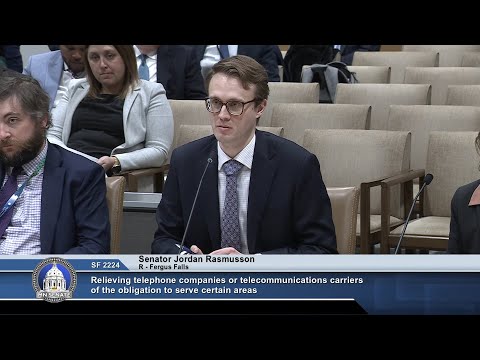
Senate File 22-24 would establish a PUC-supervised process for carriers to transition customers from copper-based telephone service to newer technologies. The committee adopted an A4 amendment (with an oral tweak) and recommended the bill be sent to the Commerce Committee for further work.
Senate File 22-24, sponsored by Senator Rasmussen, would create a process for telecommunications carriers to seek relief from "carrier of last resort" obligations for legacy copper-based telephone lines, subject to Public Utilities Commission (PUC) approval and consumer protections.
The bill requires a carrier seeking relief to submit a customer transition plan to the PUC that demonstrates: an approved alternative technology is available (for example, fiber to the home), transition costs and rates are comparable, technical assistance and dispute-resolution processes are in place, low-income customer protections are addressed, and public meetings are held where needed to inform affected customers.
Dana Bailey of Lumen Technologies said the company has been the carrier of last resort in many areas and praised the stakeholder process that led to the current compromise. "Lumen is committed to providing a thoughtful and responsible off ramp from those copper wire lines, where possible," Bailey said. Bry Christensen, president and CEO of the Minnesota Telecom Alliance, also supported the bill and urged the committee to modernize landline regulation. Sam Smith of the Department of Commerce told the committee the department supports the current bill language because it includes protections for customers who continue to rely on copper, such as access to alternatives, PUC-approved transition plans, notice requirements, technical assistance, and coverage of transition costs for low-income households.
Committee members discussed the burden-of-proof standard and the PUC's role in administrative dispute resolution; sponsors and Commerce said the process remains within the PUCs administrative jurisdiction. Senator Klein, who chairs the committee that will receive the bill back from Environment and Climate, praised the multi-stakeholder compromise and said he intends to bring the bill through the Commerce Committee.
The committee adopted an A4 amendment as amended by an oral amendment to correct wording; both motions passed by voice vote. The committee recommended that Senate File 22-24 pass and be sent to the Committee on Commerce and Consumer Protection for further consideration.
Supporters said the change aligns telecom regulation with technological and market realities while preserving consumer protections; members pointed to the need for clear PUC oversight and assistance for customers who may struggle with the transition. The bill was advanced to Commerce for additional analysis and potential refinement.