Get Full Government Meeting Transcripts, Videos, & Alerts Forever!
Get email alerts on the Paid Family Medical Leave topic
No spam. Unsubscribe anytime.
State paid‑leave officials say core systems on track for Jan. 1, 2026 launch; lawmakers press on testing and staffing
Summary
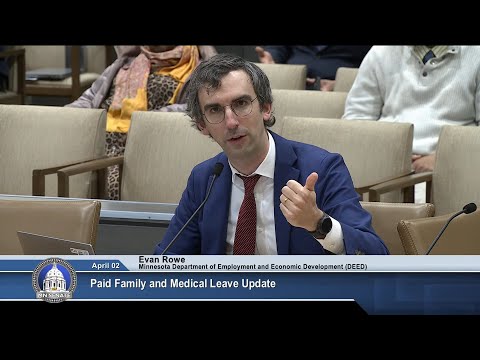
Deputy Commissioner Evan Roe of the Minnesota Department of Employment and Economic Development told the Senate Jobs and Economic Growth Committee on April 2 that the department expects the paid family and medical leave program to accept premium payments starting April 30, 2026, and to be operational Jan. 1, 2026.
Deputy Commissioner Evan Roe of the Minnesota Department of Employment and Economic Development told the Senate Jobs and Economic Growth Committee on April 2 that the department expects the paid family and medical leave program to be ready to begin collections and benefits activity in 2026, with the first premiums due April 30, 2026, and the program operational Jan. 1, 2026.
The update focused on implementation milestones and outstanding work needed to deliver benefits and employer services on schedule. Roe and Greg Norfleet, director of the department’s paid leave division, described progress on employer wage reporting, premium rate setting, rulemaking, an equivalent private‑plan exemption process and technology delivery with vendor Nava PBC.
The administration’s pitch: why this matters
Roe told the committee that wage detail reporting — collected through existing unemployment insurance filings — is a “quiet but really important milestone,” and that “over 160,000 employers have already completed their initial wage detail for paid leave by submitting their regular UI report.” He said the program’s total premium rate upon launch will be 0.88% applied to wages up to the Social Security (OASDI) wage cap this year ($176,100), and that premiums are shared between employers and employees. Roe also said first premiums are due April 30, 2026, and that employers may withhold up to 50% of the premium from employee paychecks starting Jan. 1, 2026, though employers may pay more for some or all employees.
The update summarized several other implementation pieces the department says are in progress: rulemaking submissions to the Office of Administrative Hearings, a process to review private “equivalent” insurance plans in coordination with the Department of Commerce, a web application for exemption requests, an outreach and engagement program that has held more than 150 stakeholder sessions, and a technology build led by vendor Nava PBC together with state teams.
Nut graf — what senators pressed and why it matters
Senators used the session to press agency officials on several operational risks that could affect beneficiaries and employers: final rule timing, the scope and duration of real‑world user testing, whether an independent auditor has been hired to validate software life‑cycle practices, staffing counts and contact‑center readiness, and program integrity controls to prevent duplicate payments with unemployment insurance. Those questions reflect concerns about previous state software rollouts and the customer service impact of launching a complex benefit program.
Key details from the briefing
- Employer reporting and premiums: Roe said wage detail reporting is tied into existing UI processes so businesses face “minimal to no additional overhead.” Officials confirmed a 0.88% premium rate covering both family and medical leave, applied up to the OASDI wage cap. Small employers may qualify for a reduced employer contribution if they have 30 or fewer employees and average employee wages at or below 150% of the statewide average wage; the reduced employer premium does not change the employee portion. (Deputy Commissioner Evan Roe)
- Rulemaking and equivalent plans: Roe said the department has conducted multiple public comment rounds and “is in the final phases of synthesizing the comments” and is “planning to submit the final rules to OAH imminently.” He described a parallel process with the Department of Commerce to enable employers to apply for private equivalent plans and said an online application will let employers upload plan documents and submit payment in 10–15 minutes. (Evan Roe)
- Technology and vendor model: Director Greg Norfleet described a single‑vendor architecture led by Nava PBC with state Minute (MNIT) staff and paid‑leave division staff providing product management and long‑term support. Norfleet said the Minnesota implementation differs from Massachusetts, where multiple vendors handled front‑end and back‑end functions; Minnesota’s contract makes Nava responsible for the front, middle and back end. He said the team is applying modern product management and short development cycles. (Greg Norfleet)
- Testing, automation and program integrity: Officials said testing is being done continuously (unit, integration, regression and user acceptance testing) and that user acceptance testing with representative businesses and leave administrators is already under way. Norfleet said “out of the gate, we’ll have far more manual processing than what we may have down the road” and that automation will be used strategically after integrity checks. Roe and Norfleet said the department is establishing internal controls using Green Book standards and building data interchanges with UI to prevent duplicate payments. (Evan Roe; Greg Norfleet)
- Staffing and contact center: Norfleet said the division has hired 83 full‑time employees to date, had roughly 20 positions posted, and was tracking “green” on its hiring plan. The agency described plans for a staffed contact center at launch but acknowledged Jan. 1 is a holiday and that state staff would observe holidays; the application itself will be live on that date. The department said it has already answered more than 1,200 public questions through its website and currently responds to about 95% of inquiries within two business days. (Greg Norfleet; Evan Roe)
Questions senators pressed repeatedly
Committee members repeatedly asked for firm timing on rule submission and OAH review, the identity and start date for an independent auditor (the department said an active procurement is in its final stages and expects to have an auditor on board soon), the planned length and participants for external beta/user acceptance testing, and thresholds for acceptable manual‑review rates once claims volume grows. Roe declined to set a single nationwide percentage target for manual review, saying states employ different mixes of automation and manual adjudication and that Minnesota will set business‑process targets that match statute and operational capacity.
Selected direct quotes
- “Over 160,000 employers have already completed their initial wage detail for paid leave by submitting their regular UI report.” — Evan Roe, deputy commissioner, Department of Employment and Economic Development
- “We are in the final phases of synthesizing the comments … and we’re planning to submit the final rules to OAH imminently.” — Evan Roe
- “Out of the gate, we’ll have far more manual processing than what we may have down the road. We would want to use automation strategically.” — Greg Norfleet, director, Paid Leave Division
What remains unresolved
Lawmakers asked the department to provide ongoing reporting about customer‑service wait times, duplicate‑payment checks and staffing as the program nears launch. Roe said the agency will produce the statutorily required reports to the Legislature and would be willing to return with updates during the 2026 session. The department is continuing the procurement for an independent auditor, finalizing rule submissions to OAH and expanding user acceptance testing with employers and applicants.
Ending
Senators said they welcomed the update but emphasized persistent concerns about testing, staffing and the customer experience. Officials repeatedly asked committee members to continue directing specific questions and said they would provide additional information and statutorily required reports as the launch date approaches.