Get Full Government Meeting Transcripts, Videos, & Alerts Forever!
Get email alerts on the Major Highway Planning topic
No spam. Unsubscribe anytime.
Senate committee advances bill to reshape major highway planning, add cumulative‑impact review and formal advisory role for local officials
Summary
Senate File 817, which would (1) clarify trunk‑highway “highway purposes” to explicitly include multimodal transportation, (2) require formal policy advisory committees (PACs) and bylaws for major projects, and (3) establish a cumulative impact review and an environmental justice ombudsperson at MnDOT, passed the Transportation Committee on a 6–5
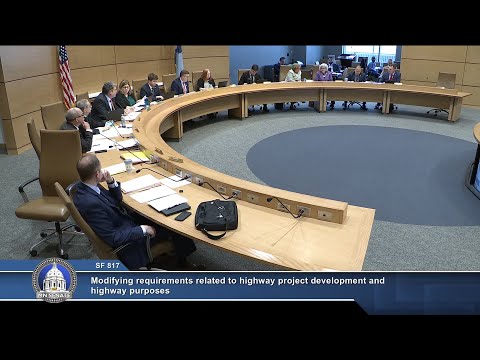
ST. PAUL, Minn. — The Senate Transportation Committee on April 2 approved Senate File 817 on a party‑divided roll call after a multi‑hour hearing that featured MnDOT officials, local elected leaders and community advocates debating when and how large trunk highway projects should account for community preferences, air‑quality and cumulative environmental impacts.
The vote: The committee recorded a roll‑call vote on a procedural motion to pass Senate File 817 “without recommendation” and refer it to the Senate State and Local Government Committee; the motion passed 6–5. Committee minutes show the tally as six yes votes and five no votes.
What the bill would do: Senate File 817 contains three main elements that sponsors described as complementary: (1) clarify the statutory definition of highway purposes (Minn. Stat. ch. 174.01) to explicitly include multimodal transportation — allowing trunk highway funding flexibility for transit and active transportation in addition to roadway infrastructure; (2) formalize requirements for MnDOT policy advisory committees (PACs) for major trunk highway projects, add bylaws and require PAC approval as one step before selecting a preferred alternative or beginning construction on large projects; and (3) require a cumulative impact assessment process for major projects affecting designated environmental‑justice communities and create an independent environmental justice ombudsperson at MnDOT.
Supporters’ case: Senator Fate, the bill’s chief author, said the changes will “enhance community engagement and strengthen planning processes to ensure that highway investments are environmentally conscious, fiscally responsible, and reflective of the priorities of local communities.” Proponents, including Joe Harrington of Our Streets and Peter Wagenius of the Sierra Club, argued the bill gives communities a meaningful advisory role and prevents costly redesigns later by surfacing concerns and alternatives early in project planning. April Graves, mayor of Brooklyn Center, said her city’s PAC on the Highway 252/I‑94 corridor was not presented with non‑freeway alternatives the community requested and that residents “will never know how the non freeway options perform in critical areas like traffic noise, air quality, and environmental impacts” unless the process changes.
Opposition and agency concerns: Minnesota Department of Transportation Commissioner Nancy Daubenberger testified that the bill’s timing requirements for cumulative impact analysis and PAC involvement could force assessments before a NEPA (National Environmental Policy Act) or Minnesota Environmental Policy Act review had identified a preferred alternative. “An assessment of adverse and cumulative impacts prior to listing projects in the STIP would be incomplete,” Daubenberger said, and doing so “could put MnDOT out of compliance with federal law and jeopardize federal funding on projects across the state.” MnDOT’s fiscal analyst detailed a substantial fiscal note: MnDOT estimated it would need additional staff (the fiscal note projected up to 50.8 FTEs by fiscal year 2028 in the trunk‑highway fund under the assumptions used), consultant support for PACs and cumulative assessments, and annual costs that could include consultant work and per‑project cumulative‑impact assessments the agency likened to planning and environmental linkage studies (which MnDOT estimated at about $1,000,000 per project in its illustrative scenario).
Areas of negotiation: Supporters said the author team was willing to clarify the bill’s “trigger” so PACs and cumulative impact assessments apply only to projects that substantially change a corridor or meet other objective thresholds. Joe Harrington (Our Streets) and other proponents told the committee they wanted to avoid creating PACs for routine pavement repairs and would work with MnDOT and legislators to better define when the requirements apply. Multiple local officials and community members pressed for stronger, earlier consideration of non‑freeway alternatives and for formal mechanisms to incorporate community‑preferred alternatives into the planning process.
Fiscal and legal context: Testimony included references to Minn. Stat. 174.01 (the trunk highway statute), the federal National Environmental Policy Act (NEPA), and the Minnesota Environmental Policy Act. MnDOT’s fiscal summary estimated substantial additional trunk‑highway fund costs in staff and consultant support under the approach described in the fiscal note, and MnDOT warned that carrying out some statutory requirements before federal environmental reviews would risk noncompliance with NEPA.
Committee action and outlook: After extended debate and testimony from municipal leaders (including Brooklyn Center Mayor April Graves), environmental advocates, MnDOT officials and industry voices, the committee recorded a 6–5 vote to pass the bill without recommendation and refer it to State and Local Government. Sponsors and staff signaled a willingness to negotiate trigger language narrowing when PACs and cumulative impact analysis would apply. If amended to clarify project thresholds, the bill’s author and supporters said they would work with MnDOT to reduce administrative burden on routine projects and focus resources on corridor‑changing investments.