Get Full Government Meeting Transcripts, Videos, & Alerts Forever!
Get email alerts on the Veterans Accreditation Sf1959 topic
No spam. Unsubscribe anytime.
Subcommittee adopts accreditation requirement for paid VA-claim helpers, advances SF 1959 to full committee
Summary
The Minnesota Senate Subcommittee on Veterans and Military Affairs voted to adopt an amendment reinstating a VA-accreditation requirement for anyone who charges veterans for claims assistance and referred Senate File 1959, which contains budget and policy provisions for the Department of Military Affairs and the Minnesota Department of Veterans Affairs, to the full committee.
The Minnesota Senate Subcommittee on Veterans and Military Affairs voted to adopt an amendment reinstating a VA-accreditation requirement for anyone who charges veterans for claims assistance and referred Senate File 1959, which contains budget and policy provisions for the Department of Military Affairs and the Minnesota Department of Veterans Affairs, to the full committee.
The measure, and a late amendment labeled A4 that reintroduced accreditation and enhanced consumer-disclosure requirements, passed on a roll call vote in subcommittee 5–3. Senator Putnam, who sponsored the amendment, framed it as a consumer-protection measure aimed at so-called "claim sharks" that charge veterans for help with initial VA claims.
Why it matters: multiple county veteran service officers and veterans' advocates told the committee they have seen private companies charge veterans thousands of dollars, sometimes for services that are free through accredited representatives. Supporters said accreditation creates enforceable standards and training, while opponents raised concerns about limiting options for veterans seeking appeals.
Policy and budget items in SF 1959 Mr. Watson, staff for the bill's policy article, summarized key policy provisions included in Article 2: permitting Minnesota Department of Veterans Affairs staff limited access to the state's MAXIS database to verify eligibility for some programs; increasing the State Armory Building Commission's bond-debt limit from $15 million to $45 million; technical updates to burial eligibility for state veterans cemeteries to align federal references; an increase in the annual grant cap to the Minnesota Association of County Veterans Service Officers (MACVSO); changes to continuing-education access for surviving spouses who remarry; and direction for the Minnesota Department of Administration to place a Gold and Blue Star family plaque on the State Capitol grounds.
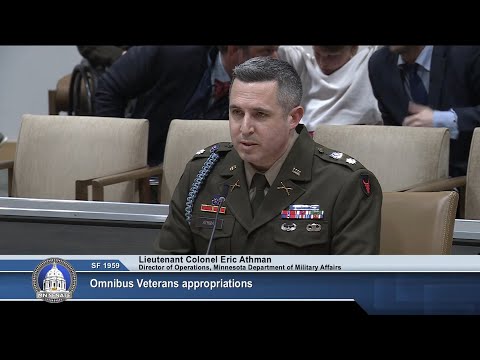
Lieutenant Colonel Eric Athman, director of operations for the Department of Military Affairs, told the committee he supported the bond limit increase and the operating adjustments in SF 1959 but noted several DMA requests were not included in the amendment. "This is the adjutant general's number 1 priority, to continue to support our service members," Athman said, referring to a request for additional enlistment-incentive funding that was not included in the current draft. Athman also listed three items the agency sought but that were not adopted: a $2 million increase for FY2026 and $6 million for FY2027 for enlistment incentives; a one-time $800,000 increase for a holistic health and fitness program in FY2026; and increases for cyber coordination (roughly $353,026 and $395,000 in FY2027). The committee's change-item spreadsheet (A2) showed the chair's recommended amendments totaling $40,958,000 for the budget biennium and $53,744,000 for the tails biennium.
Accreditation and consumer protection debate Testimony at the hearing focused heavily on reintroducing accreditation into the bill to curb companies that charge veterans for initial claims assistance without VA accreditation. John Blomstrom, manager of government relations and public affairs for Veterans Guardian, said his organization supported the bill as drafted but warned that adding accreditation language back in would raise legal issues for some private firms; he also cited a recent federal court development affecting similar challenges.
Multiple county veteran service officers and veterans' organizations supported accreditation and additional penalties. Barry Hendrickson, legislative chair for the Department of Minnesota, Veterans of Foreign Wars, told the committee: "Cracking down on predatory claim companies is the number 1 priority of the Veterans of Foreign Wars." Trent Dilkes, legislative director for Disabled American Veterans, said requiring accreditation was not an impermissible limit on choice: "We want to limit the option to choose fraud," he said. Michael McLaughlin, a county veteran service officer and national legislative director for the National Association of County Veterans Service Officers, described accreditation as providing "a baseline of training, continuing education, and ... ethical representation." County officers described cases they said illustrated harm—signed fees, unnecessary medical opinions, and repetitive appeals that burden veterans and the VA claims system.
Opposition and legal concerns Some senators raised questions about possible legal challenges and whether state-level penalties overlap with federal law. Senator Anderson asked where veterans would turn if the VA initially denied a claim and fewer private attorneys were willing to take cases; supporters said the amendment contains language intended to make it easier for attorneys to practice in Minnesota and that accreditation is already the federal standard for representatives who assist veterans. Senator Putnam responded to concerns about litigation by noting one federal court had remanded a challenge and by stressing the subcommittee's goal of creating enforceable state penalties and avenues for injunctions against bad actors.
Votes and next steps - A2 (delete-all change items and appropriations spreadsheet) was moved by Senator Putnam and adopted by the committee (voice vote), placing the chair's budget changes into the bill. - The A4 amendment, reintroducing accreditation and updated disclosure and penalty provisions, was offered by Senator Putnam and adopted on a roll call vote, 5–3. - Senator Putnam moved that Senate File 1959, as amended, be recommended to pass and be referred to the full committee on Agriculture, Broadband and Veterans Affairs; that motion carried on a roll call vote, 5–3.
Committee members and witnesses repeatedly urged follow-up work to refine enforcement language and to coordinate with federal authorities. The bill's next formal step is consideration by the full committee, where lawmakers may further amend SF 1959.
Ending Supporters told the subcommittee they hoped state action would reduce veteran exploitation now, rather than wait for federal changes. "The choice to be exploited is not a real choice," Senator Putnam said when offering the amendment. Several county veteran service officers urged the subcommittee to adopt standards they said would increase successful outcomes for veterans seeking benefits. The full committee will now consider SF 1959 as amended.