Get Full Government Meeting Transcripts, Videos, & Alerts Forever!
Get email alerts on the Agriculture Budget topic
No spam. Unsubscribe anytime.
Senate committee reviews agriculture budget bill, adds funding for animal health, meat inspection and farm programs
Summary
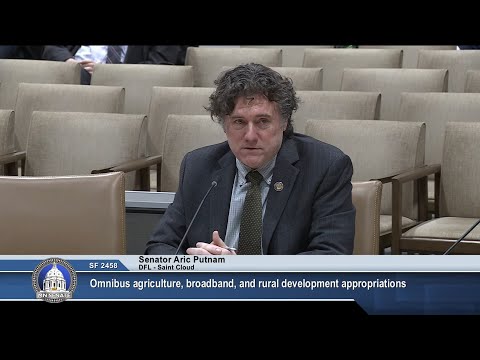
The Minnesota Senate Committee on Agriculture, Veterans, Broadband and Rural Development reviewed the A3 delete‑everything amendment to Senate File 2458, detailing change items that shift funds for animal disease response, meat inspection, farm‑to‑school and other farm programs while trimming several grant lines to meet targets.
The Minnesota Senate Committee on Agriculture, Veterans, Broadband and Rural Development on an amendment to Senate File 2458 reviewed a detailed fiscal spreadsheet and discussed change items that would shift and add state funding for the Minnesota Department of Agriculture (MDA), the Board of Animal Health and the Agriculture Utilization Research Institute (AURI).
The committee’s staff said the committee’s base general‑fund budget for MDA, the Board of Animal Health and AURI is $151,786,000 per biennium. Staff described a target savings of $313,000 for fiscal years 2026–27 and new “tails” spending of $2,928,000 for fiscal years 2028–29 under the DE amendment before the panel.
The amendment includes a mix of added spending and reductions. Major change items summarized by committee fiscal staff include: $100,000 each biennium for wolf depredation compensation and $100,000 for elk crop damage compensation (both tied to Senate File 469 proposals); an agency operating adjustment of $1,344,000 in 2026–27 and $1,848,000 in the tails; a climate coordinator position reclassification with offsetting savings; $702,000 in 2026–27 and $900,000 in 2028–29 for expanded meat inspection; $250,000 one‑time in FY2026 for avian influenza protect grants; an increase of $300,000 per biennium for Farm to School and early care grants; and targeted reductions including a $3,000,000 cut to green fertilizer grants and reductions to biofuel incentive and infrastructure grant lines.
Board of Animal Health and AURI operating adjustments also appear: staff listed $617,000 in new spending for the Board of Animal Health in 2026–27 and $742,000 in the tails (noting this is $250,000 above the governor’s recommendation), and $136,000 in 2026–27 and $182,000 in the tails for AURI.
Non‑general‑fund changes were also discussed: a proposed $900,000 per biennium increase tied to the grain license fee, and a multi‑million dollar food licensing modernization change item that shows corresponding revenue and expenditure entries in the ag fund.
Deputy Commissioner Andrea Vavil of the Minnesota Department of Agriculture testified in support of the package, saying the department is “so grateful” that the amendment includes operating adjustments and emergency response funding and listing meat inspection, wolf and elk depredation payments, farm‑to‑school and farm safety as priorities. Hunter Peterson of the Minnesota Farm Bureau Federation and Stu Lohrey of the Minnesota Farmers Union both testified in favor of the amendment, emphasizing animal‑disease response, meat inspection staffing and programs that expand market access for farmers. Environmental and local‑food advocates including Peter Lafontaine (Friends of the Mississippi River), Laura Schreiber (Land Stewardship Project) and Carly Griffith (Minnesota Center for Environmental Advocacy) offered support for research and local‑food programs and urged reconsideration or restoration of some omitted items (for example, a grant program for continuous living cover/novel crops and private‑well nitrate mitigation funding).
Committee staff said the DE amendment meets the committee target while reallocating funding toward protection services, emergency response and meat inspection, along with investments in market access and local food. Multiple testifiers urged the panel to protect or restore dedicated AGRI account funding and certain grant lines as the bill proceeds through conference and further markup.
The committee did not take final action on Senate File 2458 at this meeting; staff and members said a markup and amendment work session is scheduled for Friday.
Ending: The committee moved to public testimony on related items after the staff walkthrough and scheduled continued markup and amendment work at a future session.