Get Full Government Meeting Transcripts, Videos, & Alerts Forever!
Get email alerts on the Human Services Policy Omnibus topic
No spam. Unsubscribe anytime.
Committee amends and advances large policy omnibus after marathon hearing on assisted living, DCT, MN Choices and waiver redesign
Summary
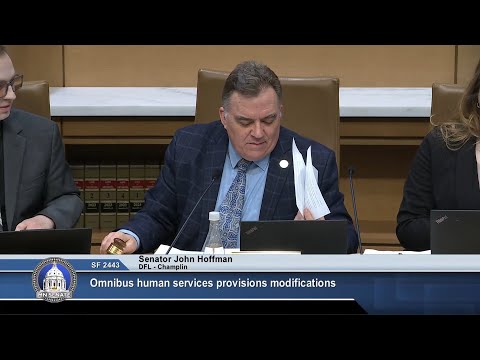
After extended debate, the Senate human services committee amended and recommended a large policy omnibus (Senate File 24 43, A5 package) that included changes affecting assisted living, DCT placement rules, MNChoices assessments and a waiver redesign advisory process.
The Minnesota Senate human services committee spent an extended session debating a sprawling policy omnibus (Senate File 24 43 and the chair's A5 amendment package) that bundled changes across assisted living, long-term care, home- and community-based services, direct care and treatment (DCT), substance-use treatment and other areas. After multiple witness panels, amendment votes and substantial debate, the committee adopted a series of amendments and recommended the bill to pass as amended and to be placed on general orders.
What the omnibus covers (high level): Committee staff described the A5 amendment as the chair's compilation of many policy proposals and technical fixes. Key topics included: spatial-separation requirements and setback rules for new licensed residential programs and small assisted living facilities; nursing-home reimbursement technical changes; assisted-living staffing/assessment rules and qualifications for comprehensive assessments; modifications to day services and DCT procedures; and substance-use disorder service provisions. The chair's office said members should "read it" because it contained many sections derived from multiple Senate files and agency proposals.
Major debates and outcomes - Spatial separation (quarter-mile / 1320-foot rules): Local officials and disability advocates clashed over proposed expansion of proximity rules that would limit where new residential programs and small assisted-living homes can operate. Josh Berg (city council member and housing nonprofit leader) urged striking or narrowing the statutory separation rule, calling it discriminatory and legally risky. After discussion, Senator Maquade offered an oral amendment to delete two sections (article 1, section 1; article 2, section 25) that would have expanded the proximity limits; the committee approved the deletions.
- DCT 48-hour rule and capacity: Members debated whether to extend or modify a temporary "48-hour" requirement about medically appropriate placements for people in need of DCT care. County and provider representatives warned the system lacks capacity; county witnesses urged abbreviated reassessments and other administrative changes to improve throughput. Some senators argued the sunset/extension must be paired with funding to expand DCT capacity. The committee discussed moving the 48-hour-rule language into the finance process; Senator Rasmussen and others urged linking any policy change to concurrent budget commitments. An author's amendment (A11) that would move the 48-hour rule debate to the budget process was discussed and ultimately the committee retained the language but agreed to continue finance-level conversations.
- MNChoices / waiver reassessment changes: Counties and advocates described long delays completing MNChoices assessments. The committee adopted technical language to allow abbreviated reassessments in specified sequences, remote reassessments in specific cases and verbal attestation for signatures for remote assessments. The A6 amendment (technical DHS/ county language) was adopted in committee.
- Assisted living: Lawmakers debated a range of assisted-living provisions: permitted uses of restraints, requirements for resident assessments, and protections regarding resident guardianship and contract termination when someone moves from private pay to public payment. Consumer advocates urged new rules on restraints and protections from retaliation; providers expressed concern that some provisions would add unfunded mandates. The committee accepted several chair- and sponsor-proposed technical amendments and agreed to continue to work on contested assisted-living provisions before floor action.
- Restraints and resident protections: Advocates urged clearer statutory rules restricting or permitting emergency restraint use and requiring documentation; the committee left those provisions in the package but signaled continued interagency work and stakeholder negotiation.
- Waiver redesign / "waiver reimagine": The committee adopted an amendment creating an advisory process for waiver redesign (A17), charging a reimagining body to coordinate participants and report to the Legislature. Sponsors said the amendment gives the advisory group clear authority to produce a plan and requires DHS to implement agreed-upon elements within existing resources while follow-up budget work proceeds.
Procedural steps and amendments: The committee adopted the chair's A5 policy amendment as amended, accepted technical changes (A7), updated SUD language to match the other body (A8), added a historic-variance amendment for certain nursing/assisted facilities on the National Register (A15), and adopted waiver-reimagine (A17) and MNChoices technical changes (A6). Several other amendments were withdrawn by their sponsors after stakeholder talks. One line-item amendment (A12) that would have required two-hour fire barriers generated a tie vote and did not pass.
Committee action: Senator Utke moved that Senate File 24 43 be recommended to pass as amended and placed on general orders, with staff authorized to make technical fixes; the committee approved that motion by voice vote.
Why it matters: The omnibus bundles many program-level changes that affect county processes (MNChoices), facility licensing and design, DCT placement rules and substance-use regulations. Several provisions depend on implementation details and budget decisions, and committee members repeatedly noted the need to tie policy changes to finance decisions to avoid unfunded mandates or unintended outcomes.
Next steps: The bill as amended will move forward to the Senate's general orders (floor docket). Committee members and authors committed to ongoing stakeholder work to refine contested provisions before floor consideration and any conference negotiations.