Get Full Government Meeting Transcripts, Videos, & Alerts Forever!
Get email alerts on the Cannabis Policy topic
No spam. Unsubscribe anytime.
House Commerce Committee hears omnibus cannabis bill; debate centers on testing, hemp beverages and CBD rules
Summary
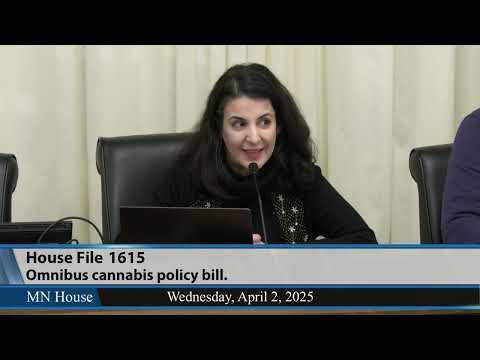
At a House Commerce Committee hearing on House File 1615 (DE), lawmakers and stakeholders reviewed an omnibus cannabis policy bill that would revise medical cannabis rules, establish a licensing variance for testing facilities, and change hemp licensing and labeling for low‑potency hemp beverages.
At a House Commerce Committee hearing on House File 1615 (DE), lawmakers and stakeholders reviewed an omnibus cannabis policy bill that would revise medical cannabis rules, establish a licensing variance for testing facilities, and change hemp licensing and labeling for low‑potency hemp beverages. Committee chairs said member questions and final consideration of the DE amendment will occur at a meeting tomorrow.
The bill is divided into three articles, Ben Johnson of House Research told the committee: Article 1 addresses medical cannabis provisions and changes to statutes in Chapter 152 and Chapter 342 related to visiting patients and tribal medical programs; Article 2 makes technical fixes to licensing and creates a variance so testing laboratories may operate while pursuing accreditation; and Article 3 updates hemp business regulations, including a new lower‑potency hemp wholesaler license and changes to beverage serving‑size language.
"House file 16 15 DE is divided into 3 articles," Ben Johnson, House Research, said in a high‑level walkthrough. On testing labs, Johnson said the DE includes language to allow the office to "grant a variance to testing facilities when the testing facility makes certain demonstrations that they are in the process of achieving accreditation." The provision is intended to avoid a mismatch between licensing and accreditation timelines.
Eric Taubel, interim director of the Office of Cannabis Management, told the committee the agency proposes a set of targeted changes to reduce administrative barriers and to support market launch. "We have 4 giant buckets that are relatively narrow in terms of what they're trying to accomplish," Taubel said, naming licensing rollout, application adjustments (including removing a two‑signature corporate requirement), continuity for the medical program (including expanded telehealth access and strengthened patient protections), and hemp licensing launch tweaks to avoid delays.
Stakeholders who testified focused heavily on hemp beverage labeling and the regulation of nonintoxicating cannabinoids (CBD). Glenn McElfresh, cofounder of PLIFT and board member of the Hemp Beverage Alliance, urged the committee to adopt DE language allowing a 10‑milligram can to be labeled as a single 10‑mg serving so Minnesota products can remain compatible with other states' rules. McElfresh said some brands are avoiding Minnesota because Minnesota requires multi‑serving labeling for 10 mg cans while other states do not. "Minnesota set the stage for what a hemp beverage regulatory framework should look like," McElfresh said, and he urged the change so Minnesota businesses can export products and so out‑of‑state brands can compete.
Advocates for patients and small businesses also spoke. Laylee Fatahee of the Minnesota Cannabis and Drug Policy Resource Center (MINCAN) said the organization supports many DE provisions but urged additional changes: tie adult patients' dosing plans to registry profiles to avoid repeated pharmacist consultations; extend civil and criminal protections now limited to registry patients to all visiting patients; reconsider the proposed $10,000 wholesaler license and renewal fee for the new lower‑potency hemp wholesaler as "prohibitively high" for small and rural operators; and preserve delivery and medical market access for micro and mezzo licensees if supply chain unification proceeds.
Small business owners expressed concern that tighter limits on nonintoxicating cannabinoids or an onerous wholesaler fee could push customers to buy unvetted products online and harm community retailers. "The majority of the products that Just Naturals offers are not intoxicating and we do not sell any smokeable products," said Patty Gilk, owner of Just Natural CBD Wellness, who said many customers are seniors who would not want to enter a recreational dispensary. Jeff Taylor, a local manufacturer, told the committee, "CBD actually does not get you high," and argued that some CBD limits are unnecessary. Ben Lipkin, founder of Northstar Hemp, said the proposed oral CBD limits risk driving consumers online and harming small businesses.
Committee members did not take action on the DE at the hearing. A staff member announced that "member questions and final adoption and consideration of the DE will occur at tomorrow's meeting," and chairs asked members to place the DE in their packets for that next session.
The hearing included technical descriptions of which prior bills' provisions were folded into the DE (House files referenced in committee discussion include HF1672, HF1877, HF1310, HF1734, HF1634, HF1271 and others), and multiple witnesses asked for clarifications or fee reductions before final adoption. The committee did not vote on any motions during this hearing.
Committee chairs indicated they will take up member questions and a final vote at the committee's next meeting, when the DE will be available for members to review in advance.