Get Full Government Meeting Transcripts, Videos, & Alerts Forever!
Get email alerts on the Legacy Funding topic
No spam. Unsubscribe anytime.
Legacy Finance Committee holds informational hearing on cultural, heritage and community funding requests
Summary
The Legacy Finance Committee conducted an informational hearing on roughly 13 funding requests from cultural organizations and local governments seeking appropriations from the Arts and Cultural Heritage Fund and related legacy accounts. No policy votes were taken on the bills; the committee approved minutes by voice vote.
The Legacy Finance Committee met for an informational hearing on multiple cultural and heritage funding requests, hearing testimony on projects ranging from community arts festivals and museum proposals to historical preservation and oral-history projects. Committee co-chairs opened the hearing noting it was informational and that no motions would be taken on the bills during today’s session.
Committee members heard brief presentations and public testimony on approximately 13 proposals including requests to fund Sweet Potato Comfort Pie’s community events, an interpretive trail in Dakota County, a Minnesota Latino arts and museum effort, Hmong veteran oral-history preservation, Hmong cultural programming, a Moorhead cultural pop-up program, a statewide community festival grant program (including Rondo Days), cultural corridor work in North Minneapolis (Camden Town/40th Avenue), Capitol Mall site improvements, a Minnesota Youth Poet Laureate program, celebration funding for the city of Osseo’s 150th anniversary, and support for ACER (African Career Education and Resources) and partnering organizations. Committee members repeatedly emphasized the informational nature of the hearing and asked presenters to keep remarks short so many groups could be heard.
Why it matters: The proposals request legacy or arts-and-culture funding to sustain cultural programming, preserve stories and artifacts, and create public-facing civic spaces. Several presenters stressed urgency for oral-history projects (aging veterans), broad community reach (markets, festivals, and statewide youth programs), and the role of these efforts in economic and cultural vitality.
Key details and requests
- Sweet Potato Comfort Pie (Rep. Feiber): Rose McGee, founder and director, and Nyla Abare, board chair, described a community program centered on Martin Luther King Jr. Day events and cultural theater that has engaged volunteers and made thousands of pies as gifts; they sought committee support for House File 1721 (no appropriation amount specified in testimony). McGee said, “Sweet Potato Comfort Pie may sound a little frivolous, but it is in fact very serious,” and described the program’s volunteer base and statewide draw.
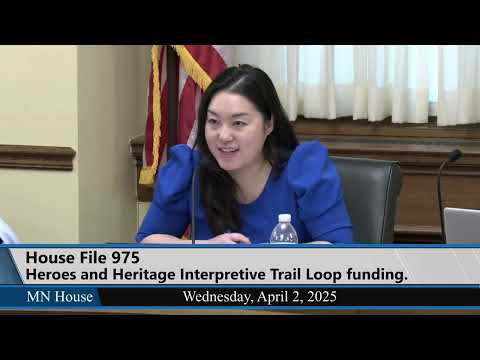
- Heroes and Heritage Interpretive Trail Loop (Rep. Cardi / Commissioner Joe Atkins): Commissioner Joe Atkins asked for $318,000 to create 23 interpretive nodes along an existing 23-mile trail in Dakota County with multi-language and accessible signage and audio; Atkins said planning is complete and the Dakota County Historical Society would be the grant recipient.
- Minnesota Latino arts and museum initiatives (Rep. Perez Vega / Erin Johnson Ortiz Aron): House File 1116 requests $250,000 in each of FY 2026 and FY 2027 from the Arts and Cultural Heritage Fund to expand Latino arts programming, support artists’ professional development and statewide events tied to a planned Minnesota Latino Museum and touring exhibits.
- Hmong veterans oral-history preservation (Rep. Jay/Sean; SGU Veterans & Families): Representatives and testifiers described the urgency of recording Hmong veterans’ accounts of the U.S.-backed “secret war” in Laos. Testimony noted prior work documenting 73 stories and that roughly 400 Hmong veterans remain in Minnesota; a named bill was discussed (cross-referenced to SF 1576 in testimony), but an appropriation amount was not specified in the committee record.
- United Hmong Family (Rep. Jay/Sean): House File 1899 requests $350,000 from legacy funds to support the Hmong New Year cultural programming and an annual dance competition; testifiers said their recent event drew tens of thousands of attendees and demand is growing.
- International/visitors grants concept (Rep. Lilly): A developing concept to provide $50,000–$100,000 in small grants to support visits by underrepresented cultural groups (conceptual program; amounts and structure described as provisional and subject to further development).
- Moorhead Cultural Pop-up (Rep. Hussain / Immigrant Development Center): Testimony requested $500,000 for an operational “cultural mall without walls” created through monthly global markets and partnership with city and local organizations; presenters emphasized regional reach and downtown activation.
- Statewide community festival grant program (Rep. Hussain): A proposal to create a festival grant program administered through the Minnesota Humanities Center (testimony referenced $1,250,000 to the Humanities Center to run the program) to support festivals such as Rondo Days and other cultural celebrations, citing high local costs for security and operations.
- Camden Town / 40th Avenue corridor cultural hub (Rep. Lee / Mixtape Strategies): Testimony described plans to develop an alleyway cultural hub for North Minneapolis focused on arts, music and place-making; testimony emphasized anti-displacement aims but did not specify an appropriation amount during the hearing.
- Capitol Mall improvements (Rep. Cleaver / House File request): Representative Cleaver described a request of $750,000 from the Arts and Cultural Heritage Fund for campus improvements on the Capitol Mall: $400,000 for trees, $200,000 for benches, and $150,000 for signage/wayfinding; language would allow remaining funds to be reallocated among those items if costs differ.
- Minnesota Youth Poet Laureate (Rep. Sansemera / HF 2979): A $100,000-per-year scalable request to establish a Minnesota Youth Poet Laureate program in partnership with the National Youth Poet Laureate organization; presenters described how the program identifies young poets who then receive mentoring and statewide civic-engagement opportunities.
- Osseo 150th commemoration (Rep. Hiltzley / HF 3019): Testimony from Osseo representatives requested funding to publish a community history, host events, and support programming tied to the city’s 150th anniversary; specific appropriation amounts were not specified in the hearing record.
- ACER and African heritage programming (Rep. Hiltzley / HF 2508): ACER (African Career Education and Resources) asked for $500,000 across two years to support culturally grounded programming, partner with smaller African community nonprofits, and expand outreach and workforce/mental-health supports for African immigrant communities in Minnesota.
Procedural action taken
The committee took one formal procedural action during the hearing: the minutes were moved for approval, and the committee approved the minutes by voice vote. Representative Heintzeman moved approval; the motion carried by voice vote and no roll-call tally was recorded in the transcript.
What the hearing did not do
This hearing was explicitly informational; no committee votes on the bills themselves were taken today. Presenters were advised that questions and testimony would be brief and that formal decision-making would occur later in the process.
Next steps and context
Committee members repeatedly noted the competing priorities for legacy funds and the usual grant-making pathways (for example, grants routed through agencies such as the Minnesota Historical Society or State Arts Board). Members flagged the need for due diligence on project readiness, maintenance plans for capital projects, and alternatives where other funding sources (including competitive grants or bonding) might be appropriate. Several presenters stressed urgency (particularly for oral-history projects) and regional impact for programs outside the Twin Cities.
Ending note: The hearing gave committee members a wide view of community-driven cultural and heritage requests across Minnesota. As an informational hearing, it enabled members to ask clarifying questions and to hear from numerous communities; any appropriation, prioritization or formal vote will occur in subsequent committee work and in omnibus or bonding proposals.