Get Full Government Meeting Transcripts, Videos, & Alerts Forever!
Get email alerts on the Elections topic
No spam. Unsubscribe anytime.
House committee approves amended elections package; proposed anti‑lottery amendment fails on tie
Summary
The Minnesota House Elections Committee voted to send House File 1378, as amended, to the General Register after adopting a manager amendment and several technical fixes.
The Minnesota House Elections Committee voted to send House File 1378, as amended, to the General Register after adopting a manager amendment and several technical fixes, committee chairs announced at the close of the hearing.
The measure — described to the committee as a vehicle bill combining multiple election‑administration provisions — was approved after the committee adopted the DE5 manager amendment, which the author said incorporated provisions from several other House files including measures on temporary polling location publication, absentee voting, polling‑place closure notices, and special‑election filing periods.
The DE5 amendment and two technical amendments (A6 and A8) were adopted in committee. Witnesses and state officials who testified praised many of the bill’s changes but urged modifications to implementation timelines and system requirements.
Michael Stahlberger, director of property and environmental resources for Blue Earth County, testifying on behalf of the Minnesota Association of County Officers, said the bill removes the permanent absentee‑ballot request box from the Election Day registration form and adds an absentee‑application deadline that the association supports. “This will help streamline some of our Election Day activities,” Stahlberger said, adding that a seven‑day absentee‑application deadline would “help with the excessive workload that occurs right before the elections” and improve service to voters.
Stahlberger also called for adjustments to several implementation details. He said the proposal that would allow cities delegated by counties to limit the period they administer absentee voting raised concerns if a city could unilaterally opt out without discussion with the county elections administrator. He asked for a longer lead time for the initial statewide chain‑of‑custody plans so the first required plan could be timed to the 2026 election cycle, and requested the college student housing list used for early voting be shared earlier than the bill’s proposed 20 days before the election to allow local officials time to process and match addresses to precincts.
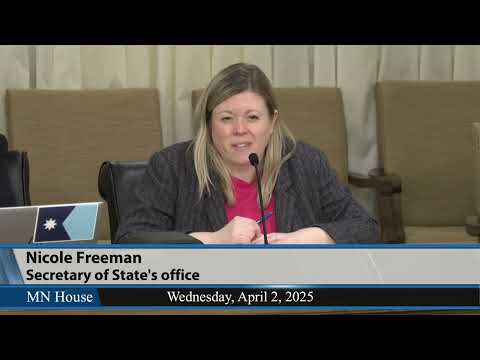
Nicole Freeman of the Office of the Secretary of State told the committee the bill “continues to support the balance of access for voters with the needs of election security,” and singled out a number of technical changes the office supports, including clarifying procedures for opening and retaining ballot envelopes and formalizing chain‑of‑custody planning. Freeman said the office prefers a five‑day cutoff for some absentee‑application receipt deadlines (rather than seven days) and asked the committee to continue discussions about whether requiring additional data fields in the statewide voter system is feasible within the bill’s timetable.
Committee debate also included an unsuccessful effort to add an amendment that would have explicitly banned offering a chance to win goods or money to induce someone to register or vote. Representative Greenman offered the amendment (A3), describing it as a clarification of existing law against bribing or inducing voters and citing recent out‑of‑state examples of lotteries used to encourage political participation. The amendment went to a roll call and the chair declared the result a 6‑6 tie; under committee rules the tie caused the motion to fail.
Representative Coulter offered an amendment (A5) clarifying lobbying definitions and exempting certain local staff communications; that amendment likewise went to a roll call and failed on a 6‑6 tie. Another amendment (A4) the author said would not be offered in committee and may be pursued on the House floor.
The committee’s final voice vote approved the bill as amended and sent House File 1378 to the General Register. Committee members who praised the bill emphasized its mixture of technical clean‑ups and operational changes; those expressing reservations sought clearer transition timelines, more precise data and system specifications, and safeguards to avoid unintended effects on voter access.
The bill package as described to the committee incorporates provisions from multiple House files (named during the hearing) and includes adjustments to absentee‑ballot processing, ballot signature and envelope procedures, candidate filing windows for certain local offices, and chain‑of‑custody planning for ballots and equipment. Several witnesses asked that specific provisions that apply to cities also be extended to townships and school districts where applicable.
The committee hearing included a mix of voice and roll‑call votes; the transcript records the DE5 manager amendment and the A6 and A8 technical amendments as adopted by voice, and records the A3 and A5 amendments failing on 6‑6 ties. The committee clerk will publish the official roll‑call records for the amendments that requested recorded votes and for the final disposition of the bill on the committee’s webpage and in the House Journal.