Get Full Government Meeting Transcripts, Videos, & Alerts Forever!
Get email alerts on the Iron Range Unemployment And Mining Permits topic
No spam. Unsubscribe anytime.
Committee hears Iron Range bill combining UI extension with mine permitting changes; moves to ways-and-means tied and laid on table
Summary
Lawmakers and union leaders urged an unemployment insurance extension for Iron Range workers affected by recent Cleveland-Cliffs layoffs while the bill’s environmental permitting provisions prompted agency concerns and member debate. The committee tied on a motion to advance the bill and laid it on the table.
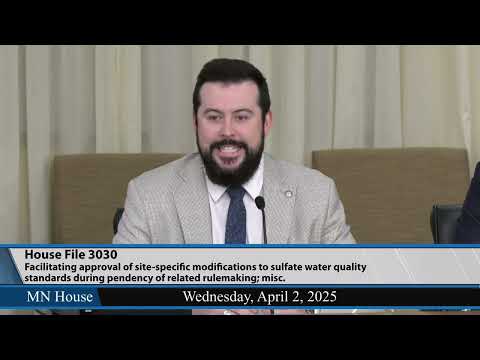
The House Workforce, Labor, Economic Development and Policy Committee on April 2 heard House File 3030, a three-article bill that would extend unemployment insurance for miners laid off after Cleveland-Cliffs’ recent action and add statutory direction for site-specific sulfide standards and rules for safe storage of reactive mine waste.
Committee members and a long line of union and local officials testified that the UI extension is urgent for workers and their communities. “This is a bill of hope for our community,” said Al King, president of Local 6115, Menoka, who testified that his local faced potential layoffs of roughly 300 people. Representative Spencer Igoe, the bill’s author, told the committee the UI extension would provide “an additional 26 weeks” after current benefits run out, and that the bill’s additional articles are intended to preserve long-term mining jobs on the Iron Range.
The bill drew pushback over Articles 2 and 3, which direct the Minnesota Pollution Control Agency (MPCA) to undertake rulemaking and establish a process for site-specific sulfide standards. Tom Johnson, Government Relations Director for the MPCA, said the agency could not complete a fiscal note in time and that the section charging the MPCA with rulemaking “would have a significant cost” because the agency must start from scratch; the MPCA’s prior rule effort was disapproved by an administrative law judge in 2017. Chair discussions and several members emphasized that the environmental-policy material falls outside the committee’s usual jurisdiction.
Testimony and questions
Union representatives, local elected officials and tribal community members urged passage. John Arbogast, United Steelworkers District 11 staff representative, said management moves at multiple taconite facilities suggested some shutdowns could be long-term and described operations that had been reduced from multiple lines to a single line. “This is the most important thing in my 30 years as a miner. We need to save the Iron Range,” Arbogast said.
Kathy Chavers, a retired tribal chairwoman from Bois Forte Band of Chippewa, said she supported the UI extension and urged tribal consultation on permitting changes. Saint Louis County Commissioner and retired steelworker Mike Jugovich warned of ripple effects, saying each mine job supports roughly three service-sector jobs.
Agency concerns and jurisdiction
The MPCA’s Tom Johnson told the committee the agency recognizes the issue’s importance but recommended the environmental portions be discussed in the Environment, Natural Resources, Finance and Policy Committee, noting the bill’s direction to complete rulemaking would constitute “a new, brand new rule effort” with significant resource needs. Some committee members echoed that the environmental work should go through the committee with direct jurisdiction over natural resources and permitting.
Committee action
Representative Pete Johnson moved an amendment (DE1) to strike Articles 2 and 3 and leave a “clean” UI extension. The sponsor and Range-area authors opposed splitting the measures. The committee held a roll call on DE1; the amendment failed on a tie and was not adopted. A subsequent roll-call motion to move House File 3030, as amended, to Ways and Means resulted in a tie; the chair announced the bill would be laid on the table for further consideration.
Why it matters
Supporters said the combination of immediate UI relief and near-term steps on permitting are necessary to keep workers and communities intact. Opponents and several members said the environmental provisions raise complex regulatory and fiscal questions that should be vetted by the environment committee and by agencies and stakeholders in separate hearings.
What’s next
Committee members and the bill’s authors said they would pursue additional hearings with relevant committees and agencies to answer fiscal and technical questions. Representative Pinto noted a separate bill carrying a UI extension was scheduled for the next day’s agenda, and members signaled intent to pursue a path to provide benefits while continuing work on long-term permitting issues.