Get Full Government Meeting Transcripts, Videos, & Alerts Forever!
Get email alerts on the Governor Tax Bill House File 2437 topic
No spam. Unsubscribe anytime.
House Taxes Committee moves Gov. Walz tax bill forward after amendment
Summary
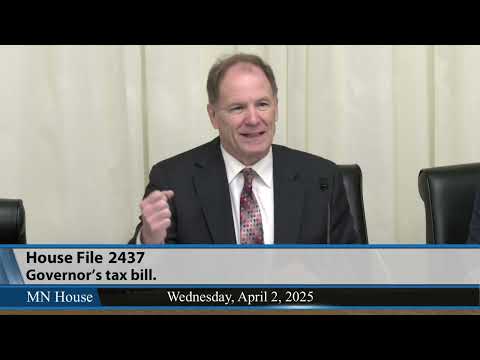
The Minnesota House Taxes Committee on 2025-03-25 advanced Governor Tim Walz’s tax bill, House File 2437, after adopting an amendment and moving the bill out of committee by voice vote.
Saint Paul — The Minnesota House Taxes Committee on 2025-03-25 advanced Governor Tim Walz’s tax bill, House File 2437, after adopting an amendment and moving the bill out of committee by voice vote.
The bill as presented combines multiple tax and revenue changes in the governor’s budget. Commissioner Paul Marquardt, commissioner of the Minnesota Department of Revenue, told the committee the proposal is “a responsible and practical tax bill” that aims to create a “fair and stable tax system” while supporting economic development.
Why it matters: The package would change how the state raises revenue and how certain programs are funded. Major provisions heard at the committee include an expansion of the state sales tax to selected professional and personal services, a 25% refundable provision for the research and development tax credit, reductions in Payments in Lieu of Taxes (PILT), changes to the Sustainable Forest Incentive Act (SFIA) payments, and administrative changes such as modifying the renter’s-credit certificate-of-rent-paid process.
Key provisions described to the committee
- Sales tax expansion and modest rate cut: The governor’s proposal lowers the statewide base sales tax rate by 0.075 percentage point while expanding the taxable base to include selected services such as accounting, legal services, banking fees, and certain professional services. Commissioner Marquardt said the proposal aims to “right-size” the sales tax to a more service-oriented economy and lower the base rate to make the tax “less regressive.” He presented department estimates showing a first full fiscal year (FY27) impact of a $99 million revenue reduction from the rate cut and a $215 million increase from the service expansion, producing a net revenue increase in the initial year tied to the expanded base.
- Research & development credit: The bill would make up to 25% of the state R&D tax credit refundable when a credit exceeds a taxpayer’s liability, the commissioner said. The Department of Revenue estimate presented to the committee characterized the credit as about a $20 million annual tax cut under the proposal and said it would benefit roughly 500 corporations and about 100 pass-through entities. Supporters described the refundable feature as a tool to encourage investment and job creation.
- PILT and local aids: The governor’s package includes a 34% reduction in the state’s Payments in Lieu of Taxes (PILT), moving annual PILT from roughly $48 million to about $31 million — returning the program to roughly 2015 funding levels, according to testimony. County officials and associations warned the committee the cut would disproportionately affect northern and rural counties that have large shares of tax-exempt public land.
- Sustainable Forest Incentive Act (SFIA): The bill would reduce incentive payments under SFIA and allow enrolled landowners to withdraw from covenants without penalty before a stated date. Forest-industry representatives and conservation groups told the committee they fear the changes would undercut private owner participation and the long-term protection of forest land used for carbon sequestration, recreation and timber.
- Renters’ credit and certificate-of-rent-paid: The proposal changes administration of the renters’ credit process and the certificate of rent paid. The bill moves some elements of the existing refund-credit structure and rebalances penalties so the Department of Revenue would receive more electronic certificates to validate renter claims, proponents said.
Public testimony and concerns
Witnesses for and against the sales-tax expansion focused on how it would affect access to essential services, administrative complexity, and competitiveness.
- Financial planners and industry groups urged rejection of a sales tax on professional financial advice. Kyle Playford of the Financial Planning Association of Minnesota said, “The Minnesota chapter of the Financial Planning Association strongly opposes the proposed sales tax on professional services, including financial planning.” He warned the tax would raise costs for families who rely on advice to plan retirement and savings.
- Bank and business groups urged greater clarity and more time to comply. Gail Mikolic, chief operating officer of Northeast Bank and testifying for the Minnesota Bankers Association, told members that “this bill does not make a distinction” between fees for optional services and fees that are part of essential banking relationships, and that banks lack the sales-tax software connections required to collect the new tax by the proposed effective date of Sept. 30, 2025.
- Legal and bar association testimony highlighted equity concerns. Brian Lake of the Minnesota State Bar Association said taxing consumer legal services would fall most heavily on people seeking protection orders, eviction defense, or help with family-law and employment disputes and would disadvantage under-resourced litigants in so-called David-versus-Goliath cases.
- Local governments and counties warned about fiscal stress. Matt Hilgert of the Association of Minnesota Counties and Nathan Jessen of the Minnesota Intercounty Association emphasized the cumulative effect of multiple proposals on county levies. Ryan Perbananzie, representing Carlton County, said the PILT reduction would cost his county “probably upwards of $200,000,” and cautioned that smaller northern counties could face substantial local tax pressure.
- Support for selected items: Business groups and the Minnesota Business Partnership supported the R&D refundability, with Gavin Hansen calling the refundable element a way to “reaffirm our state’s role as a national leader in innovation.” The Minnesota Chamber also endorsed the refundable R&D feature, citing potential long-term gains in firm formation and patents.
Committee action and next steps
Committee co-chairs moved House File 2437 and adopted a listed amendment (referred to during the hearing as the 820542 amendment). Members approved the motions by voice vote; there was no roll-call tally recorded in the transcript. The committee left the Department of Revenue staff in the room to take additional questions and indicated it would return to member questions after public testimony.
What committee members emphasized
Committee discussion noted competing priorities. Co-chair Gomez and other members expressed interest in targeting compliance and audit resources; the committee’s fiscal documents attached to the hearing show a governor’s proposal to fund additional audit staff within the Department of Revenue. Several members pressed for more detail on fiscal estimates, including how the sales-tax expansion would interact with local sales taxes and legacy funds. County and conservation witnesses urged the committee to consider the cumulative effects of multiple shifts in state-local funding.
The bill will proceed to further committee consideration. Lawmakers did not complete detailed line-by-line votes on individual provisions during this hearing.
Ending
The committee advanced House File 2437 as amended. Members said they plan follow-up questioning of department staff and additional deliberations in subsequent hearings; no final enactment or appropriation occurred at this meeting.