Get Full Government Meeting Transcripts, Videos, & Alerts Forever!
Get email alerts on the Land Use topic
No spam. Unsubscribe anytime.
House committee lays over bill to stop cities from requiring planned unit developments
Summary
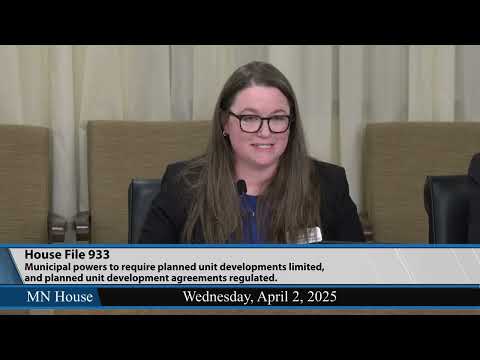
The House Committee on Housing Finance and Policy laid over House File 933 after testimony on a bill that would prevent municipalities from requiring planned unit development (PUD) agreements when a proposed residential project meets existing zoning.
The House Committee on Housing Finance and Policy laid over House File 933 after testimony on a bill that would bar municipalities from requiring planned unit development (PUD) agreements for residential projects that comply with existing zoning.
The measure, introduced in committee by Representative Nash, would prohibit a municipality from "require[ing] a planned unit development agreement in lieu of a proposed residential development, if the proposed residential development complies with the existing zoning ordinance already," Nash said. He described the bill as an effort "to make housing more available and affordable" by reducing duplicative processes cities sometimes impose.
The bill drew testimony from developers, municipal officials and a zoning attorney. Jacob Steen, an attorney and shareholder at Larkin Hoffman representing Housing First, told the committee PUDs are a flexibility tool that historically allowed negotiated deviations from base zoning, such as reduced setbacks or lot widths, in exchange for higher levels of amenity. "This bill is not intended to eliminate PUDs. It's still an important tool, but it's intended to give developers and landowners a choice of when they want to pursue a PUD," Steen said.
Representatives of local government described both uses and practical questions about the bill's language. Daniel Lightfoot of the League of Minnesota Cities said PUDs can enable mixed uses, higher density and affordability provisions, but he raised concerns about how the bill's language would work in practice because whether a proposed development "meets ordinance standards is usually determined in the application review itself," not before the PUD process begins. He also cited Minnesota Statutes section 462.358 as already governing preliminary plat approvals and rights-to-develop aspects of subdivisions.
Jennifer Monson, economic development manager for Maple Grove, said PUDs have helped her city deliver mixed-use and higher-density projects and gave Maple Grove's Rush Hollow as an example, a roughly 160-acre project that used a PUD to allow a range of lot sizes (about 50–80 feet), an 80-unit senior multifamily condominium and townhome units. Monson said the city has concerns about the practical requirement in the bill to post finalized PUD agreements in advance of council review because PUD contracts often undergo negotiation and lender review and are not typically finalized until just before construction.
Several committee members pressed on whether the bill would remove the ability to use PUDs; Representative Nash said it would not ban PUDs but would stop cities from making a PUD mandatory. Representative Mecklen asked whether cities ever attach unlawful terms or excessive exactions to PUD agreements; Steen replied such exactions sometimes exceed statutory authority and place developers in a difficult negotiating position.
Representative Nash moved the bill before the committee. After testimony and questions, the committee laid House File 933 over for possible inclusion, with no final enactment or referral taken at the hearing.
The hearing included municipal and developer stakeholders and multiple committee questions about drafting details and implementation. Committee members asked staff and testifiers to continue discussions on language that would avoid unintended consequences for both large and small cities.