Get Full Government Meeting Transcripts, Videos, & Alerts Forever!
Get email alerts on the Aviation Budget topic
No spam. Unsubscribe anytime.
Aviation seeks $564 million for FY26; $500 million capital push readies airports for 2026 events
Summary
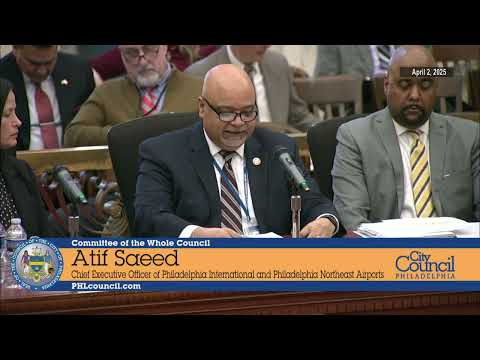
Atif Saeed, CEO of the Department of Aviation, outlined a $564,062,025 FY26 operating request, described a $500 million customer‑facing capital program tied to 2026 preparations, and highlighted airport economic‑impact figures and service growth.
Atif Saeed, chief executive officer of the City of Philadelphia’s Department of Aviation, told council the department’s fiscal year 2026 operating request is $564,062,025, a roughly 0.3% increase over FY25 estimated obligations, and that both Philadelphia International Airport (PHL) and Northeast Philadelphia Airport (PNE) operate as enterprise funds without general‑fund support.
Saeed said an updated 2023 economic‑impact study estimated the airport system generates roughly $18.7 billion annually for the regional economy, supports more than 102,000 regional jobs, and contributes about $119 million annually in tax revenues to the city. “We facilitate commerce within our four walls that makes businesses successful,” Saeed said.
Saeed and Appy Appalingam, the department’s chief development officer, described a $500 million capital program focused on customer‑facing terminal, landside and airfield projects intended to be largely completed before the 2026 events. Appalingam said the program includes a restroom renovation program (about $20 million to renovate roughly eight restroom sets and a custodial operations center), a $15 million SEPTA Airport Line platform modernization completed last fall, terminal refreshes across seven terminals, and nighttime rehab of the primary runway intended to conclude this summer.
Saeed said the capital plan is funded primarily by airline rates and charges under an agreement with carriers that increased capital commitments; he described the $500 million as a prioritized subset of a larger capital portfolio. Appalingam said the department is modernizing visible customer elements — painting, lighting, seating, flooring — and that three new restroom sets opened recently with five more scheduled through July.
Saeed described airport workforce and customer‑service investments such as PHL Works, a department‑wide program to elevate customer service, and a workforce development program to retain and upscale staff. He also described efforts to expand local vendor participation in concessions, noting 19 local businesses are currently featured and two more (Federal Donuts and Oyster House) planned to open.
On future aviation technology, Appalingam said the department has long‑term planning work identifying potential roof‑top locations for eVTOL (electric vertical takeoff and landing) facilities and reiterated that eVTOL operations would need to be independent of fixed‑wing operations and generally not interrupt existing taxiway/runway functions. Council members asked about equity opportunities for small‑business participation in the capital program and about human‑trafficking prevention work connected to large events; Saeed said the department has an action plan and named Cassie Schmidt as a strategy officer leading anti‑trafficking efforts during major events and pledged to provide written follow‑ups.
Ending: Aviation officials agreed to provide additional written breakdowns of the $500 million capital portfolio, minority participation statistics for recent bond financings when available, and a written plan on human‑trafficking prevention and workforce development tied to the 2026 schedule.