Get Full Government Meeting Transcripts, Videos, & Alerts Forever!
Get email alerts on the Election Policy topic
No spam. Unsubscribe anytime.
Ways and Means advances absentee-voting, election-plan and education bills; roll calls record mixed votes
Summary
The Ways and Means Committee on April 2 voted favorably on a package of election-law, education and tax-related bills, adopting subcommittee amendments on several measures and approving most bills as amended. Several bills drew specific debate on deepfakes, ballot drop boxes and absentee ballot notices.
The Ways and Means Committee held a voting session April 2 and approved a series of bills on election procedures, school policies and tax and benefit rules, adopting subcommittee amendments on many measures and recording roll-call votes on several items.
The committee approved changes to absentee-voting outreach and election planning, advanced a measure targeting election-related deepfakes, and passed bills on school device policies, GED testing in Spanish and enrollment rules for military dependents. Most measures passed “favorably as amended,” with recorded roll calls on a number of bills.
Committee action and context
Delegate Feldmark opened the session and moved amendments to Senate Bill 4, which alters the composition, powers and duties of the West North Avenue Development Authority and designates the authority as a body politic and corporate. The amendments were adopted and the bill passed favorably as amended.
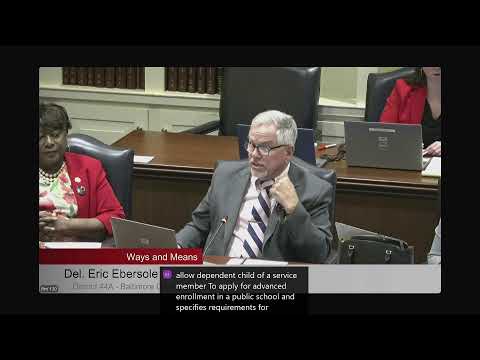
On election-law measures, Delegate Ebersole described Senate Bill 93 as requiring that “each local board of elections include a notice about how to request an absentee ballot application with the specimen or sample ballots and any other mailings to voters or eligible voters.” The committee adopted technical subcommittee amendments and approved the bill favorably as amended on a roll-call vote.
House Bill 201 (the House cross-file of Senate Bill 93, concerning sending absentee ballot applications before primary elections) was amended to conform to SB 93 and passed favorably as amended after a roll call.
Senate Bill 259, which revises local boards’ election-plan requirements and adds procedures for public notice and comment when a local board adopts an election plan, was amended in subcommittee to require that the Attorney General rather than the State Administrator review and approve ballot drop-box locations and to add provisions about geographic diversity of locations. The committee approved the amendments and passed SB 259 favorably as amended on a roll-call vote. A committee member asked whether moving review authority to the Attorney General was a change from the original text; the subcommittee amendment introduced that change.
The committee also considered Senate Bill 361, revised in committee to narrow its scope to a prohibition on disseminating deepfakes with fraudulent intent to influence a voter’s decision. The committee held initial discussion on SB 361 and later returned it to the calendar; the bill passed favorably as amended in the subsequent roll call.
Other bills approved as amended included: - Senate Bill 130 — requires local school boards to adopt policies limiting smartphone use during instructional time while allowing limited, important uses; amendments aligned the bill with a House cross-file. - Senate Bill 341 — authorizes a Baltimore City organization affiliated with a Major League Baseball team to conduct raffles; technical amendment adopted. - Senate Bill 295 — establishes an income-tax reconciliation program administered by the comptroller to allow justice-involved individuals who were unable to file state returns while incarcerated to set installment plans and receive waivers of interest and penalties for tax years 2025–2029; amendments conformed the bill to its House cross-file. - Senate Bill 451 — requires the Maryland Department of Labor to allow individuals to take all GED components in English or Spanish; amendment clarified language and aligned the bill with the House cross-file. - Senate Bill 601 — allows advanced enrollment for dependent children of service members and modifies procedures to allow students with disabilities to remain enrolled through the end of a school year under certain residency changes; amendments were adopted and the bill passed favorably as amended. - Senate Bill 310 — expanded youth suicide-prevention program curricula to include instruction about the relationship between gambling, problem gambling and youth suicide; the bill passed favorably.
Votes at a glance (committee outcome) - Senate Bill 4: Passed favorably as amended (amendments adopted by voice vote). - Senate Bill 93: Passed favorably as amended (subcommittee amendments adopted; roll call conducted). - House Bill 201 (cross-file of SB 93): Passed favorably as amended (conforming amendments; roll call conducted). - Senate Bill 130: Passed favorably as amended (school device policy; amendments adopted). - Senate Bill 204: Passed favorably (property-tax deadline change provision; amendments discussed and bill moved). - Senate Bill 259: Passed favorably as amended (changes to election-plan requirements; Attorney General review of drop boxes added; roll call conducted). - Senate Bill 295: Passed favorably as amended (income-tax reconciliation for justice-involved individuals; roll call conducted). - Senate Bill 310: Passed favorably (youth suicide prevention curriculum expansion). - Senate Bill 341: Passed favorably as amended (raffle authorization for Baltimore City-affiliated organization). - Senate Bill 361: Held early in the calendar for further review, then passed favorably as amended (deepfake/disinformation provisions narrowed to “fraudulent intent” standard). - Senate Bill 451: Passed favorably as amended (GED testing English/Spanish option). - Senate Bill 601: Passed favorably as amended (advanced enrollment for military dependents). - House Bill 525 (cross-file of SB 361): Passed favorably as amended.
Discussion highlights and clarifications
- Ballot mailings and absentee applications: Committee members clarified that the bills require inclusion of information about how to request an absentee ballot application with specimen/sample ballots and other mailings; they do not require mailing the absentee applications themselves.
- Ballot drop boxes: An amendment to SB 259 moved review/approval of ballot drop-box locations to the Attorney General’s office rather than the State Administrator; one member said that change could affect their vote and thanked staff for the clarification.
- Deepfakes and fraud standard: Members discussed whether the bill’s standard turns on creation of synthetic media or on a demonstrable fraudulent intent to influence voters. The subcommittee rewrote the measure to focus on prohibiting dissemination of deepfakes with fraudulent intent and to exempt parody, satire and ordinary news reporting. Committee counsel and members noted that enforcement would rely on reporting to prosecutors and that a report would trigger review by authorities.
- Education measures: The committee aligned multiple education bills with House cross-files, including policies limiting smartphone use during instructional time, adding gambling-related material to youth suicide-prevention instruction, offering GED components in Spanish, and allowing advanced enrollment for children of service members with specific protections for children with disabilities.
Procedure and next steps
Several bills were amended in subcommittee and then moved by the committee favorably as amended. Where recorded roll-call votes were conducted the clerk called the roll; several members voted “no” on individual measures during roll call, and a subset of bills passed unanimously by voice vote. The committee concluded the voting session and scheduled subcommittee meetings for the next day.
The committee’s actions will be transmitted to the full House for floor consideration. Specific effective dates and implementation details (including which agency will issue guidance or rulemaking, where applicable) were not specified during the session.