Get Full Government Meeting Transcripts, Videos, & Alerts Forever!
Get email alerts on the Nursing Homes Inspections topic
No spam. Unsubscribe anytime.
Committee approves bill letting counties augment state nursing‑home surveys if inspections fall six months behind
Summary
The Health and Government Operations Committee on April 2 approved amendments to House Bill 429 that allow counties to augment state nursing‑home survey staff with county funds when the Maryland Department of Health is six months or more behind Centers for Medicare & Medicaid Services (CMS) inspection intervals.
The Health and Government Operations Committee on April 2 approved amendments to House Bill 429 that would let counties augment state nursing‑home survey staff with county funds if the Maryland Department of Health is six months or more behind required Centers for Medicare & Medicaid Services (CMS) survey intervals.
The bill, as amended, requires the Department of Health to start a memorandum of understanding within 45 days of a county request and to develop a plan for how the county augmentation would operate. It also establishes reporting requirements so the department must provide localities information every six months about which nursing homes in each locality have had required surveys completed and the department’s statewide progress toward meeting CMS intervals.
Vice Chair Bonnie Collison, speaking as sponsor of the amended language, summarized the committee’s work and the department’s progress: “They have indeed put a number of things in place to fix it and as a result they have significantly, progressed in their annual surveys required by CMS,” and said the department expects to complete required surveys by June 1, 2026 given current staffing and temporary contract support. Collison stressed the amendments are intended to add accountability rather than supplant the state’s role.
Committee members pressed for clarity on how “behind” would be measured and on the timeline before county involvement could begin. Delegate Hill said average statewide interval data may mask local problems and asked for range data, not just averages. Collison and other members explained the bill uses a statewide interval metric to determine whether the state is behind and clarified that if the state remains behind after the six‑month check the county could pursue an MOU; based on committee discussion the earliest a county MOU could be in place is likely 2027.
Several delegates raised concerns about residents in the facilities that would be last to receive inspections. One member asked whether Montgomery County — which historically conducted its own inspections under an earlier MOU — would receive special treatment; Collison said Montgomery County is not an outlier and that CMS confirmed states may permit localities to perform the full range of inspection tiers.
Committee members also asked about staffing and federal funding. Collison said the department hired temporary contract surveyors and has 45 staff with 15 in training; she said training timelines mean it could take roughly a year to train new surveyors and that the department expects a full complement of staff by late 2025. When asked whether there is an enforcement mechanism beyond reporting, Collison said the committee will have the data to determine enforcement actions and will monitor compliance.
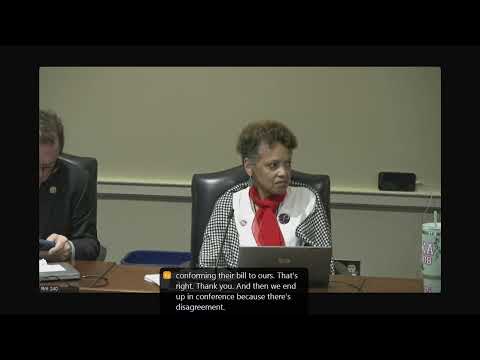
After discussion, the committee moved and adopted the amendments and then moved the bill as amended. Chair Jocelyn Pena Milnick summarized committee action: “We're gonna take the department at their word. We're gonna give them the time,” and said the committee will revisit the issue.
The amendment and the bill as amended passed in committee. The cross‑file, Senate Bill 376, was moved and amended to conform to the House changes and also passed in committee.
What the bill does: If the department is six months or more behind federal (CMS) survey intervals and a county requests help, the department must initiate an MOU within 45 days to allow the county to augment state survey staff using county funds; the department must report at least semiannually to localities on survey completion by facility and statewide progress. The bill clarifies that counties may perform the full tiers of inspection with appropriate authority.
Next steps: The bill and its conforming Senate cross‑file will proceed in the legislative process; committee members said they expect to revisit implementation and monitoring as the department hires and trains staff.