Get Full Government Meeting Transcripts, Videos, & Alerts Forever!
Get email alerts on the Committee Work Session Roundup topic
No spam. Unsubscribe anytime.
Environment and Natural Resources Committee advances work sessions: plastic bag measures kept, airport safety and mining bills tabled or rejected, PFAS vehicle‑
Summary
The Environment and Natural Resources Committee met for a series of work sessions and voted on multiple bills, including three related to Maine’s plastic bag law, a metallic‑mineral mining proposal, an airport safety amendment, a PFAS exemption for off‑road equipment, and a study request for single‑use propane canisters.
The Environment and Natural Resources Committee of the Maine Legislature met for a series of work sessions that covered plastic bag legislation, an airport safety amendment, multiple mining proposals, an exemption for certain equipment from PFAS product notification requirements, and a study request on single‑use propane canisters.
Committee actions were mixed: the panel voted to recommend "ought not to pass" on several plastic bag bills that sought to change the 5¢ bag fee or repeal the ban; it tabled an airport/Endangered Species Act amendment after extended discussion about aviation safety; it voted "ought not to pass" on a broad metallic‑mineral mining bill and tabled a related pegmatite bill; it considered but recorded a roll call on a PFAS exemption for off‑road equipment; and it declined to pursue a narrowly drafted bill on single‑use propane canisters because the department was already studying stewardship options.
Why it matters: the bills affect everyday consumer costs (bag fees), municipal and retail operations, airport safety practices, how the state regulates mining and mineral exploration, and how businesses manage PFAS‑containing components and hard‑to‑recycle propane canisters. Several items also raise questions about how Department of Environmental Protection (DEP) rulemaking, federal aviation guidance, and other state agencies intersect with legislative changes.
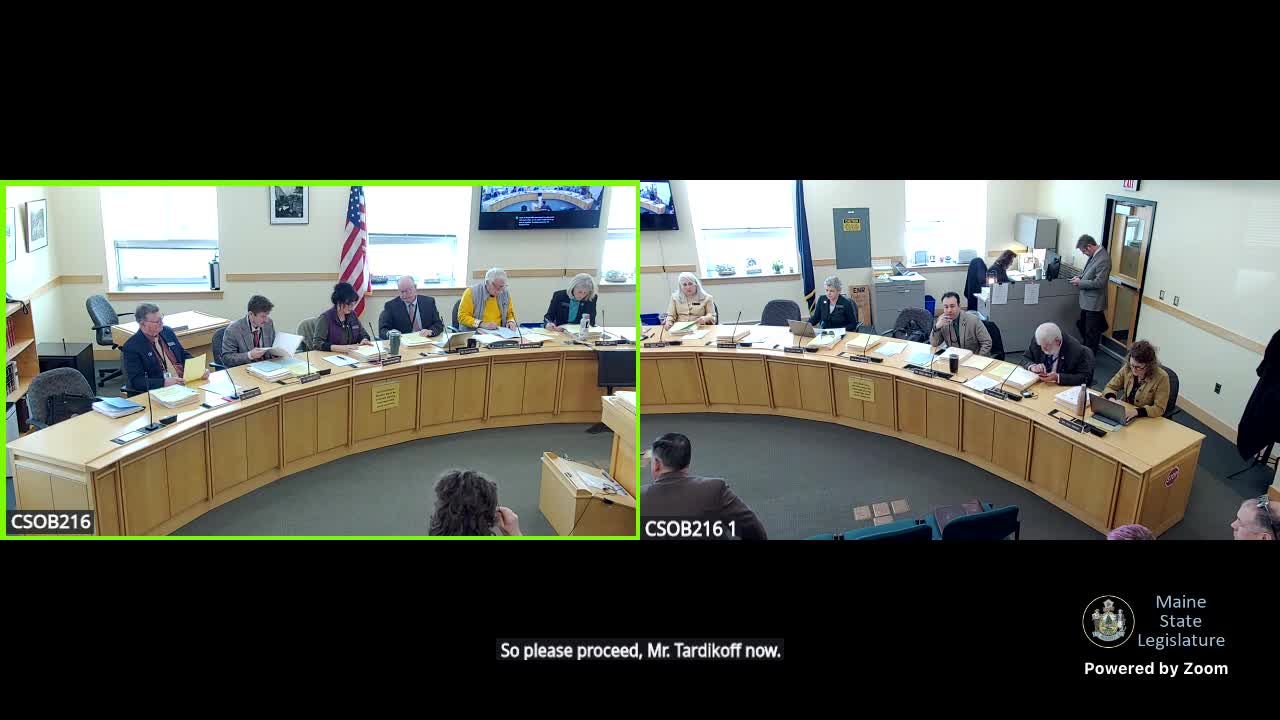
Plastic bag bills (LD 56, LD 69, LD 1122) Dan Tartikoff, the committee analyst from the Office of Policy and Legislative Analysis (OPLA), summarized three related bills that had been heard together because they all amend Maine’s plastic bag law enacted in 2019 (LD 1532) and codified at 38 M.R.S.A. §1611. LD 56 would remove the 5¢ minimum fee for paper or qualifying reusable plastic bags; LD 69 would repeal the plastic bag restrictions entirely; and LD 1122 would adjust definitions and raise the fee from 5¢ to 10¢ while clarifying that certain thicker reusable plastic bags are covered.
Committee members debated consumer incentives, retailer concerns and public‑health testimony about reusable bags. Representative Bill Bridal moved that LD 56 be given an "ought not to pass" recommendation; Representative Vicky Dudera seconded. The roll call recorded seven members voting in favor of the motion and five opposed, with one member absent (7 yes, 5 no, 1 absent). The motion carried; recorded votes are shown below in the "Votes at a glance" section.
For LD 69, which would repeal the ban, Representative Art Bell moved "ought not to pass," seconded by Representative Osher. After discussion that included remarks about litter reduction and marine impacts, the motion received eight affirmative votes, three negative votes, and two absences (8 yes, 3 no, 2 absent) and carried.
LD 1122, which would increase the bag fee to 10¢ and clarify the law’s reach (including bags provided at self‑checkout and delivery), prompted discussion about whether the 5‑cent fee strikes the intended balance. Committee members asked whether the change would disproportionately affect low‑income customers and whether retailers had provided data about who manufactures paper bags in Maine. Diane Johansen, representing the Maine Forest Products Council and the American Forest and Paper Association, told the committee that no Maine manufacturing facilities produce the grocery‑style paper bags covered by the law, though other bag products are made in‑state. After brief discussion, the committee recorded an "ought not to pass" motion on LD 1122; all members present voted in the affirmative on that motion, with one member absent.
Airport safety / Endangered Species amendment (LD 138) The committee spent a lengthy portion of the session on LD 138, an amendment that would constrain the application of Maine’s conservation rules near airports. The discussion drew airport directors, aviation stakeholders and wildlife officials into the room. Jonathan Labonte, transportation director and airport manager for Auburn‑Lewiston Municipal Airport, said his federal grant obligations and the Federal Aviation Administration (FAA) guidance require airports to avoid cultivating wildlife habitat in aeronautical areas. Nathan Webb, wildlife director for Maine Fish and Wildlife, acknowledged the department’s public‑safety priority and said Fish & Wildlife’s role is advisory in permitting reviews; he reiterated that DEP and USDA Wildlife Services commonly coordinate with airports to reduce wildlife hazards.
Airport operators urged the committee to focus any statutory change to publicly obligated "public use" airports and to limit the geographic language to FAA‑recognized aeronautical areas (runways, taxiways, aprons and adjacent areas inside airport fences). Some committee members favored narrow, iterative language changes while others urged an "absolutist" approach to safety. Because multiple parties requested more time to reconcile statutory language with federal definitions and with airport layout plans, the committee voted to table further action on LD 138 and asked staff and stakeholders to return revised language at a future work session.
Metallic mineral mining (LD 1073) and pegmatite/pegmatite‑mining proposal (LD 795) LD 1073 (sponsored by Representative Rana) proposed a series of changes to the Maine Metallic Mineral Mining Act (Title 38, Chapter references distributed in committee materials) including additional health‑equity and human‑health review requirements. DEP testified that the current statutory and rule framework is already among the most protective in the country and cautioned that the bill would require substantial expansion of DEP’s responsibilities and rulemaking. Maine CDC also submitted written comments about the human‑health language and data availability.
Representative Brigio moved "ought not to pass" on LD 1073; Representative Campbell seconded. The roll call shows all members present voted in the affirmative on that motion (committee minutes show three members absent). The motion carried and the committee recommended "ought not to pass."
LD 795, which initially proposed a permit‑by‑rule approach for pegmatite mining and a limited waiver for small, recreational blasting activities, was discussed at length. DEP described the extensive 2023–2024 rulemaking process that created the existing "exclusion" framework (which currently limits an actively mined area to 5 acres under the exclusion rules adopted after LD 1363/LD 1471). Senator Martin subsequently amended LD 795 to remove the permit‑by‑rule and instead direct DEP to consider increasing the exclusion limit to up to 20 acres via rulemaking. DEP indicated it could pursue rulemaking if the committee directed that change, but some committee members preferred to give stakeholders one more iteration before adopting statutory language. After debate, the committee voted to table LD 795 and asked staff to convene the relevant parties and return with revised language.
PFAS notification exemptions for off‑road equipment (LD 987) LD 987 would have amended the PFAS‑in‑products statute to clarify or extend exemptions for certain vehicles and equipment. The sponsor and industry representatives sought an exemption or clarification that off‑road construction and forestry equipment be treated similarly to the existing farm‑equipment exemption; DEP staff said the narrow amendment circulated at the meeting—adding "construction" and "forestry" to the existing list—would be consistent with the statute as written and would not constrain DEP’s rulemaking.
Representative Campbell moved "ought to pass as amended" with the short drafting change circulated at the meeting; the motion was seconded. The recorded roll call on the amendment shows seven members voting in favor and one opposed, with five members absent. The committee clerks also recorded the recommendations from both sides as part of the official transcript. (See the Votes at a glance section below for the recorded roll call.)
Single‑use propane canisters (LD 1035) LD 1035 would have directed DEP to study the safe disposal and management of single‑use propane canisters. During the session committee staff and DEP representatives noted that DEP is already reviewing whether such canisters should be handled under existing Extended Producer Responsibility (EPR) rulemaking or as a separate stewardship program because the canisters are typically treated as packaging. Given that DEP already is undertaking that analysis, the committee voted "ought not to pass" on the bill to avoid duplicative direction while preserving oversight opportunities through DEP’s rule process.
Votes at a glance (recorded motions, movers and roll‑call tallies as captured in the committee transcript) - LD 56 (remove 5¢ fee): Motion on floor—"Ought not to pass" (mover: Representative Bill Bridal; second: Representative Vicky Dudera). Recorded tally: 7 yes, 5 no, 1 absent. Motion carried in committee (recommendation: "Ought not to pass"). - LD 69 (repeal plastic bag law): Motion—"Ought not to pass" (mover: Representative Art Bell; second: Representative Osher). Recorded tally: 8 yes, 3 no, 2 absent. Motion carried (recommendation: "Ought not to pass"). - LD 1122 (clarify bag definitions, increase fee to 10¢): Motion—"Ought not to pass" (mover and clerk recorded). All members present voted in the affirmative on the motion; one member absent. Motion carried (recommendation: "Ought not to pass"). - LD 138 (airport/Endangered Species language): Motion—table (mover: Representative Sobolewski; second recorded). Motion to table carried by voice/show of hands; committee asked staff and stakeholders to produce revised language for a future work session. - LD 1073 (metallic mineral mining changes): Motion—"Ought not to pass" (mover: Representative Brigio; second: Representative Campbell). Recorded tally: unanimous of members present in favor; three absent. Motion carried (recommendation: "Ought not to pass"). - LD 795 (pegmatite permit‑by‑rule / blasting waiver): Motion—table (mover recorded in transcript). Motion to table carried; committee asked DEP and sponsors to reconvene and return revised language. - LD 987 (PFAS exemptions for off‑road equipment): Motion—"Ought to pass as amended" (mover: Representative Campbell; second). Recorded tally on the amendment: 7 yes, 1 no, 5 absent. The committee recorded both the tally and the recommendations filed by proponents and opponents; DEP did not object to the narrowly drafted amendment sent to the committee. - LD 1035 (study single‑use propane canisters): Motion—"Ought not to pass" (mover: Representative Bell withdrew earlier referral and moved "ought not to pass"). Recorded tally: unanimous among those present with three absences. Motion carried.
What comes next The committee directed staff to draft letters (including a suggested letter on solar project screening for DEP) and to convene stakeholders on the airport and pegmatite mining language for additional work sessions. DEP, Maine Fish & Wildlife, the Maine Forest Products Council, airport managers and industry representatives will be asked to provide either revised statutory text or rule proposals in advance of the committee’s next scheduled work session.
Ending Committee chair Senator Denise Teppler closed the meeting after the last votes and reminded members that staff will circulate drafts and that several items will return for additional consideration. The committee adjourned following a distribution of proposed draft language and letters for review.