Get Full Government Meeting Transcripts, Videos, & Alerts Forever!
Get email alerts on the Child Welfare Reform topic
No spam. Unsubscribe anytime.
Maine DHHS outlines child-welfare staffing, safety and placement reforms in OCFS briefing
Summary
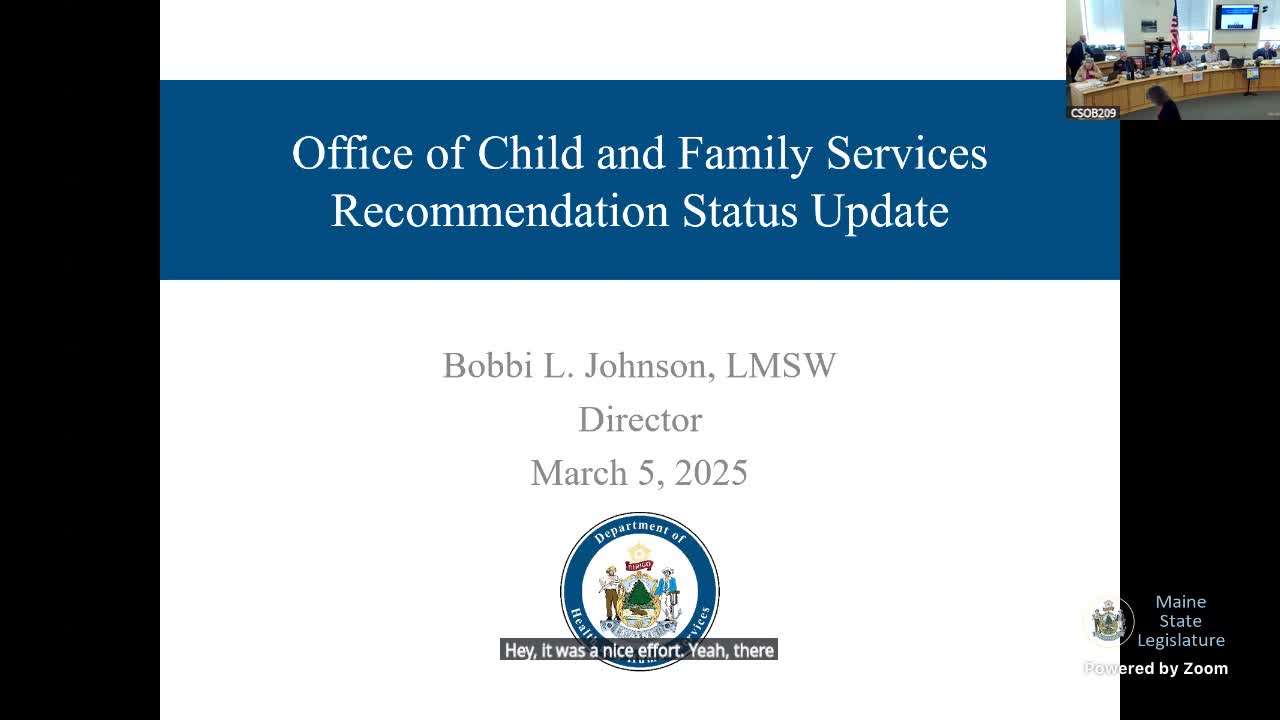
Bobbi Johnson, director of the Office of Child and Family Services at Maine DHHS, briefed the Health and Human Services Committee on steps taken after the Government Oversight Committee's review, including pay increases, supervisor-trainer positions in every district, a decision-making matrix for field staff, strengthened clinical consults and a cross-office complex-case protocol.
Good morning. Bobbi Johnson, director of the Office of Child and Family Services (OCFS) at the Maine Department of Health and Human Services, briefed the state Health and Human Services Committee on the agency's progress implementing recommendations from the Government Oversight Committee related to child safety, workforce stability and placement options.
Johnson told the committee OCFS has focused on hiring and retention, supervisory support, clearer decision-making guidance for field staff, and new cross-office structures to manage complex cases and placements. She reported the vacancy rate for case aide positions fell from about 25 percent to about 10 percent and said the agency still had roughly 8 to 10 vacancies statewide in those roles while continuing active recruitment.
Why this matters: Lawmakers pressed for detail because many recommendations had been produced by outside reviews and public concern has centered on whether OCFS can reliably assess child safety, keep staff at work long enough to deliver services, and avoid placing children in hotels or emergency departments.
The main steps described
- Staffing and pay: Johnson said the Legislature approved pay increases for frontline case aides and for child-protective caseworkers and supervisors. OCFS has created supervisor-trainer positions, assigning one supervisor-trainer to each district office to improve onboarding and ongoing coaching for both new and tenured staff.
- Management reorganization and decision tools: OCFS reorganized regional leadership into discrete roles (strategy/policy/implementation, statewide programs, and field operations). The agency rolled out a decision-making matrix in January — developed with PCG — and in February solicited district-level feedback to refine it. Johnson said the matrix is intended to empower frontline staff to make timely safety and visitation decisions with supervisory support.
- Complex-case coordination and clinical consults: OCFS has stood up a cross-office complex-case protocol and strengthened access to a multi-disciplinary team for children with complex medical or behavioral-health needs. Johnson said clinical consultants assigned to each office are available both to advise on complex cases and to provide supports for staff secondary trauma.
- Child-safety and court practice: Johnson stressed that reunification decisions proceed through court processes and described use of trial home placement periods (commonly about three months) during which the department retains custody while children return home and OCFS increases oversight and service coordination. As Johnson put it, “When we are reunifying a family, we are doing that through court — the court has to sign off any reunification that happens.”
- Safety science and external review: OCFS plans an annual safety-science report and has joined the National Center for Fatality Review and Prevention's case reporting system. The agency reported standardizing consultation with child-abuse pediatricians at intake and during investigations; OCFS also increased its contract funding so the provider now has two certified child-abuse pediatricians and a nurse practitioner available for consults.
- Placements and beds: Johnson described continuing work to reduce reliance on hotels and emergency-department settings for children in custody. OCFS has hired a central-office coordinator for hotel/ED placements, created community-sitter cohorts to provide supervisory coverage, and is engaged in multi-state peer calls to identify placement models and supports. She warned staffing shortages among residential providers remain a limiting factor.
- Family-team meetings, services and prevention: OCFS is reviewing the family-team-meeting model and training for facilitators, exploring the nurse-family partnership model with Maine CDC partners, and working with MaineCare and community providers to reduce waitlists for behavioral and substance-use services (some waits were described as 3'to'12 months). Johnson also described prevention campaigns ('Be There For Me') and piloting prenatal 'plans of safe care' for substance-exposed infants.
Committee questions and clarifications
Members pressed Johnson on distinctions between 'ongoing' and 'in progress' items; she defined 'ongoing' as activities already incorporated into practice and 'in progress' as strategies being implemented or where policy/training remains to be completed. Several members asked for data follow-up (for example, the percentage of substance-exposed newborns who go home), and Johnson said the department would try to provide those figures.
Key clarifying details captured from the briefing
- Case aide vacancy rate: reported decline from roughly 25% to about 10%; OCFS estimated 8'to'10 current vacancies (source: Johnson briefing). - Supervisor-trainer positions: OCFS has placed one supervisor-trainer in each district office to onboard staff and identify training needs (source: Johnson briefing). - Decision-making matrix: rolled out in January; district feedback gathered in February (source: Johnson briefing). - Trial home placement period: commonly about three months while department retains custody and monitors progress (source: Johnson briefing). - Child-abuse pediatrician capacity: contract increased to two certified child-abuse pediatricians plus a family nurse practitioner (source: Johnson briefing). - Memory care beds (context from later committee discussion): a January 2024 tally cited 58 facilities and 2,079 memory-care beds statewide (context provided later in committee business).
Sources and limits
All factual claims in this article are drawn from the OCFS briefing transcripts and materials Johnson referenced to the committee. Where Johnson described numbers or progress, the article reports them as she did (for example, vacancy-rate figures are Johnson's report to the committee). The article does not infer causes beyond what speakers stated or report performance metrics that were not provided in the hearing.
What to watch next
Committee members asked the commissioner and OCFS for regular updates; the briefing referenced an ongoing strategic plan, an incoming deputy director position whose responsibilities will include OCFS strategic planning, and continued public reporting on progress and metrics. The committee also asked for follow-up data on placements, service waitlists and outcomes for substance-exposed infants.
Ending
Committee members thanked Director Johnson for the briefing and asked the department to provide follow-up figures and the safety-science report when available.