Get Full Government Meeting Transcripts, Videos, & Alerts Forever!
Get email alerts on the Court Interpreters Bargaining topic
No spam. Unsubscribe anytime.
Committee OKs measure to allow consolidated bargaining for court interpreters in certain years
Summary
The committee passed AB 792, a bill that would allow multi-region consolidated bargaining for court interpreters when several regions enter negotiations in the same year, sponsors and union leaders said it would speed bargaining and help recruitment of interpreters.
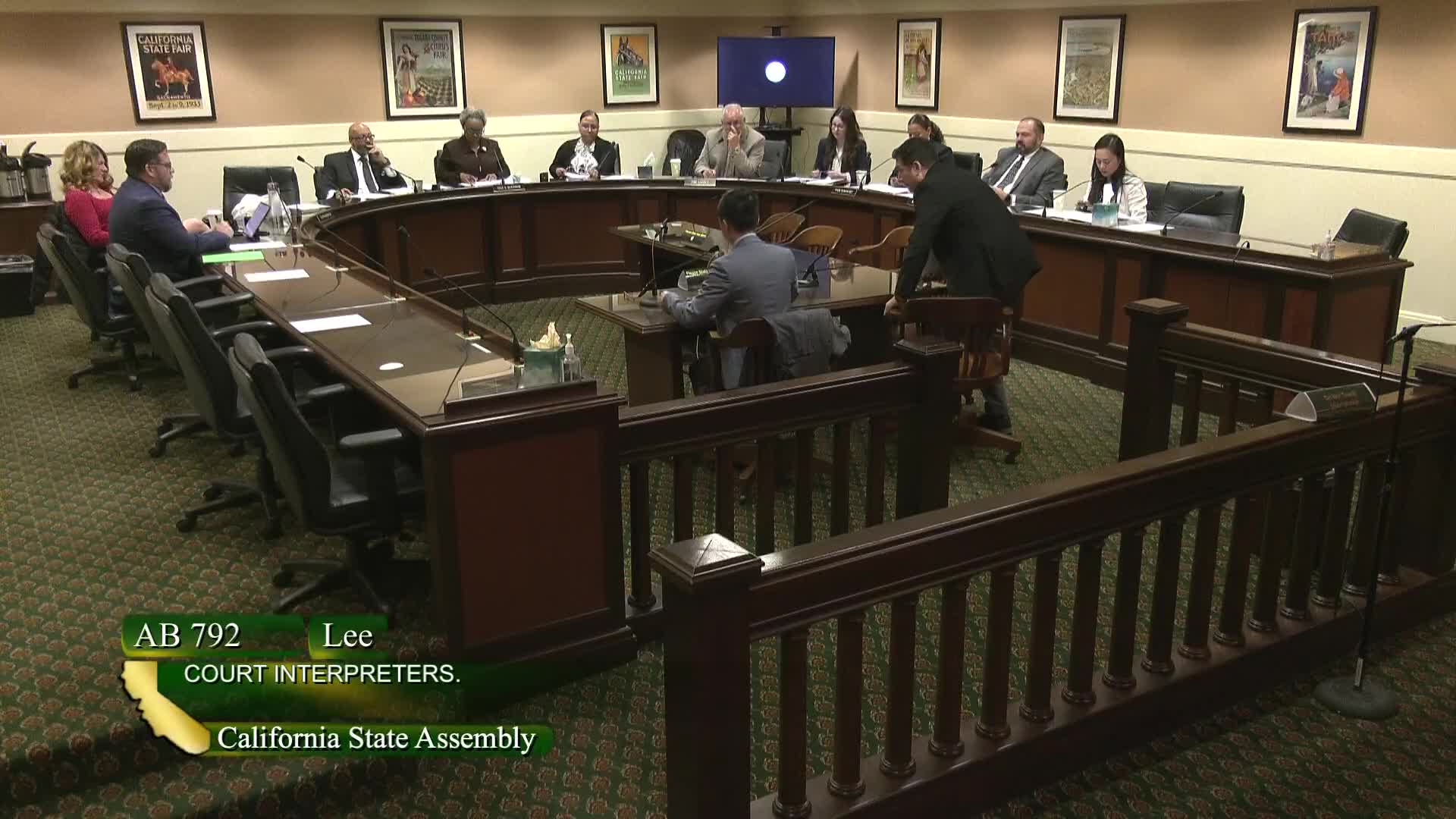
Assemblymember Lee presented AB 792 to the Assembly Committee on Public Employment and Retirement on March 28, saying the bill would permit consolidation of bargaining when more than one of the four statutorily defined court‑interpreter regions is in contract negotiations in the same year.
Supporters, including Ignacio Hernandez of the California Federation of Interpreters and Carmen Ramos, president of Local 39000 (the statewide court interpreters’ union), said the current regional bargaining structure causes duplicative, time‑consuming negotiations that drain the union’s limited resources. Hernandez told the committee there are roughly 900 court interpreter employees statewide and that many bargaining items—especially those tied to state budget actions—are effectively the same across regions.
Ramos said protracted, region‑by‑region bargaining has delayed agreements and hampered courts’ ability to hire and retain interpreters, noting recent close calls with work stoppages and uneven local hiring. She said the bill would permit multiple regions to negotiate at the same time when their contract calendars converge, allowing more efficient resolution of state funding and wage matters.
No witnesses testified in opposition. Committee members asked how the consolidation would operate and whether it would create a statewide wage. Supporters said the bill would not require statewide bargaining; it would only allow consolidation when multiple regions are negotiating in the same year, and wage differences by region could still be recognized. Committee members also asked about the 100‑day independent contractor rule and the pay gap between contractors and employees; supporters said contractors sometimes charge per diem rates as high as $1,500–$2,000 while employee wages were around $400 per day, and that the bill aims to create incentives for hiring qualified employees.
The committee approved AB 792 by voice and roll call, moving it to the Committee on Appropriations. The motion to “do pass and re‑refer to the Committee on Appropriations” was made by Assemblymember Borner and seconded by Assemblymember Elawari; the roll call reflected sufficient affirmative votes and the committee placed the bill on hold for potential amendments. The committee record shows the item advanced without recorded opposition.
Supporters said consolidated bargaining in the specific circumstances the bill describes could speed negotiations linked to state budget actions and help courts recruit permanent interpreters. The bill is now before the Appropriations Committee.