Get Full Government Meeting Transcripts, Videos, & Alerts Forever!
Get email alerts on the Public Sector Labor Discipline topic
No spam. Unsubscribe anytime.
Assembly committee advances bill to require minimum discipline and grievance standards in local MOUs
Summary
The Assembly Committee on Public Employment and Retirement voted to pass AB 4 65, a measure requiring employers to negotiate minimum disciplinary and grievance procedures into memoranda of understanding when requested by unions, after testimony from labor groups and opposition from local governments and county representatives.
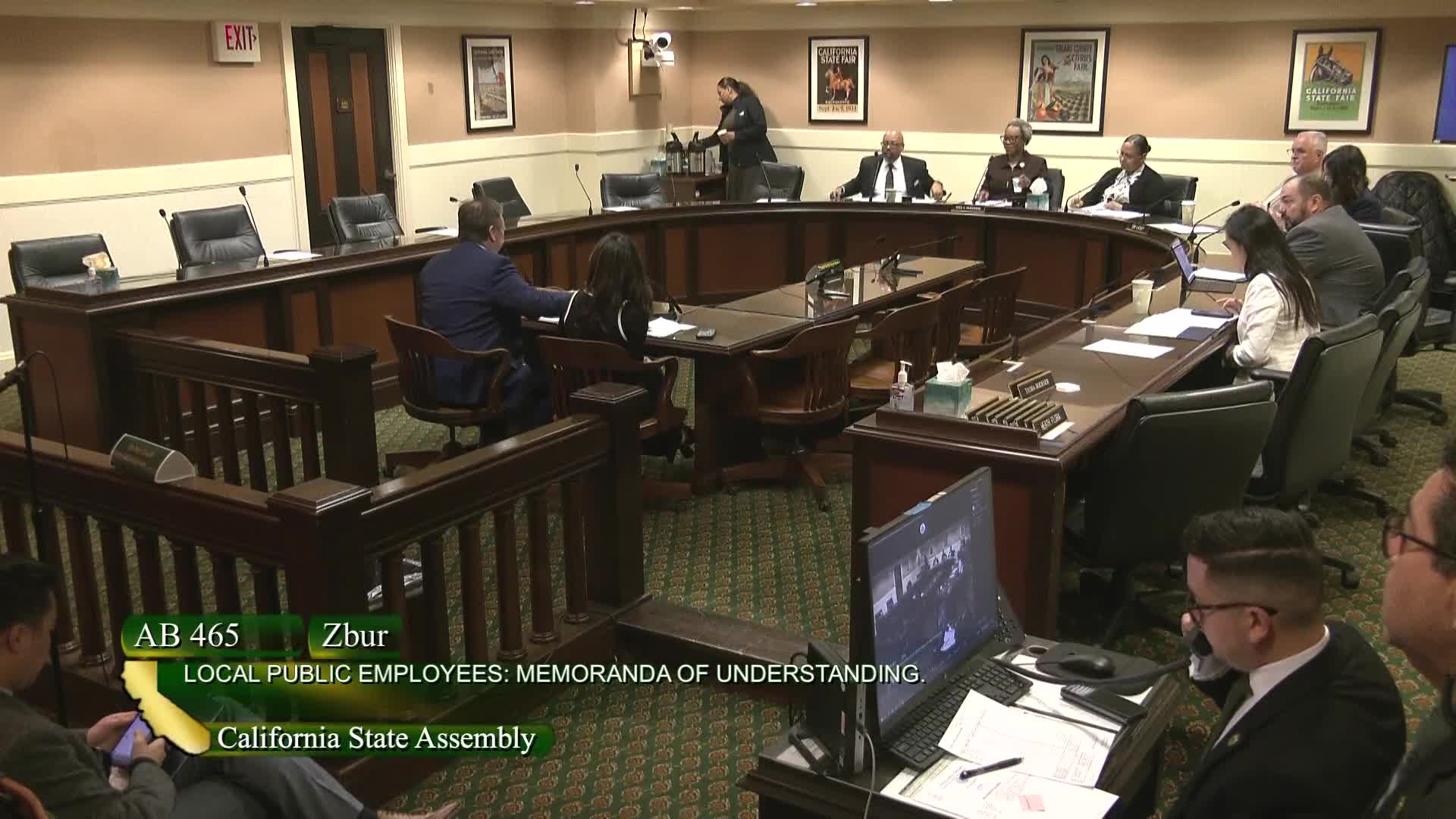
Assemblymember Saburra introduced AB 4 65 on behalf of AFSCME and SEIU California, telling the Assembly Committee on Public Employment and Retirement on March 28 that the bill would require employers to negotiate minimum standards for employee discipline and grievance procedures into Memoranda of Understanding when requested by a union.
The bill would require three elements in an MOU when requested by a union: a system of progressive discipline that includes a just-cause standard and due process; a grievance procedure allowing employees to appeal adverse actions; and reasonable paid release time for employee representatives participating in grievance proceedings. “This bill will protect California’s public sector employees by requiring employers, when requested by a union, to negotiate fair disciplinary procedures in an MOU,” Assemblymember Saburra said.
Janice O’Malley of AFSCME California, a primary witness in support, described public-sector workers as “the lifeblood of their communities” and urged the committee to back AB 4 65. Other supporters who spoke during the hearing included Kimberly Rosenberger of SEIU, Sarah Flocks of the California Federation of Labor Unions, Megan Soopers of California Professional Firefighters, Navneet Perrier of the California School Employees Association, and representatives of several public employee associations.
Opponents raised concerns that the bill would impose one-size-fits-all requirements on local governments and could reduce accountability in certain contexts. Sarah Decquette of the Rural County Representatives of California said she was “concerned with the requirement that every MOU include a grievance procedure that culminates with compulsory and binding arbitration,” and argued that arbitration can reduce disciplinary penalties and limit local accountability in sensitive functions such as policing or child welfare. Johnny Pena of the League of California Cities said the bill would “dramatically expand the scope of existing law” and could prohibit non‑progressive discipline in cases where progressive measures are inappropriate.
During committee discussion members asked whether the bill would require Skelly hearings; AB 4 65’s author replied that the bill had removed an explicit reference to Skelly hearings but incorporated a legal definition of due process and progressive discipline. Committee members also questioned who would pay for arbitration when it occurs; an AFSCME witness responded that, in practice, costs would generally fall to employers unless an arbitrator rules otherwise.
The committee carried a motion to “do pass and re-refer to the Committee on Appropriations.” The motion, made by Assemblymember Pointer and seconded by Assemblymember Elawari, passed with five ayes, zero noes and two not voting. The committee record shows McKinner, Berner, Elawari, Garcia and Win voting aye; Assemblymembers Lackey and Alanis were recorded as not voting. No amendments were adopted on the floor during the hearing.
Supporters said the bill would create baseline protections where Memoranda of Understanding currently vary widely across jurisdictions; opponents said those matters should remain subject to local bargaining and that compulsory arbitration could undermine accountability in certain public roles. The author said she would continue discussions with opponents to seek compromise on the concerns they raised.
AB 4 65 now goes to the Assembly Appropriations Committee for further consideration.