Get Full Government Meeting Transcripts, Videos, & Alerts Forever!
Get email alerts on the Farm To School topic
No spam. Unsubscribe anytime.
CDFA seeks $24.9 million for Farm to School incubator; LAO questions scope of $3 million technical assistance grants
Summary
CDFA asked for $24.9 million in new general fund support for its Farm to School program in FY 2025'6, proposing $20 million for incubator grants, $3 million for climate‑smart technical assistance and $1.9 million for network programming.
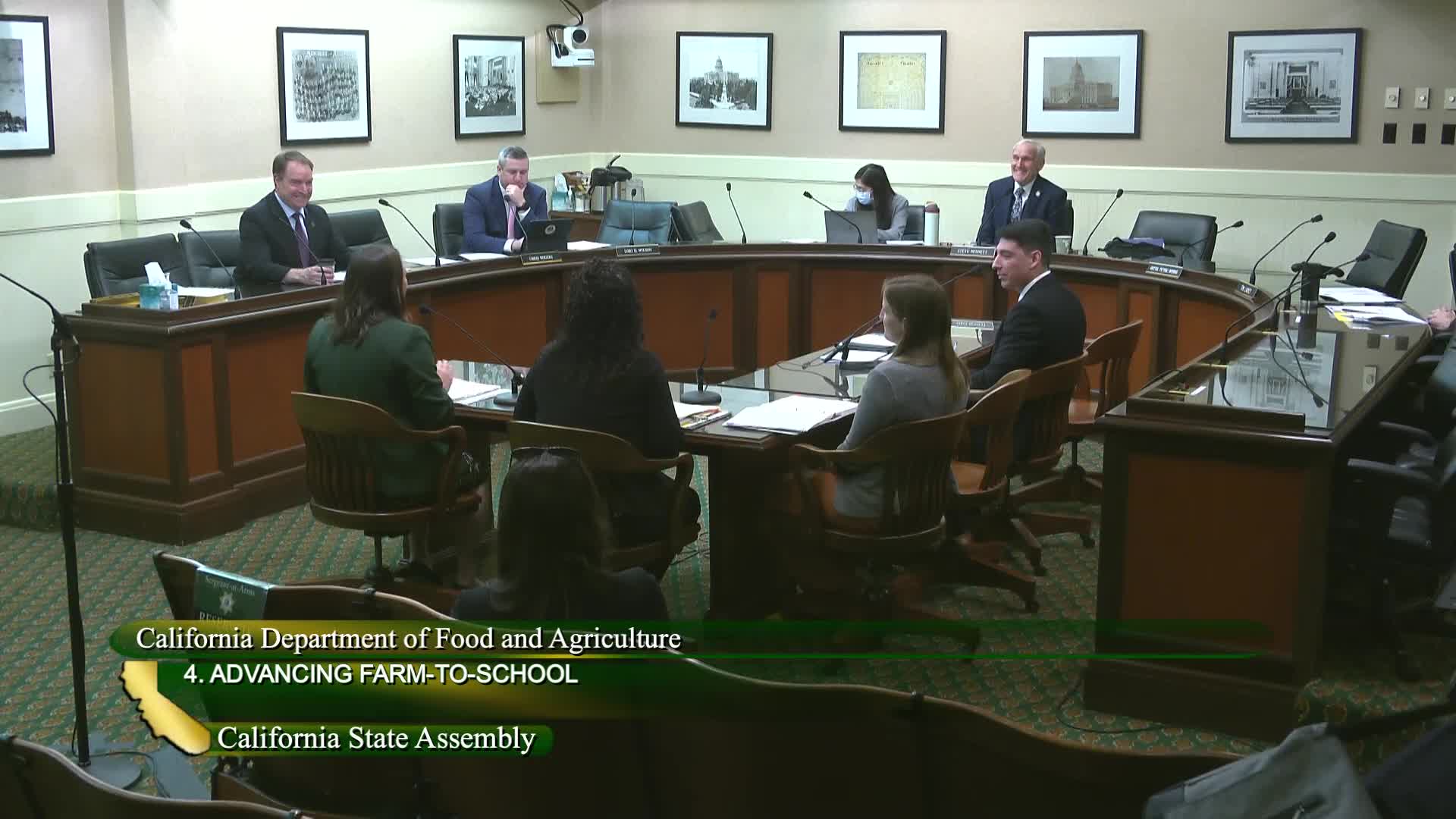
The California Department of Food and Agriculture asked the Assembly Budget Subcommittee No. 4 to fund the Farm to School program with $24,900,000 in the 2025'6 budget year to expand competitive incubator grants, technical assistance and statewide network work.
"CDFA requests $24,900,000 general fund in fiscal year 25 26 to continue this program and address some of the gaps and next steps that were identified in that roadmap to success," Deputy Secretary Arma Cozina said, describing the Farm to School incubator grant program's four tracks (K–12 procurement and education; producer/food hub capacity; technical assistance; and early care and education).
Why it matters: CDFA said Farm to School has reached 49% of California students after three funding rounds and argued the program delivers economic, environmental and equity benefits while creating markets for producers using climate‑smart practices.
LAO recommendation and committee questions
The Legislative Analyst's Office recommended rejecting the $3,000,000 set aside for climate‑smart agricultural technical assistance within the request. LAO said those grants would not directly support producers to sell to schools and characterized them as broad investments in farm practices statewide rather than narrowly targeted capacity building to increase school procurement. "We recommend that the legislature reject this portion of the funding," LAO wrote on the record.
CDFA responded that the proposed technical assistance is intended to expand the pipeline of producers using climate‑smart practices so more suppliers are eligible for Farm to School procurement tracks; CDFA described a per‑producer cost estimate of roughly $1,000 to reach and assist new producers.
Budget context and alternatives
LAO and several Assembly members suggested the Legislature consider whether part of the request could be funded through Proposition 98 appropriations for K–14 education, which have greater near‑term capacity for discretionary proposals than the General Fund. The subcommittee asked CDFA and Finance to explore Prop 98 eligibility for portions of the proposal.
Next steps
Committee members expressed support for the program's goals but emphasized the need to prioritize new general fund spending against other demands and suggested further discussion about narrowing or retargeting the proposed technical assistance grants if the Legislature wishes to constrain general fund exposure.