Get Full Government Meeting Transcripts, Videos, & Alerts Forever!
Get email alerts on the Higher Education Financial Aid topic
No spam. Unsubscribe anytime.
HECC tells Oregon legislature state financial aid is stretched as student costs rise
Summary
Higher Education Coordinating Commission staff told the Education Subcommittee on April 2 that rising tuition and living costs, a federal FAFSA formula change and higher enrollment of needy students have increased demand for state grants and will require cost controls unless additional funding is approved.
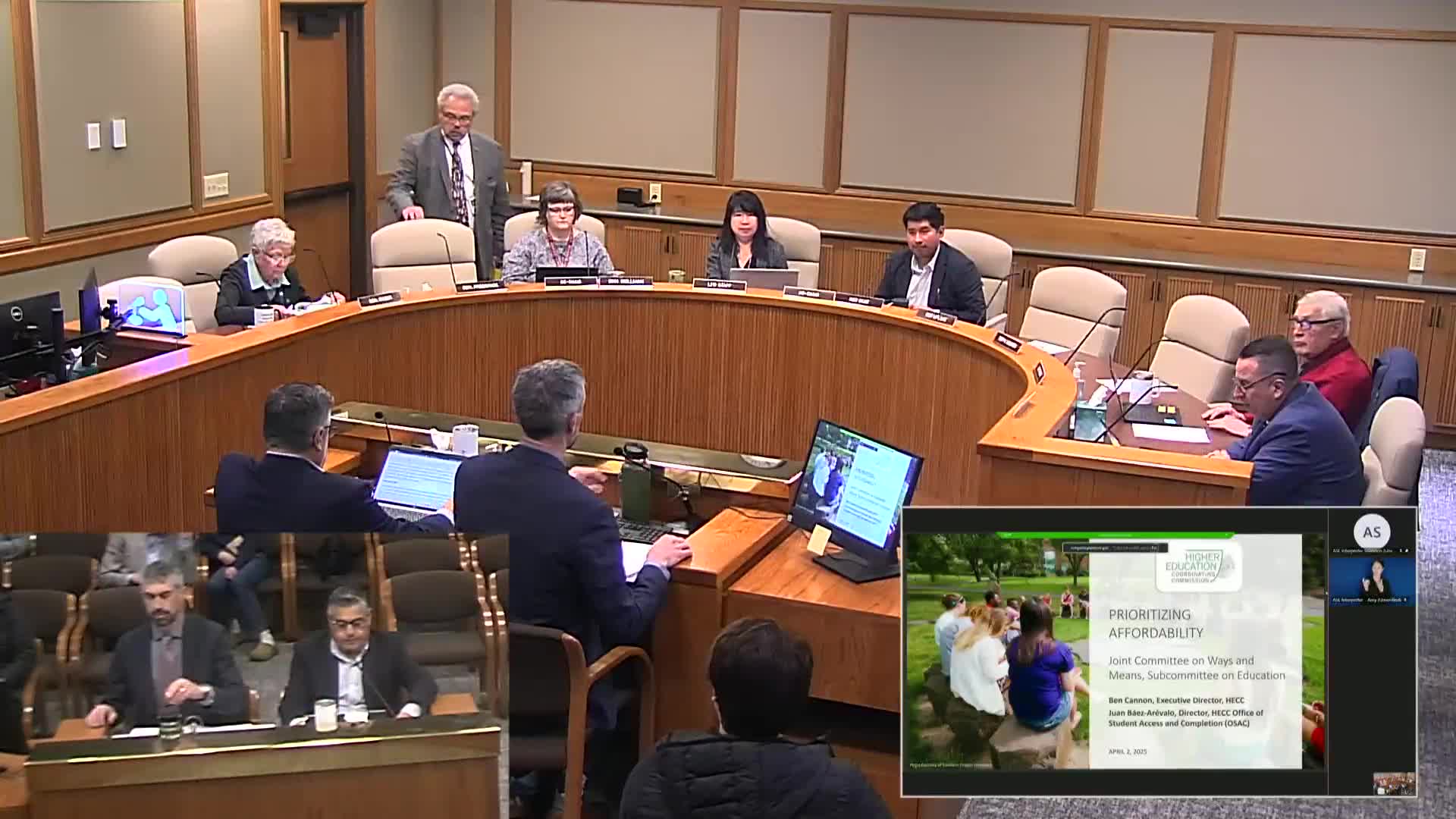
The Education Subcommittee held an informational hearing on Senate Bill 5525 on April 2, 2025, where Ben Cannon, executive director of the Higher Education Coordinating Commission, and Juan Baez Herbalo, director of the HECC Office of Student Access and Completion, outlined demand pressures on Oregon state financial aid programs and the agency’s budget requests.
Cannon told the committee that “affordability is really a multi dimensional problem,” and said HECC will focus on grant programs that reduce what students must borrow or cover out of pocket. He and Juan described the effects of the federal shift from the Expected Family Contribution (EFC) to the Student Aid Index (SAI) on applicants and awards, and how that change expanded the pool of students eligible for maximum federal and state need-based aid this year.
The Oregon Opportunity Grant, HECC’s largest state aid program, was authorized for about 61,000 students this academic year, with roughly 39,000 enrolled and using the award so far, Juan Baez Herbalo said. HECC reported that the SAI recalculation and higher full-time enrollment pushed Pell recipients in Oregon from about 33,000 to about 46,000 and required the agency to request roughly $3.5 million in additional expenditure limitation to avoid a budget shortfall.
The agency described the governor’s recommended budget (GRB) proposal to increase the Opportunity Grant by $25 million and to add funds for other programs, including a proposed $5 million behavioral health workforce scholarship and a $2.5 million increase for the Oregon Tribal Student Grant. Juan said the $25 million GRB increase would “bolster support for students in need” and help maintain award purchasing power compared with the current service level (CSL).
Committee members questioned specific programs. HECC staff said the Oregon Promise is a last-dollar program for recent high school and GED graduates that covers community college tuition for up to 90 attempted credits. Interest and applications for Oregon Promise rebounded after the pandemic; HECC set an SAI cap of 25,000 for the 2024 cohort to limit costs and warned that, at CSL funding, it expects cost-control measures would be necessary during the 2025–27 biennium.
Juan described the new Oregon Tribal Student Grant, started in 2022–23, as a rapidly growing last-dollar program for members of Oregon’s nine federally recognized tribes and said GRB-level funding would likely require cost controls such as eliminating graduate awards or reducing new undergraduate awards if demand continues to outpace funding. He also noted the Oregon National Guard State Tuition Assistance program (ANGSTA) was reformed by Senate Bill 101 (2021) so state aid stacks with Department of Defense federal tuition assistance; that change and a new stipend for books and fees have increased participation.
HECC officials provided additional program details that committee members raised: the Oregon Student Childcare Grant serves student parents but covers only a fraction of applicants (HECC said it could fund about 22% of applicants this year); OSAC-administered private scholarships total more than $12 million across roughly 3,500 students; and OSAC’s scholarship and grant portal (oregonstudentaid.gov) is the central application and catalog for state grants and privately funded scholarships.
Staff repeatedly noted operational challenges tied to federal FAFSA disruptions and the SAI transition, including the agency’s reduced ability to flag administrative score changes and the unusually high share of students enrolling full time (HECC reported a peak of about 77% full-time enrollment among award recipients this fall). HECC described several potential cost-control levers it has used historically or might use if funding falls short: earlier FAFSA cutoff dates, SAI caps for Oregon Promise, limiting graduate awards for certain programs, reducing award amounts, or setting eligibility thresholds.
Committee members also discussed related affordability factors beyond grant aid. Members raised housing and textbook costs; HECC said it administers a legislatively funded program for open educational resources and low-cost textbooks but does not have statutory authority to directly set textbook prices. On private scholarships and access, Juan pointed legislators to the OSAC portal and noted bilingual staff and outreach supports are available.
The subcommittee paused the informational hearing after the HECC presentation and questions. No formal action or vote was taken during the session on April 2. The committee will continue hearings on the HECC budget and related higher-education items in subsequent meetings that staff said will include further detail on statewide strategies and institutional investments.
Ending: HECC staff urged that legislative investment levels will determine which cost controls are needed; the agency recommended the governor’s proposed increase to the Opportunity Grant to maintain award purchasing power and to meet rising demand driven by the SAI change and increased full-time enrollment.