Get Full Government Meeting Transcripts, Videos, & Alerts Forever!
Get email alerts on the Land Use topic
No spam. Unsubscribe anytime.
Leavenworth County commissioners weigh special-use permit for RJ Farms amid animal-welfare and nuisance allegations
Summary
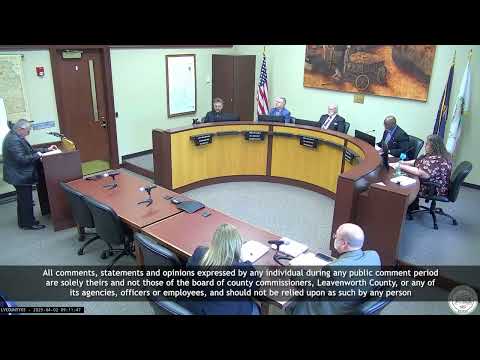
At a Leavenworth County Commission meeting, commissioners considered a special‑use permit application (Case DEV24125; Resolution 2025‑06) for RJ Farms to operate a private event/fairgrounds that could include rodeos, prompting lengthy public comment, expert testimony and competing motions for denial and conditional approval.
At a Leavenworth County Commission meeting, commissioners considered a special-use permit application (Case DEV24125; Resolution 2025-06) for RJ Farms, a privately owned event/fairgrounds where applicants said weddings, community events and occasional rodeos would be held.
The matter drew prolonged public comment and expert testimony. Neighbors and representatives of two humane organizations urged denial, citing a pattern of events held without permits, photographs and videos they say show animal mistreatment and repeated nuisance issues including loud music and heavy traffic. Supporters, including the applicants and their attorney, asked the commission to approve the permit and to allow multi-year terms so the operation can move forward under county oversight.
Planning staff told the commission the Planning and Zoning Commission reviewed the application twice and recommended approval, 8–0 with one absent, with several amendments to the applicant’s proposed conditions. The planning commission’s changes included removing a proposed one‑year limit on the permit, modifying restrictions on amplified music and adding a requirement for the applicant to have a licensed veterinarian “on call” during rodeo events.
Those opposing the permit repeatedly cited Kansas law and national rodeo standards. Crystal Black Deer, representing the Leavenworth County Humane Society, told commissioners that the Kansas animal-cruelty statute (KSA 21‑64‑12) “specifically prohibits horse tripping,” and urged strict compliance. A veterinarian who testified later said professional rodeo rules and public‑health requirements encompass animal-health inspections, Coggins testing and an on‑site veterinarian at performances. Dr. John Bernand said publicly available photos and videos, state statutes, and PRCA (Professional Rodeo Cowboys Association) rules submitted to the county document years of allegedly unlawful activity and that “a veterinarian has to be on‑site at all times for all performances.”
Applicants and supporters disputed some evidence and said many of the photos or videos were inaccurately attributed to their property. Aurelio Harrow, who identified himself as the property owner, told commissioners, “we do not trip the horses,” and said the operation has run community and Hispanic events for two decades. Norma Brockenberry, co‑owner of JR Farms, said the site is used for weddings, quinceañeras and other community events as well as occasional rodeos and that “we take care of our animals.” Their attorney asked the board to consider a multi‑year permit rather than an annual renewal.
Leavenworth County Sheriff’s Office concerns were placed in the record. Commissioners read a letter from the sheriff warning that repeated events have generated nuisance complaints and calls for service, that deputies responding to complaints sometimes could not identify responsible parties, and that there are unconfirmed allegations of conduct that could constitute cruelty to animals. The sheriff recommended limiting the number of events covered by a permit and allowing law-enforcement access to the premises during public events for animal‑welfare review.
Commission discussion centered on three enforcement questions: (1) whether a neutral, independent observer or licensed security firm should be required at rodeo events to document compliance; (2) whether county staff could (and would) perform spot checks during events outside normal working hours; and (3) how to ensure compliance with state law and professional rodeo standards for animal health and safety (including whether a veterinarian must be on‑site rather than merely on call).
Planning staff told the board they can perform spot checks using rotated staff hours but noted there will be a cost and limited coverage. Commissioners debated whether the county should require or preapprove a security vendor (some suggested off‑duty law‑enforcement officers) and whether costs for staffing or security should be borne by the applicant.
Two competing formal motions were made during the meeting: one to deny Resolution 2025‑06 (the special‑use permit) and one to conditionally approve it consistent with the planning commission’s recommendation. The transcript records both motions and an ensuing roll‑call discussion; the minutes in the packet do not contain a clear, unambiguous roll‑call result in the transcript excerpt provided to this article. The record shows that the board discussed revocation procedures and the planning commission’s recommendation that violations of the SUP could lead to a revocation proceeding before the commission.
What happened next: commissioners instructed staff to develop enforcement parameters, including options for neutral on‑site observation at rodeo events and policy recommendations for how spot checks and preapproved security would be handled if the board adopts similar SUPs in future cases. Commissioners and staff noted they would return with clearer policy language and operational details if the board wished to require third‑party security or expanded county monitoring in future SUP approvals.
Votes at a glance: The planning commission recommended approval with amendments (8–0, 1 absent). The county commission heard two motions on Resolution 2025‑06; the transcript of the meeting shows formal motions to deny and to conditionally approve, but the public transcript segment provided does not contain a clear, complete roll‑call outcome within the excerpt.
Why it matters: The decision raises questions about the county’s ability to enforce zoning conditions for event venues in rural residential areas, how local land‑use authority interacts with state animal‑welfare statutes and industry rules, and whether county staffing levels are sufficient to enforce conditions of large events held outside normal business hours.
The commission moved on after asking staff to return with options for independent monitoring criteria and costs, a clearer standard for veterinarian presence at rodeos, and procedures for triggering revocation if violations are documented.