Get Full Government Meeting Transcripts, Videos, & Alerts Forever!
Get email alerts on the Water Utility topic
No spam. Unsubscribe anytime.
Rapid City hears 100‑year Water Utility System Master Plan; consultants say current water rights adequate through 2125
Summary
City staff and consultant Black & Veatch presented a 100‑year Water Utility System Master Plan to the Legal and Finance Committee on April 2, 2025, outlining updated population and demand projections, capital improvement program scenarios, pipeline‑replacement priorities and recommendations to strengthen groundwater and storage resiliency.
Morgan Falcone, a civil engineer with the City of Rapid City and the project manager for the Water Utility System Master Plan, and Sean Labonde, project manager for consultant Black & Veatch, presented the plan to the Legal and Finance Committee on April 2, 2025.
The consultants said the plan updates population and spatial growth forecasts, produces average‑ and maximum‑day demand projections, performs an asset‑condition assessment for buried pipelines and facilities, and presents a 100‑year capital improvement program (CIP) with unconstrained and constrained funding scenarios. The presentation and subsequent Q&A emphasized groundwater resiliency, storage rights and the need for staged conservation measures and reuse options.
Why it matters: the master plan sets the city’s long‑range capital priorities for water supply, treatment and distribution. It changes the size and timing of major facilities compared with the 2008 study, reduces some projected peak‑day demand estimates, and assigns replacement priorities for more than 34,000 pipeline segments — findings that affect spending, permitting and developer requirements for decades.
Key findings and figures presented
- Current (2025) average‑day production: about 11.5 million gallons per day (MGD), presented by the consultant as the baseline. - Forecasts: the master plan uses updated city planning data and produced service‑area scenarios for 2025, 2045 and a 100‑year horizon (2125). The plan’s long‑range population baseline was described as roughly 155,000 people by 2125, approximately double today’s population according to the consultant’s slides. - Peak demand revisions: the consultant contrasted the 2008 master plan’s higher peak assumptions (a cited 52 MGD projection) with the current analysis, which showed a substantially lower peak estimate (a cited 28 MGD figure in the consultant’s comparison), a difference driven by lower per‑capita use assumptions and revised population growth rates. - Per‑capita use: the team used a reduced per‑capita water‑use rate consistent with recent Western U.S. trends (the presentation showed a long‑term decline from ~200 gpd per person in earlier plans toward ~135 gpd per person in the current model). - Wholesale customers: the plan carries a contingency for wholesale customers at about 16% of total demand. - Water rights and supply scenarios: the report evaluated three supply scenarios (normal, moderate drought with junior‑rights calls, and severe multi‑year drought). Under normal inflows the city’s existing portfolio (surface and groundwater plus storage rights at Pactola and Deerfield Reservoirs) provides high reliability; under moderate and severe drought the groundwater system and storage rights are key to resiliency. - Capital plans and costs: the consultant supplied two CIP bookends. The unconstrained CIP presented an average annual capital spend of about $17.5 million; the constrained CIP presented about $10.5 million average annual spending. The differences largely reflect the rate of pipeline replacement and timing of major capacity programs. - Pipeline replacement: under the unconstrained scenario, the plan estimated replacing roughly 76% of pipeline length by 2125 (the consultant cited a pacing equivalent of ~56 city blocks per year in early decades); the constrained scenario reduced replacement to about 19% (an example pace of ~15 city blocks per year), increasing the risk of more breaks in older ductile‑iron mains installed in the 1950s–1960s. - Materials and service life: the presentation noted most recent installs are PVC (estimated life ~120 years); older ductile‑iron mains were assigned shorter service lives (~70 years) and are entering the age range where failures become more likely.
Policy and program recommendations
Labonde and Falcone recommended protecting and building groundwater resiliency (including development of the city’s Madison Aquifer rights), pursuing more senior water rights if they become available, adopting a more staged water‑conservation ordinance tied to Pactola storage levels (moving from an all‑or‑nothing outdoor‑watering ban to intermediate stages), and studying reuse opportunities for nonpotable irrigation. They also delivered hydraulic and pipeline replacement models and multiple time‑stamped hydraulic model versions to support project analysis.
Q&A and council concerns
Council member Kevin Maher asked whether piping Missouri River water to the Black Hills was considered. Labonde said the plan evaluated that option, but given the updated demand forecasts and the city’s current water‑rights portfolio the Missouri River alternative remains a long‑term, expensive option beyond the plan horizon; the city should continue to monitor the project and consider participation if regional or supplier roles change.
Maher and others asked about potential high‑volume users — the consultant said a hypothetical data‑center load (cited examples of 3–4 MGD from other regions) can create localized distribution constraints that must be evaluated with site‑specific hydraulic modeling and probably require upsized mains to serve that point load.
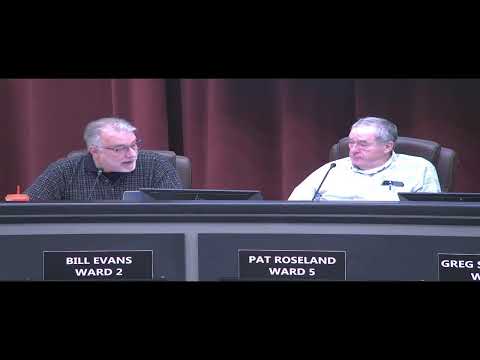
Council member Bill Evans urged planning for higher growth to avoid “underbuilding,” noting historical cycles of rapid growth and saying the city should weigh the tradeoffs between higher upfront capital costs and future constraints.
Formal committee action
Council member Bill Evans moved to acknowledge the presentation; Council member Kevin Maher seconded. The committee voted in favor and the motion carried. The presentation was informational; the committee did not adopt the master plan as policy at this meeting.
Clarifying details from the meeting
- Service‑area planning horizons presented: 2025, 2045 and a 100‑year horizon (2125). (Dates and horizons reflect the consultant’s slides and were clarified during the presentation.) - Funding scenarios: unconstrained average annual CIP ~$17.5 million; constrained average annual CIP ~$10.5 million (values cited in consultant slides as annual averages over the planning horizon). - Pipeline counts: the plan scored and ranked ~34,000 pipeline segments for condition and replacement priority. - Conservation recommendations: move from a single outdoor‑watering ban trigger to staged restrictions tied to Pactola reservoir levels (example: reducing allowable watering days before an outright ban).
What the city will likely see next
The consultant provided data‑rich deliverables (hydraulic models, replacement and facility‑condition datasets and project data sheets) intended for staff use in engineering scopes and procurement. City staff indicated this package will be used to refine project scoping and funding decisions in future budget cycles.