Get Full Government Meeting Transcripts, Videos, & Alerts Forever!
Get email alerts on the Local History topic
No spam. Unsubscribe anytime.
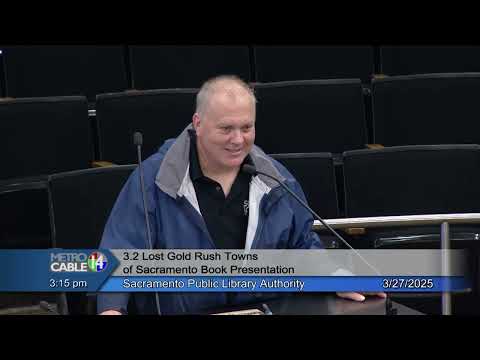
Authors present 'The Lost Gold Rush Towns of Sacramento' to library authority, spotlight submerged communities
Summary
Co-authors Eric Webb and Andrew McLeod described their survey of lost Gold Rush-era towns in Sacramento County and urged support for archives and local history preservation.
Authors Eric Webb and Andrew McLeod presented their new book, The Lost Gold Rush Towns of Sacramento, to the Sacramento Public Library Authority on March 31, emphasizing the region’s understudied local-history resources and the role of archives in recovering lost communities.
Webb, a former Sacramento Room director and co-author James Scott’s colleague, outlined the book’s scope and the research process, saying the project began before his retirement and was intended as a literature survey to open new lines of inquiry. He described Sacramento-area cultural institutions and archives as central to the work and encouraged residents and officials to use those collections.
Webb offered specific historical teasers from the book: part of the area near South Land Park Drive was once considered as a potential capital site, and two of the most important early Gold Rush towns are now submerged under Folsom Lake, one of which contained one of the earliest and largest African American communities in California. Webb cautioned that the book is an entry point and not a comprehensive account.
Andrew McLeod, joining by Zoom, said the project revealed gaps in the historical record — missing newspapers and incomplete assessor records for the county’s early decades — and stressed the book relies heavily on public and private archival holdings across Sacramento and neighboring counties.
Library leadership thanked the authors and noted the book complements other titles produced with library support. Directors expressed enthusiasm for public talks and local map content in the volume; several asked about planned book events and signings.
The presentation was informational; the board did not take formal action.