Get Full Government Meeting Transcripts, Videos, & Alerts Forever!
Get email alerts on the Transportation Brt topic
No spam. Unsubscribe anytime.
Beaverton council approves TV Highway BRT locally preferred alternative, OKs $1 million for project development
Summary
The Beaverton City Council voted unanimously to back the TV Highway Bus Rapid Transit locally preferred alternative, allocate $1 million in Transportation Development Tax funds for project development, and direct the city manager to negotiate an intergovernmental agreement with TriMet.
The Beaverton City Council voted 7-0 to approve the locally preferred alternative (LPA) for the TV Highway Bus Rapid Transit (BRT) project, allocate $1,000,000 from Transportation Development Tax (TDT) funds toward project development, and direct the city manager to negotiate an intergovernmental agreement (IGA) with TriMet outlining partner contributions and roles.
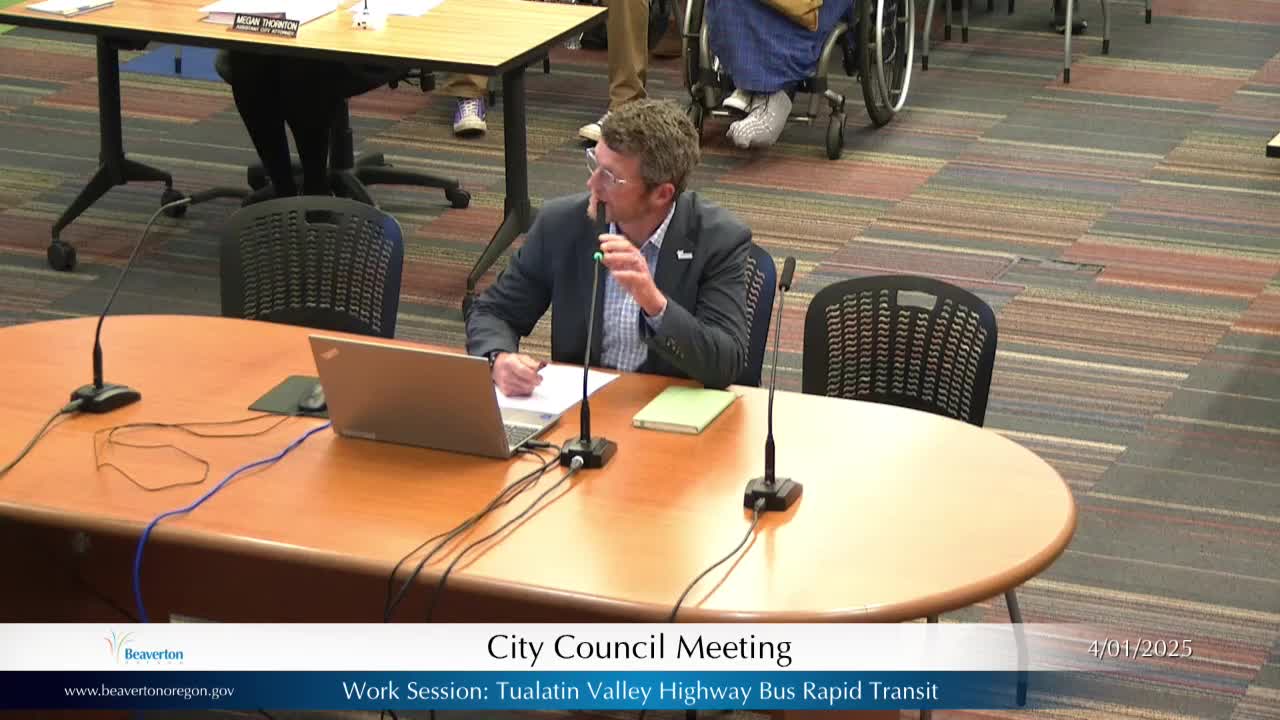
The approval—moved by Councilor Hartmeyer Prigg and seconded by Councilor Dugger—responds to a steering-committee recommendation and advances the project into the next phase of work, project development. Andy Varner, Community Development Department director, and Jocelyn Blake, Government Relations Manager, presented the plan and answered council questions prior to the vote.
The LPA presented to council calls for 41 station pairs along the corridor, upgrades to station amenities, the purchase of 15 new vehicles, bus chargers and facility upgrades, rebuilding four intersections, transit signal priority upgrades at 59 signals, filling sidewalk gaps and improving crossings, and reducing the number of stops to shorten travel times. Varner described the LPA as a “concept plan that will lead the project” and identified six station locations within Beaverton: the Beaverton Transit Center, Watson Avenue, Hawken Avenue, Murray Boulevard, Milliken Way and 100th/170th (as listed in the presentation).
Jocelyn Blake said the steering committee approved a project funding plan on Feb. 13 that estimates roughly $300 million in total project costs, with about $100 million from local and regional governments (a one-third share noted in the presentation). Blake said a $50 million capital construction request is being pursued from the state legislature and a $150 million request is planned to seek Federal Transit Administration (FTA) Small Starts funding. Blake confirmed the council was being asked only to authorize project development funding at this meeting, not construction funding.
Councilors asked several funding and risk-management questions. Councilor Dugger asked what would happen to Beaverton’s $1 million if the state did not provide its $50 million contribution. Blake said partners expected to reassess with the steering committee and indicated the June legislative outcome would inform next steps; she said the city would have the chance to “take a step back” before moving forward on project development if funding commitments changed. Metro staff (identified in the meeting as Kate) added that Metro and partners would not anticipate asking local jurisdictions to backfill the state request for the development-phase funding and that project development could proceed using other options to make the corridor “shovel ready.” As Kate put it, the partners “would not anticipate coming to local jurisdictions to fill that funding gap.”
Mayor Lacey Beatty and several councilors expressed both support and fiscal caution. Beatty said the $1 million request is substantial compared with other local planning projects but indicated she would vote in favor while remaining “apprehensive.” Councilor Hartmeyer Prigg, who served on the steering committee, thanked staff and committee members for the work; Councilor Gonzales said the corridor “needs a lot of love and attention” and supported participation. Councilor Teeter and others described the project as transformative and noted the opportunity to unlock large regional investment if Beaverton participates.
Blake also told council that Beaverton’s estimated construction contribution (to be considered in a future IGA) is listed in the presentation as “1,025,000.000” and would be split over fiscal years 2028–2031; she emphasized that construction funding was not being approved at this meeting and that estimates will continue to evolve.
The motion directed the city manager or designee to negotiate an IGA with TriMet that would specify partner contributions to project development, including how Beaverton’s $1,000,000 would be split across the next two fiscal years and the form of the contribution. Staff said partners expect IGAs to be signed by June, and that a draft IGA would be brought back to council for adoption by that deadline.
Votes at the meeting were recorded by roll call as unanimous: Council President Kimmy, Mayor Lacey Beatty, Councilor Dugger, Councilor Hartmeyer Prigg, Councilor Tiburon, Councilor Hassan and Councilor Teeter voted “yes.”
The council did not adopt any construction funding in this action; staff and presenters noted that state and federal decisions about construction funding (the state capital request and the FTA Small Starts grant) would determine the later construction-phase contributions and timing.
Next steps: staff will return with a draft IGA for council consideration and continue work with Metro, TriMet and the TV Highway steering committee on project development and funding coordination.