Get Full Government Meeting Transcripts, Videos, & Alerts Forever!
Get email alerts on the Wastewater topic
No spam. Unsubscribe anytime.
Houston wins $700,000 grant for Lockwood lift station; mayor outlines plan for generators at essential sites
Summary
Mayor announced a $700,000 state grant to install a backup generator at the Lockwood lift station and said the city intends to install generators at about 100 essential sites during his first term, part of a longer effort to address sanitary sewer overflows and compliance stemming from a federal consent decree.
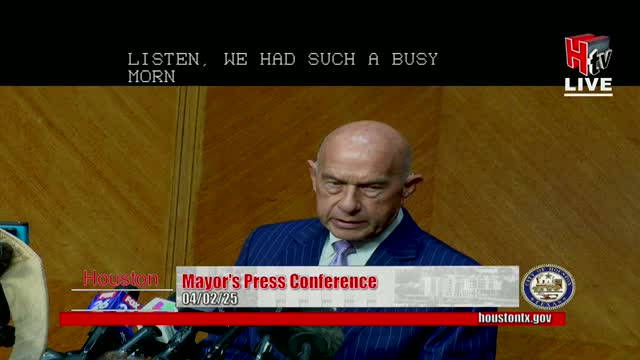
Mayor (name not specified) told a city press briefing that Houston has received a $700,000 grant to provide backup power at one wastewater lift station and outlined a broader plan to add generators to essential city sites over the next three years.
The mayor said the grant will cover the Lockwood Lift Station and called the award “the start” of a larger effort, praising collaboration with state partners. “Folks, that's what makes cities work, the collaboration,” he said.
Randy, a city staff member who spoke after the mayor, described the scale of Houston's wastewater infrastructure and why backup power matters. “We have nearly 400 lift stations across Houston,” Randy said. He added that Houston's combined water and wastewater utility is one of the largest municipal utilities in the country and that its collection system includes “more than 6,000 miles” of pipe. Randy said the federal consent decree stemming from sanitary sewer overflow issues identified in 2013 led to rehabilitation work but did not require backup power for stations.
Randy cited last year's hurricane impacts as an example of the consequences when lift stations lose power: “We saw firsthand after hurricane Burrell last year what happens when our lift stations don't have power. There were SSOs all across the city.” He said the $700,000 grant will fund a generator for the Lockwood Lift Station and that the city intends to include backup power in future rehabilitation and design standards.
The mayor and staff also said the administration plans to bring generators to other essential city facilities. The mayor said resilience and recovery staff will present a program to install generators at about 100 locations—libraries, fire and police stations, cooling and heating centers and other multi-service sites—by the end of his first term. “By the end of my first term, we'll have a hundred generators in sites that have had none,” the mayor said.
City officials characterized the Lockwood award as an initial step. Randy cautioned that one generator “doesn't move the needle a whole lot,” but said the intention is to work throughrehab, consolidation and new construction to ensure backup power becomes a standard design component.
Officials also referenced a federal consent decree that arose from EPA action after sanitary sewer overflows were documented; staff said the decree drove much of the system rehabilitation since 2013 but did not require backup generators. The press briefing did not include a detailed schedule or procurement timeline for the additional generators beyond the administration's stated goal of reaching about 100 sites during the mayor's first term.
City staff and the mayor said funding for other generators would come from a mix of sources, including philanthropy and corporate donations, and that more state and federal collaboration is being pursued for future sites.
The briefing did not include a formal council vote or ordinance related to the Lockwood grant; officials described the award and the administration's implementation plans.