Get Full Government Meeting Transcripts, Videos, & Alerts Forever!
Get email alerts on the Energy Pea Built To Last topic
No spam. Unsubscribe anytime.
Philadelphia Energy Authority seeks $10 million to expand Built to Last, streetlight and clean-energy programs
Summary
The Philadelphia Energy Authority urged council to increase its FY26 allocation to $10 million, citing past leverage of city dollars into larger clean-energy investments and risks from federal funding cuts that could slow home-repair and clean-energy projects.
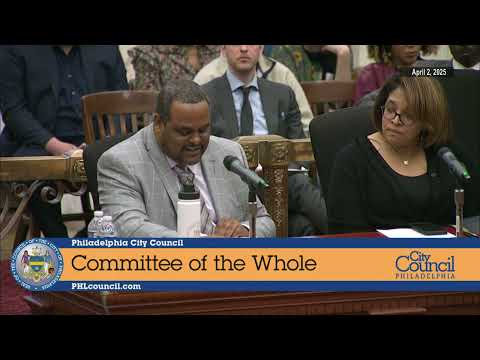
Emily Shapiro, president and chief executive officer of the Philadelphia Energy Authority, told the Committee of the Whole on May 20 that PEA needs $10,000,000 in city funding for FY26 to sustain operations, workforce development and several city projects including Built to Last and the Philadelphia Streetlight Improvement Project (PSIP).
Shapiro described a record of leveraging modest city investments into larger capital projects. "For every city dollar we have received since 2017, we've created $75 of economic investment," she said, and reported that the city's roughly $13.4 million investment in PEA since 2017 has helped spur about $1 billion in clean-energy projects and supported thousands of jobs, figures she presented to council.
PEA requested $10 million for FY26; Mayor Parker’s proposed budget submitted to council included $1.3 million for the authority, while PEA’s FY25 allocation was about $6,050,000, Shapiro said. The FY26 ask would fund operations ($3,000,000), $5,000,000 to expand Built to Last (an integrated whole-home repair and energy-efficiency program that PEA runs with partners), $500,000 to provide bridge loans via the Philadelphia Green Capital Corp. and $1,500,000 for workforce development to recruit and train residents into energy and construction careers.
Built to Last coordinates multiple programs — basic systems repair, weatherization, energy-efficiency measures and other funding streams — to preserve older housing stock and reduce energy burden for low-income homeowners. Shapiro said the program has completed 220 homes with another 430 in construction and aims to scale toward 1,000 homes a year if funding is available. She described a case in which a West Oak Lane homeowner received coordinated assistance from multiple programs totaling more than $70,000 and avoided displacement after repairs, mold remediation and a new heating system.
Shapiro also highlighted the Philadelphia Streetlight Improvement Project, a $91,000,000 guaranteed energy-savings project that has replaced tens of thousands of fixtures with LED lights and a remote management system. She cited a University of Pennsylvania study that found a 21 percent reduction in gun crimes in locations where lighting was upgraded, and said the project has high local contracting participation by minority- and women-owned firms and hires from local workforce initiatives.
Shapiro warned council that federal funding uncertainty threatens parts of PEA’s pipeline. She said the authority has lost about $16,000,000 in expected federal funding for Built to Last and faces risk to another $4,000,000 of currently anticipated funds. She asked city funding to provide continuity for ongoing projects, workforce stipends and the authority’s ability to bridge rebate and tax-credit timing through its Green Bank affiliate.
Council members pressed PEA on workforce outcomes and contracting participation. Shapiro said PEA has trained roughly 150 people in its own programs and that the PSIP has generated substantial local contracting and hiring; she offered to provide a fuller workforce report and additional demographic and contracting detail. Council members also asked for more specific breakdowns of minority- and women-owned business participation on upcoming projects and for continued engagement with community groups.
Shapiro said several large procurements and projects are under way — including school energy upgrades, additional LED and solar procurements and potential multi-hundred-million-dollar investments in energy efficiency and biogas — but that the authority will need predictable local funding to move confidently where federal and state support has become uncertain.
The hearing continued with council follow-up questions; no formal vote on the PEA request occurred during the testimony.