Get Full Government Meeting Transcripts, Videos, & Alerts Forever!
Get email alerts on the Sanitation Clean And Green topic
No spam. Unsubscribe anytime.
Philadelphia officials outline Clean and Green and sanitation priorities as FY26 budget proposals advance
Summary
City officials and Sanitation leaders testified to the Committee of the Whole about FY26 operating requests and new Clean and Green initiatives, emphasizing expanded cleanup operations, stepped-up illegal dumping enforcement and modest recycling targets tied to longer-term waste diversion plans.
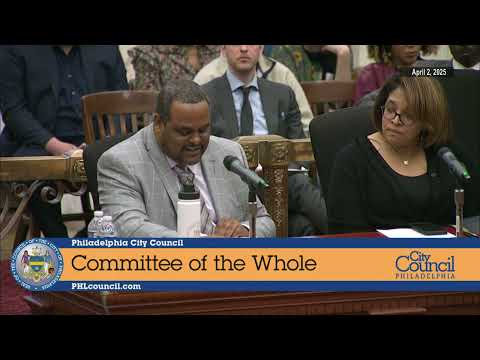
Philadelphia City Council’s Committee of the Whole heard detailed testimony on the Office of Clean and Green and the Department of Sanitation on May 20 as officials laid out programs and budget requests tied to the mayor’s Clean and Green agenda.
The hearing focused on proposed operating investments for fiscal year 2026 and updates on initiatives launched after the administration created the Office of Clean and Green in 2024. Carlton Williams, director of the Office of Clean and Green, and Crystal Jacob Shipman, commissioner of the Department of Sanitation, described a year of expanded street- and lot-cleaning programs, new enforcement tools and pilots to reduce litter and illegal dumping.
Williams told council that the administration’s citywide cleanup — branded “1Philly United” — has been institutionalized and will be conducted twice a year across neighborhoods. "The 1 Philly United City citywide cleanup will now be conducted twice per year in every neighborhood over a 13 week period," Williams said. He said work from the program has generated more than 110,000 quality-of-life services and helped create a Community Appearance Index (CAI) to target resources to areas with the greatest need.
The sanitation commissioner framed the FY26 request as a continuation of those investments. "I cannot overstate my pride in the success and accomplishments of the men and women of this sanitation department during the past year," Commissioner Jacob Shipman told council, while outlining a proposed FY26 general fund request of about $180,000,000 for the newly created department and noting roughly $8,000,000 in new funding in the request to sustain recently launched initiatives.
Officials described several operational changes that they said are already producing measurable results. Those include a council-district residential cleaning program that officials said has cleaned more than 35,000 blocks across the city since September; a twice-weekly trash-collection pilot in parts of South Philadelphia that officials said reduced illegal dumping complaints there by about 30 percent after it began; expansion of mechanical street sweeping; deployment of roughly 1,500 solar-powered “Big Belly” trash compactors on commercial corridors; and reintroduction of a citywide curbside bulk collection program that began in October 2024 and has collected more than 5,000 items, officials said.
Williams and Jacob Shipman also credited partnership programs. They said the Pennsylvania Horticultural Society (PHS) and the Community Life Improvement Program (CLIP) have supported lot cleaning and landcare — PHS, they said, expanded landcare to more than 12,000 lots and CLIP removed more than 185,000 graffiti locations in 2024 — and that the TCB (Taking Care of Business) corridor cleaning program now covers 155 commercial corridors with 39 community-based organizations.
On enforcement, officials highlighted new civil procedures and higher penalties enabled by recent council legislation that allow the Law Department to pursue civil judgments against illegal dumpers. Williams said the Law Department’s cases last year resulted in judgments totaling about $3.5 million. The administration also said it has installed approximately 400 cameras targeted at known dumping hotspots in addition to access to the city’s police camera network; officials said camera evidence and a new enforcement strategy have contributed to a nearly 20 percent citywide decline in illegal dumping complaints this year.
Council members pressed officials on details and next steps. Council President Johnson asked for counts and waiting-list data on the same-day work program administered by the Commerce Department; Dennis Murphy, deputy director of Commerce, said PHS is a partner in Landcare and that nine community organizations run same-day work-and-pay pilots funded in part through Commerce and PHS. Council members asked about an $800,000 proposal in the mayor’s budget for a mural/anti-graffiti effort near I‑95; officials said the funding is intended for an anti-graffiti strategy that includes CLIP and mural arts partnerships and work with PennDOT.
Recycling and broader diversion strategy drew sustained questioning. Officials acknowledged Philadelphia’s recycling rate remains low — they cited roughly 80,756 tons of recycling versus about 609,000 tons of trash in FY24 (about a 13 percent recycling rate) — and said the FY26 budget sets a modest goal to reach 15 percent. Commissioner Jacob Shipman said the department is expanding auditing, educational campaigns and infrastructure including a new transfer station in Northwest Philadelphia and exploring organics and textile diversion as part of a renewed zero-waste plan.
Council members also pressed for more public data. Sanitation officials said the Community Appearance Index will be made public soon and will replace the older litter index on the city’s StreetSmartPHL portal.
Several council members asked about service rollout and staffing. Jacob Shipman said the twice-weekly curbside collection pilot will expand to North Philadelphia this fall/winter, pending delivery of specialized trucks; deputy officials said procurement and long lead times for vehicles are a primary constraint. The department said overall employee attendance has improved — a reported decline from about 30 percent in FY21 to 19 percent in FY24 — and officials said new hiring pipelines such as FutureTrack are helping staffing stability.
Council members also raised operational questions: how bulk pickup scheduling works (residents can schedule pickups online or through 311 and may put items out on noncollection days), whether Big Belly units are cost-effective, and how cleanup schedules can be coordinated with curbside trash days so crews clear areas after collection. Officials said they are aligning cleaning schedules as closely as possible with trash routes but that vehicle availability and crew assignments make exact alignment difficult.
The hearing was part of a broader Committee of the Whole review of FY26 operating and capital proposals; the council had read a series of budget-related bills into the record at the start of the session, including multiple ordinances to adopt the operating and capital budgets and tax-rate changes (bill nos. 250195 through 250212 and resolution no. 250214). No formal votes were recorded during the testimony portion of the hearing.
Next steps: Council staff and department officials said they will make CAI data public, follow up on procurement and financing questions, and provide more detail on the same-day work program, the PHS landcare consolidation and the anti-graffiti funding earmark. The Committee recessed for lunch and resumed with further testimony in the afternoon.