Get Full Government Meeting Transcripts, Videos, & Alerts Forever!
Get email alerts on the Elementary Progress Reports topic
No spam. Unsubscribe anytime.
Darien committee unveils revisions to elementary progress reports; teachers cite six-hour workload per report
Summary
The Darien Board of Education curriculum committee reviewed updated elementary progress report templates tied to standards and social-emotional learning, discussed Aspen technical issues and a teacher handbook, and heard that teachers currently spend about six hours completing each report.
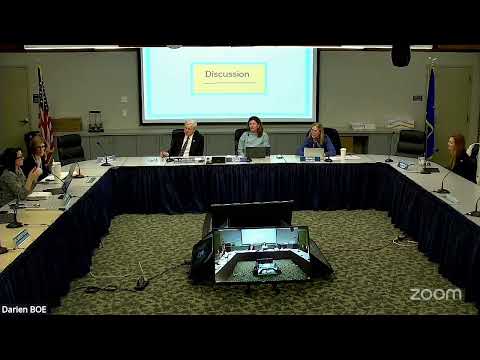
The Darien Board of Education curriculum committee on April 2 reviewed a multi-year effort to revise elementary progress reports, including clearer standards alignment, restored subheadings and a social-emotional learning (SEL) section aligned to CASEL, and planned technical fixes in the Aspen student information system.
The revision work began after a 2023 memorandum of agreement with the Darien Education Association that created a joint committee to redesign progress reports. Jeanne Tirschman, a fifth-grade teacher at Henley and vice president of the DEA, told the committee the group convened in spring 2023, surveyed teachers, and iteratively revised indicators and comment banks districtwide. “It takes each teacher about 6 hours to complete a progress report,” Tirschman said, describing time and functionality concerns that drove many changes.
Committee members said parents generally found the indicators clear and appreciated an SEL section. The team restored subheadings after parent feedback, refined SEL items to reflect grade-level expectations, and adjusted academic indicators to align more closely with the district curriculum and the science of reading. The materials shown to the committee separate academic indicators (reading, writing, math, science/social studies) from SEL areas such as relationships, emotional management and work habits.
Staff described technical constraints in Aspen that increased teacher workload: teachers currently can preview only the current trimester and must enter one curricular area at a time; printing and downloading by parents has been difficult. The IT department was reported to be working on fixes so teachers can preview previous trimester marks and parents can more easily download or print records.
Board members asked how above‑ or below‑grade-level performance will be communicated. Tirschman said differentiated performance (above, at, below) will be reflected in comments and, where applicable, families are notified through established SRBI/MTSS processes including phone calls and letters. The committee plans to provide both a teacher handbook and a family handbook with rubrics and grade-level “yardsticks” to clarify what ratings mean and to give teachers guidance on comment length and content.
The committee reiterated that the report format update does not change curriculum or instructional practice; rather, it is intended to improve how the district communicates student progress to families. Staff said the district will continue benchmarks and interventions (MTSS/SRBI) and that special‑education and occupational‑therapy supports remain available for students with handwriting or fine-motor needs.
Timeline and next steps include summer development of the companion handbooks and Aspen template work, additional Aspen testing, targeted teacher training, and a planned roll‑out for the revised progress reports in the October–November reporting window next school year. Staff told the committee they will provide another update at the May curriculum committee meeting and continue summer implementation work.
The committee heard multiple questions from board members about specifics—how fluency, handwriting, social studies skill application and AIMsweb/benchmark data will be shown to families—and staff responded that some of those items will be addressed in the forthcoming handbooks and through information shared at conferences. Staff emphasized conferences remain the primary opportunity to discuss individualized detail and that in-person conferences are the default unless a family requests a remote option.
Board members and staff also discussed implementation supports, including professional learning and internal capacity-building so teachers who piloted materials can help lead rollout and training.
Staff and committee members asked that the board consider additional professional development time to support a districtwide implementation and signaled they would return with more concrete resource and timeline requests if needed.
The discussion produced no formal motion or vote at this meeting.