Get Full Government Meeting Transcripts, Videos, & Alerts Forever!
Get email alerts on the Energy Infrastructure topic
No spam. Unsubscribe anytime.
Residents urge board to reject overhead Golden-to-Mars transmission routes near schools; board explains limits
Summary
Dozens of Loudoun County residents urged the Board of Supervisors on April 1 to withdraw recommendations favoring overhead transmission routes near Rosalie Carter Elementary and Rock Ridge High School and to press Dominion and state regulators for underground alternatives.
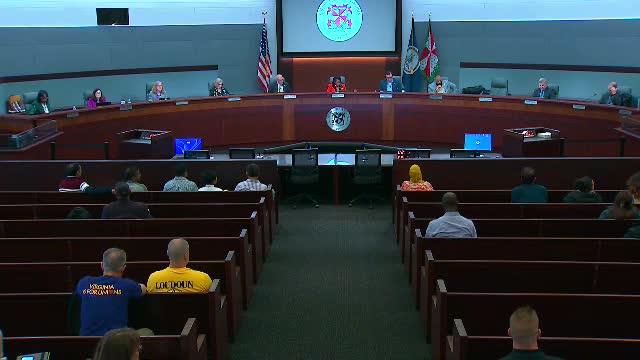
Dozens of Loudoun County residents urged the Board of Supervisors on April 1 to withdraw any recommendation that would permit overhead high-voltage transmission lines near local schools and asked the board to press Dominion Energy and state authorities for undergrounding.
Public comment ran more than an hour. Speakers from Sterling and Loudoun Valley neighborhoods described the proposed green and blue routes for Dominion Energy—s Golden-to-Mars project as running within a few hundred feet of Rosalie Carter Elementary School and Rock Ridge High School. Multiple parents, school-age students and residents said the board should honor the Loudoun County School Board—s recent vote opposing overhead lines on school property and instead support partial or full underground alternatives.
"Please use your resources to find out," one parent said, referring to the purple (underground) route, and asked the board to help verify whether underground options had been independently examined. Students and parents raised health concerns about prolonged electromagnetic-field exposure and asked the county to protect schoolyards, athletic fields and walking routes.
Board members responded that the State Corporation Commission (SCC) is the regulatory body that grants siting approvals for interstate transmission lines and that Loudoun—s role is to present local concerns and, where possible, participate in SCC proceedings. County legal staff confirmed that the next procedural steps in the SCC process include a proposed scheduling order, local public hearings (likely late summer) and evidentiary hearings in the fall. The county attorney—s office said the SCC makes the final routing decision; commissioners are appointed by the General Assembly.
Chair Randall reminded the public the board had previously urged undergrounding in related cases and said the county had participated and appealed earlier SCC decisions. Vice Chair Turner and other supervisors reiterated that the board will continue to press for community input and, where possible, urge undergrounding, but that state-level authorities and legislation ultimately control outcomes.
The meeting included many individual accounts: parents noting playground proximity, engineering concerns about the feasibility report Dominion filed, and calls to form a coordinated defense for the local SCC process. Speakers requested the board rescind any earlier county recommendation that had favored routes passing close to schools and instead press for undergrounding or alternatives that would follow existing rights-of-way.
The board did not take a formal vote on routing at the meeting; supervisors said they would continue to explore legal and procedural steps the county can take to represent community concerns to the SCC and to ask Dominion and PJM for further review of underground alternatives.
This exchange accounted for the largest single uninterrupted public comment block at the meeting.