Get Full Government Meeting Transcripts, Videos, & Alerts Forever!
Get email alerts on the Sf2255 Governor Budget topic
No spam. Unsubscribe anytime.
Wide public testimony as Senate committee hears governor’s education budget; charter schools, special education and Q‑Comp singled out
Summary
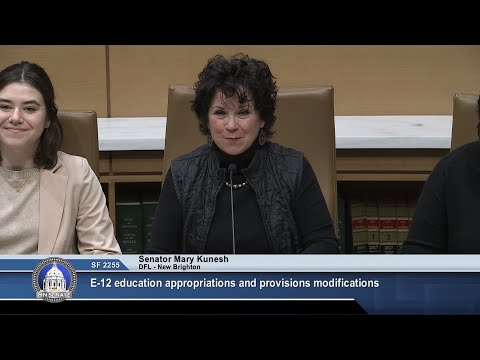
The Minnesota Senate Education Finance Committee held a long hearing on the governor’s proposed education budget (Senate File 2255), hearing widespread concern about proposed cuts affecting charter schools, special education, and teacher-development funding.
The Minnesota Senate Education Finance Committee held a long hearing on the governor’s proposed education budget (Senate File 2255), hearing a series of in‑person and remote testimonies that voiced widespread concern about potential cuts to charter school funding, special-education transportation reimbursements, Q‑Comp teacher development funding, nonpublic pupil aid and several smaller program supports.
Committee Chair Kunish opened the governor’s bill hearing and noted a long list of testifiers. School finance and charter leaders described concrete budget impacts if the governor’s proposal is enacted. John Morstad, executive director of finance and operations for Osseo Area Schools and president of the Minnesota Association of School Business Officials, said the 2023 compensatory funding changes already cost Osseo about $5.5 million and that statewide shifts moved roughly $40 million away from independent school districts to charters. He asked the committee to hold compensatory funding harmless for one year or reinstate data collection methods used previously.
Multiple charter-school leaders warned that proposed cuts would be disproportionate because charters do not have local levy authority. Shannon Peterson, director of Lakes International Language Academy (LELA), said eliminating long‑term facilities maintenance (LTFM) aid and reducing special-education reimbursements would force their charter to transfer more from general funds and would worsen a funding gap already described as "about $50,000 per classroom per year" compared with neighboring district schools. Joseph Billings, an administrator at Purdue Academy, said proposed special-education cuts alone would cost his school approximately $418,000 next fiscal year.
Speakers from traditional public districts described their own shortfalls. Chris Lennox, superintendent of Mounds View Public Schools, said Q‑Comp funding accounts for roughly $3 million in his district and that eliminating the funding would undercut a two‑decade program of teacher development. Hopkins Public Schools’ assistant superintendent Nick Lightfoot said his district receives about $1.78 million in Q‑Comp funds and uses the money for stipends and five full‑time instructional coaches.
Special-education and transportation concerns were prominent. Nasita Thomas, executive director of student services for Roseville Area Schools and president of the Minnesota Administrators for Special Education, told the committee special-education transportation is a legal necessity to meet students’ Individualized Education Program (IEP) requirements and that reductions would disproportionately affect the most vulnerable students. Several speakers warned that a shift from a higher percentage reimbursement to a 50% tuition‑billing change or similar reductions would force districts and charters to reallocate already strained resources.
Nonpublic school representatives also urged preservation of nonpublic pupil aid and nonpublic transportation, citing Minnesota statutes and longstanding policy dating to 1969 and 1975 that shaped transportation and educational benefits for nonpublic students. Tim Benz, president of Independent School Districts association of nonpublic schools, framed the services as important to ensuring parental choice and equity for families who choose private or parochial schools.
Other witnesses urged maintaining or restoring funding for specialized or smaller programs. Testifiers asked the committee to retain funding for computer-science coordination and grants, STARBASE STEM programming, community education aid, and other targeted supports. Dr. Alexandra Holter and representatives of the Computer Science Teachers Association urged at least $1 million to maintain a full‑time computer‑science lead at MDE and grants for districts; Melanie Peters of STARBASE sought the governor’s recommended $500,000 per year for program continuation.
Several district finance organizations warned of large combined shortfalls if the governor’s proposals are enacted. Scott Krunkquist, with the Association of Metropolitan School Districts, testified that members’ aggregate shortfall under the governor’s proposal could be about $265 million and warned of staff layoffs and program reductions. Testifiers and committee members repeatedly urged that budget tradeoffs consider alternative revenue choices rather than cutting classroom supports.
The hearing concluded with committee members noting the difficulty of the budget decisions and the upcoming omnibus process. No committee votes were taken on the governor’s bill during the hearing; the committee will continue to weigh testimony as it drafts its budget language.