Get Full Government Meeting Transcripts, Videos, & Alerts Forever!
Get email alerts on the Consumer Restitution Account topic
No spam. Unsubscribe anytime.
Senate panel backs new consumer restitution account, limits annual payouts to $1 million
Summary
The Minnesota Senate Finance Committee on April 2 voted to recommend passage of Senate File 447, creating a consumer restitution account administered by the Attorney General’s Office to compensate defrauded consumers when individualized restitution is unavailable, with annual transfers capped at $1 million.
The Minnesota Senate Finance Committee on April 2 voted to recommend passage of Senate File 447, a bill to create a consumer restitution account administered by the Attorney General’s Office to compensate people who have been defrauded when individual restitution is not possible.
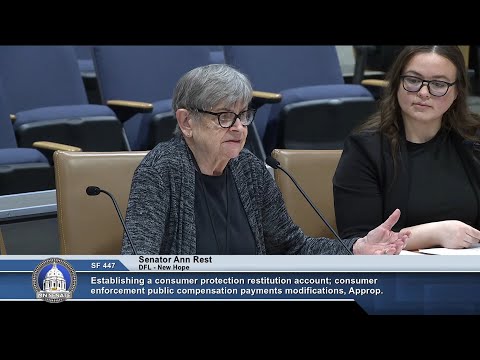
Sponsor Senator Rest told the committee the account, supported by AARP, would be limited to no more than $1 million in any fiscal year and is intended to help victims for whom there is no practical path to individualized restitution. "The proposal will establish a consumer restitution account, limited to, no more than a million dollars in any given year," Senator Rest said.
Under the bill’s language, 50% of a particular category of undistributed revenues that currently flow to the general fund would be redirected to the new account up to the $1 million annual cap. Committee staff and Minnesota Management and Budget officials cautioned that the revenue stream is "lumpy" and unpredictable. Brian Dahl of Minnesota Management and Budget said such receipts are difficult to forecast and that MMB would need to review the underlying data further to reconcile numbers presented in committee discussion.
Committee debate focused on fiscal forecasting, the mechanics of distribution, and transparency. Senator Pratt cited data provided to the committee showing wide year‑to‑year variation in the revenues that could feed the account — listing $9.2 million in 2021, $3.6 million in 2022, $398,000 in 2023 and $3.2 million in 2024 — and asked MMB for a clearer forecast. "We would have taken out $3,200,000 in those 4 years," Pratt said when referencing the years discussed.
The committee adopted two amendments before voting on the bill. The A11 amendment, supported by the sponsor and co‑authors, added transparency requirements intended to provide the Legislature greater visibility into Attorney General distributions. The A13 amendment gives the attorney general the option to recommend to the Legislature a formula for prorating or capping payments if the attorney general projects ongoing shortages that would leave many eligible claimants unpaid; the amendment does not itself authorize the attorney general to set a prorating formula without legislative approval. Ms. Olivia Severson, senate counsel, and Deputy Attorney General Jessica Whitney explained that subdivision language in the bill already addresses when distributions are "unreasonable" and that A13 is intended to permit the attorney general to recommend statutory changes to address persistent backlogs.
Whitney described the account’s purpose: it is meant to reach victims in enforcement matters where no money can be traced to particular victims, or where the amounts are too small or the victims cannot be located. "Those are the victims in part that would be protected by this fund," Whitney said.
Committee members also debated process and information needs for the fiscal note. MMB requested time to review the data cited in committee and to coordinate with the Attorney General’s Office and the Legislative Budget Office on forecasting. After adopting the amendments, the committee voted by voice to recommend the bill as amended and to refer it to the Tax Committee. "Senator Friends moves that Senate File 447 as amended be recommended to pass and refer to the Committee on Taxes," the chair said; "Aye. Opposed? No. Motion prevails."