Get Full Government Meeting Transcripts, Videos, & Alerts Forever!
Get email alerts on the Youth Vaping Retailer Enforcement topic
No spam. Unsubscribe anytime.
Committee hears testimony on bill to raise retailer penalties for selling vaping products to minors
Summary
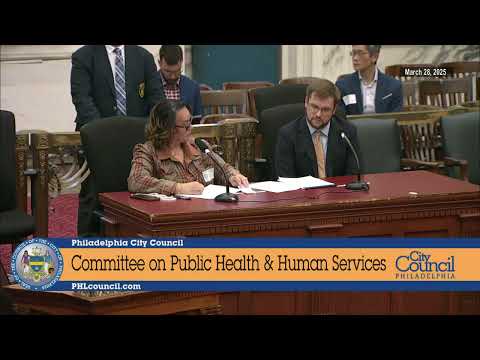
At a meeting of the Philadelphia City Council Committee on Public Health and Human Services, members heard testimony on Bill 250213, which would amend Philadelphia Code section 9-633 to revise definitions and raise penalties and enforcement options for the sale of electronic smoking devices and other unapproved nicotine delivery products to minors.
At a meeting of the Philadelphia City Council Committee on Public Health and Human Services, members heard testimony on Bill 250213, which would amend Philadelphia Code section 9-633 to revise definitions and raise penalties and enforcement options for the sale of electronic smoking devices and other unapproved nicotine delivery products to minors.
The bill’s stated aim is to reduce youth access to vaping products by increasing graduated fines for retailers and directing a portion of civil penalties toward youth prevention and education. The Department of Public Health said it supports the bill’s goals but asked for additional review and legal guidance and requested the bill be held in committee for further consultation.
Why it matters: Council members and public-health witnesses said stronger penalties and targeted enforcement could reduce youth access and address disparities in vaping rates, especially in lower-income neighborhoods. Retail and grocer witnesses warned that the proposal, combined with current enforcement practices, could impose excessive burdens on small businesses and called for clearer procedures, language access and faster notice of citations.
The hearing began with the clerk reading the bill title and text for Bill 250213. Ben Hartung, a public policy adviser with the Philadelphia Department of Public Health, told the committee the department ‘‘agrees with the bill’s goals of reducing youth access to vaping products’’ but asked that the bill be held to allow law department review and further drafting to ensure the language will achieve the intended outcomes. "We respectfully request that the bill is held in committee to allow this continued engagement," Hartung said.
Dr. Andy Tan, associate professor and director of the Health Communication Equity Lab at the University of Pennsylvania’s Annenberg School for Communication, testified in support of the bill and described research on retail exposure and youth vaping. Tan said Philadelphia has a high retailer density and that youth in lower-income and racial and ethnic minority neighborhoods face greater exposure to tobacco advertising. He cited figures given in testimony that Philadelphia has more than 2,500 licensed tobacco retailers and that 90% of public schools are within 1,000 feet of a tobacco retailer. Tan said the bill’s approach — graduated fines with an allocation of fine revenue to youth vaping prevention programs — could reduce access and address disparities if implemented equitably. "This bill represents a crucial step in preventing and protecting the health of Philadelphia's youth from addictive nicotine and tobacco products," Tan said.
Jacob Zajic of the American Heart Association also supported the legislation, noting national law sets the minimum age of sale at 21 and urging consistent penalties across tobacco product types. He said flavors and retail promotions are major drivers of youth uptake and welcomed the bill’s requirement that a share of fines fund prevention programs.
A large group of small-business owners and trade representatives opposed or urged changes to the bill’s enforcement details. Frank Francisco Rosario, director of community outreach for the Dominican Grocers Association, and multiple bodega and market owners described enforcement problems they said undermine fairness: citations delivered months after an alleged sale, video evidence that expires because camera footage is routinely retained for about 30 days, use of a contracted third-party investigator that brings minors into stores, and what they described as inconsistent inspections and due-process problems. Rosario said members see the process as punitive and sometimes unreliable.
Several business owners recounted cases in which they said they were cited or had licenses not renewed despite being able to produce video evidence showing they did not complete an illegal sale. One speaker who identified himself as an attorney and son of a grocer described spending dozens of hours and large legal fees on appeals when citations arrive months after an incident. Speakers said steep fines, temporary closures and public posting of violations could harm small businesses and asked the council to consider warning periods, culturally and linguistically appropriate outreach, and clearer, timelier enforcement procedures.
Committee members acknowledged the concerns and emphasized that the stated purpose of the bill is deterrence through stronger penalties. Chair Ahmed said the bill is focused on changing fine structure and urged retailers to card every customer: "Card everybody. If you don't sell to minors, you don't pay a fine," she said. The chair and other members committed to follow up with the health department and convene a separate meeting with retailers to address procedural and implementation questions before advancing the bill from committee.
No vote was taken. The chair recessed the hearing and said the committee will reconvene after additional meetings with the Department of Public Health and community stakeholders to clarify enforcement practices, data on retailer density and licensing, language-access needs and processes for issuing and appealing citations.
Ending: The committee paused further action on Bill 250213 to allow additional review and stakeholder meetings. Council staff said they will request data from the health department — including current counts and maps of licensed and suspected unlicensed tobacco retailers, details on enforcement procedures and citation timing — and will meet with trade groups to discuss implementation, language access, and measures to avoid inequitable enforcement. The committee did not set a date for reconvening or voting.