Get Full Government Meeting Transcripts, Videos, & Alerts Forever!
Get email alerts on the Health Insurance Policy topic
No spam. Unsubscribe anytime.
Senate committee adopts A9 amendment to health-insurance bill, refers measure back to Commerce
Summary
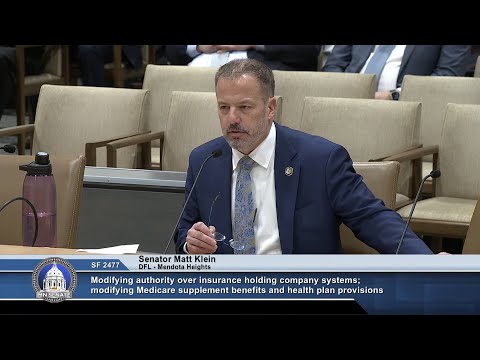
The Senate Health and Human Services Committee adopted the A9 amendment to Sen. Klein's bipartisan insurance bill (Senate File 2477), approved amendments clarifying hospital closure notifications and insurer practices, and voted to send the bill back to the Commerce Committee for further consideration.
Senate Health and Human Services members voted to adopt an A9 amendment to Senate File 2477 and recommended the bill as amended be returned to the Committee on Commerce and Consumer Protection.
The bill, presented by Sen. Mark Klein and Commerce Department staff, contains two main Commerce policy provisions and several Health Department changes. "We have 2 policy provisions, in our policy bill this year," Ashley Sedlet, health policy director in the Department of Commerce's insurance division, told the committee, summarizing Commerce provisions that include a late-enrollment penalty for Medicare Supplement open enrollment and a change allowing insurers to terminate individual plans rather than exit the market entirely.
The Department of Health presented related provisions placed into the bill. "This really just clarifies this procedure for both the hospitals and specifies that if inpatient health services are moved to another campus, or if maternity and newborn care services are discontinued, advance notice is required," Lisa Timmyn, director of government relations for the Minnesota Department of Health, said when describing updates to hospital closure and curtailment-of-service notifications in the amendment. The amendment also added alignment with federal network adequacy requirements for state-based health exchanges required by Jan. 1, 2026, allowed insurers to deliver explanations of benefits electronically (with paper by default), and included technical fixes to drug price-transparency language and HMO regulation updates.
Committee members questioned the bill's consumer and market effects. Sen. Annette Otke asked about the proposed 10% late-enrollment penalty for Medicare Supplement open enrollment and the reasons for it. Sen. Klein explained that the penalty is intended to discourage late enrollment during the authorized open-enrollment period created by prior legislation and to help stabilize rates when a 2023 law removed preexisting-condition underwriting tied to Medicare Supplement plans.
Sen. Roger Abler raised concerns about the real-world effect of the hospital curtailment language, citing a past closure of overnight pediatric beds at Mercy and urging the Department of Health to provide clearer opinions when requests for review occur. Department witnesses said the amendment was intended to add clarity for providers and impacted communities about notice requirements.
After committee discussion, Senator Mann moved adoption of the A9 amendment. The amendment was adopted by voice vote. Senator Mann then moved that the file, as amended, be recommended to pass and be referred back to the Committee on Commerce and Consumer Protection; the committee approved the motion and referred the bill.
The committee record shows the A9 amendment was adopted and Senate File 2477 as amended was sent back to Commerce for further consideration.