Get Full Government Meeting Transcripts, Videos, & Alerts Forever!
Get email alerts on the Child Victims Act topic
No spam. Unsubscribe anytime.
Judiciary Committee adopts amended Child Victims Act changes capping awards and attorney fees
Summary
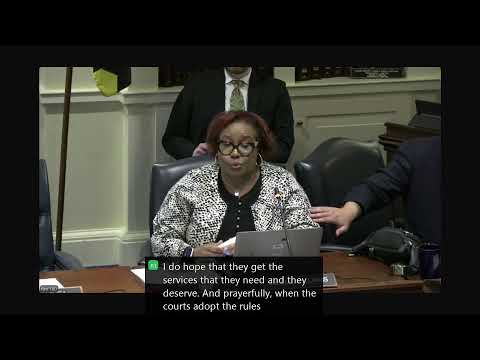
The House Judiciary Committee on April 2 adopted an amended version of House Bill 13 78, Chairman Wilson’s bill that changes how certain historical child-victim claims will be resolved and limits recoveries for a defined group of previously barred claimants.
The House Judiciary Committee on April 2 adopted an amended version of House Bill 13 78, Chairman Wilson’s bill that changes how certain historical child-victim claims will be resolved and limits recoveries for a defined group of previously barred claimants.
The amendment sets maximum recoveries for the targeted universe of past claims at $700,000 against private institutions and $400,000 against public institutions, caps attorney fees at 20% of a settlement and 25% of a judgment for those cases, asks the Supreme Court of Maryland to adopt rules to implement the statute, and requires annual judiciary reporting on settlements and awards. The amendment makes the bill effective June 1, 2025.
Committee supporters said the amendments are intended to create a predictable process for a discrete set of historical claims that were previously barred by limitations rules and to give the judiciary and litigants a framework for resolving them more quickly. Opponents said the changes shrink accountability and undervalue harms to survivors.
Debate and key details - Scope: Committee members repeatedly described the bill as limited to a “universe” of past claims that had been barred by prior statutes of limitations or repose, with witnesses and staff estimating roughly 4,500 potential historical claimants referenced during the hearing. The committee sponsor said the bill does not affect prospective claims arising after the effective date.
- Caps and rationale: The amendment lowers the private-institution cap to $700,000 and the public-institution cap to $400,000. Supporters said the $400,000 public cap is comparable to the cap under the Local Tort Claims Act; proponents also argued the state faces different fiscal exposure than private defendants. Opponents said placing lower caps on public-institution claims treats survivors unequally.
- Attorney fees and procedural mechanics: The committee adopted an oral technical amendment to make explicit that the 20%/25% attorney-fee limitation applies to the specified historical universe across public, private and local-government claims. The bill asks the Maryland Supreme Court to adopt rules to implement the subtitle and requires annual reporting by the judiciary about settlements and awards under the statute.
- Fiscal and scope concerns: During debate members offered conflicting estimates of the law’s fiscal exposure; one member walked through a multiplication (4,500 claimants × $400,000) and stated an estimate of about $1.9 billion as a notional comparison. Committee discussion repeatedly stressed that the number of claims likely to proceed and the ultimate payouts would be shaped by ongoing negotiations, mediation and court processes.
Voices in the record - Delegate Ericham: “This is the worst bill I think I’ve ever seen in the 7 years I’ve been down here,” a comment made during debate reflecting strong opposition to the caps and their equity implications.
- Multiple members (recorded in debate): expressed support for giving courts rules and structure to handle these matters and for limiting state fiscal exposure while noting the measure is an imperfect compromise.
Committee action and next steps The committee adopted the amendments and then voted to report House Bill 13 78 favorably as amended. The committee chair stated the bill will proceed to the House floor; the transcript excerpt records that the motion for a favorable report was adopted but does not provide a complete roll-call tally in the provided excerpt.
Why it matters The bill targets a distinct group of historical child-victim claims that were previously barred by limitations rules. The committee’s action changes the maximum recoveries and fee structure for that group and asks the Maryland Supreme Court to adopt rules to manage the process. The changes are intended to reduce uncertainty for courts, defendants and claimants but also have prompted sharp debate about fairness to survivors and the state’s fiscal exposure.
What the record does not show The transcript excerpt supplied to this report does not include a full numeric roll-call breakdown for the committee’s final favorable vote on the amended bill. The record supplied does show extensive debate, the amendment text as summarized in committee, and that the committee adopted the amendments and reported the bill favorably.
For the public If the House passes the amended bill, implementing rules and judicial processes described in the bill and adopted by the Supreme Court of Maryland will determine how individual claims are handled, whether through settlement, mediation or judgment.