Get Full Government Meeting Transcripts, Videos, & Alerts Forever!
D.C. council roundtable urges faster, trauma‑informed behavioral‑health responses and expanded non‑police options
Summary
A joint Committee on Health and Committee on Judiciary and Public Safety roundtable on March 31, 2025, reviewed PR 205‑108 and called for faster 988/OUC call handling, expanded mobile crisis teams and crisis stabilization options, and clearer protocols to reduce police involvement in behavioral‑health crises.
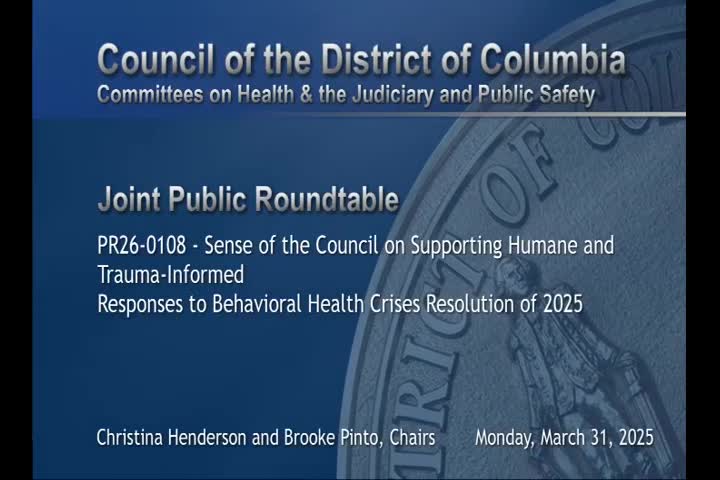
A joint roundtable of the D.C. Council's Committee on Health and the Committee on Judiciary and Public Safety heard public testimony on March 31, 2025, about PR 205‑108, the "sense of the council" resolution urging a more coordinated, trauma‑informed response to behavioral‑health crises. Chair Christina Henderson, an at‑large council member and chair of the Committee on Health, and Ward 2 Council member Brooke Pinto, chair of the Committee on Judiciary and Public Safety, presided over the hearing and heard professional, advocacy and lived‑experience testimony on gaps in current services and possible reforms.
The resolution urges the mayor and executive agencies to strengthen call‑center operations so at least 90% of diverted calls from the Office of Unified Communications (OUC) are answered within 15–20 seconds by 2027; to implement warm handoffs for 988 and the DBH access helpline so staff stay on the line until a provider is reached; to expand and properly resource mobile crisis teams; to invest in crisis stabilization options such as community crisis beds, short‑term observation units and respite centers; and to permit people with behavioral health disabilities to specify their preferred responder.
Why it matters: Witnesses told the committees that many D.C. residents still default to 911 in crises and too often encounter police or long waits for behavioral‑health responders. Kristen Ewing, policy counsel for DC Appleseed, testified, "When behavioral health providers respond to crises, several positive things occur," adding that a care‑first approach can reduce unnecessary arrest, hospitalization and use of…
Already have an account? Log in
Subscribe to keep reading
Unlock the rest of this article — and every article on Citizen Portal.
- Unlimited articles
- AI-powered breakdowns of topics, speakers, decisions, and budgets
- Instant alerts when your location has a new meeting
- Follow topics and more locations
- 1,000 AI Insights / month, plus AI Chat